

an underhand grip, palms facing up, loads the biceps hardest. In Coratella's 2023 measurements, the biceps was 19% more active with it than with an overhand grip and 12% more active than with a neutral grip. The bottom half of the range, where your arm is nearly straight, gave +8.9% elbow flexor thickness versus +3.4% for the bent-arm half in Sato's 2021 study, so straighten your arm at the bottom. Isolated curls grew the biceps about twice as much as rows did: 11.06% versus 5.16% over 8 weeks in Mannarino's 2021 study. A strict curl is done standing against a wall with your shoulder blades and glutes pressed to it; the entry-level WRPF rank for men in the 75 kg (165 lb) class is 35 kg (77 lb), a little under half of bodyweight.Starting point: 3 kg (6.5 lb) dumbbells for women and 6 kg (13 lb) for men, 3 sets of 10 twice a week with 2–3 reps left in the tank. Over our 8-week plan, training volume per session grows 2.4 times for women and 2.1 times for men.
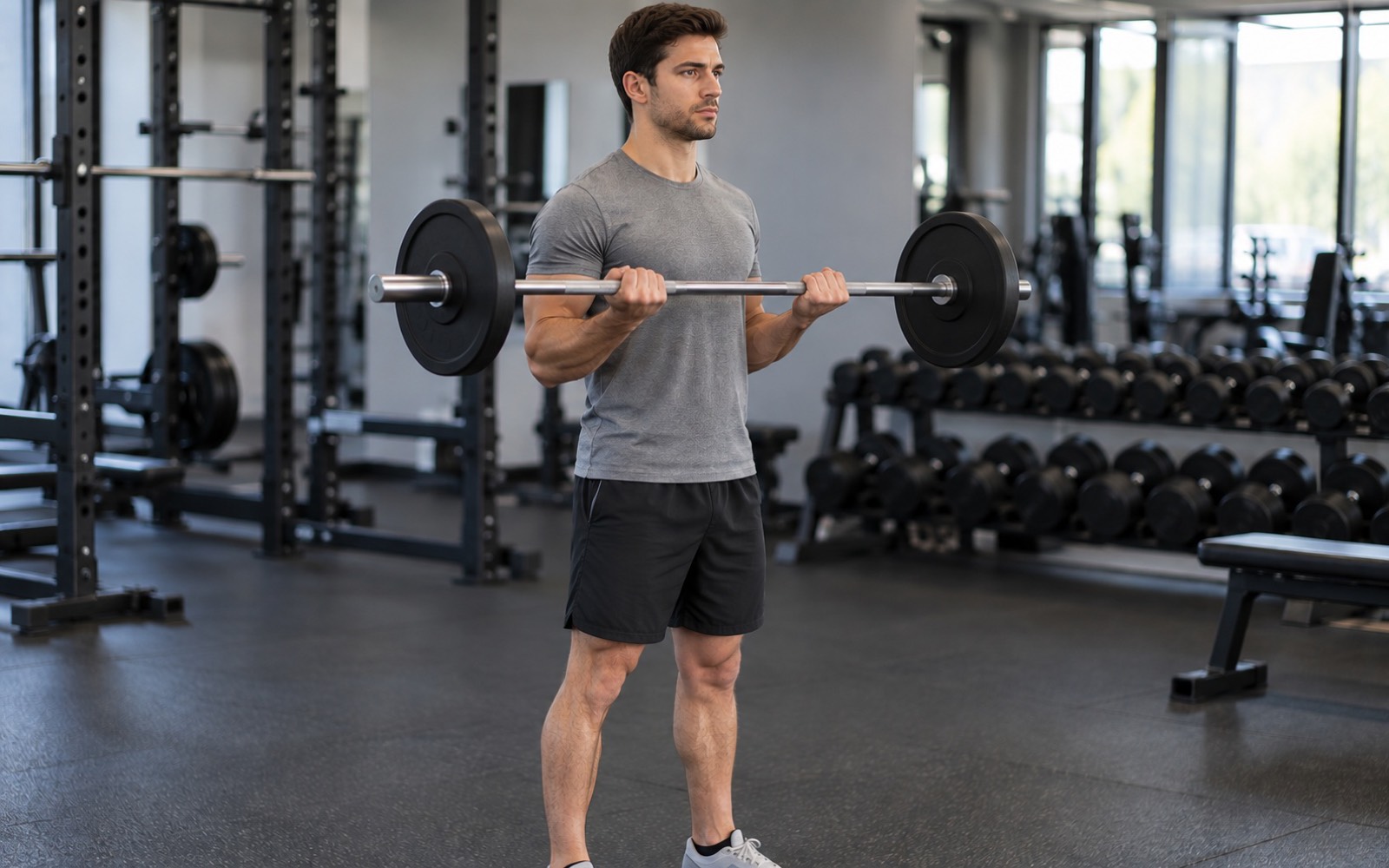
A bicep curl is bending your arms at the elbows against a barbell or dumbbells while your shoulders and elbows stay in place and only your forearms move. The biceps brachii does most of the work, and the brachialis and brachioradialis help it. For a beginner, 3 sets of 10–12 reps twice a week is enough, done at the end of the workout after your rows and presses. Start with dumbbells: 3 kg (6.5 lb) in each hand for women, 6 kg (13 lb) in each hand for men, or use a light EZ bar. Keep your elbows against your ribs, straighten your arms fully at the bottom, and don't swing the bar up to your shoulders at the top.
What a bicep curl is and what muscles it works
A bicep curl is bending your elbow against a weight while your upper arm stays by your side and only your forearm moves; the biceps brachii does most of the work, with help from the brachialis and brachioradialis. Gyms call it by several names: arm curl, barbell curl, dumbbell curl, standing curl. There's also a biceps on the back of your thigh, the biceps femoris, which is one of the hamstrings. It has nothing to do with this article.
The biceps is the muscle on the front of your upper arm, the one people show off when they flex. It has two heads, a long head on the outside and a short head on the inside, and both attach by one tendon to the radius, a forearm bone, just below the elbow. Because of that attachment, the biceps has two jobs: it bends the elbow and it turns your palm up. The second movement is called supination. That's why the biceps works hardest with an underhand grip. With an overhand grip it loses its leverage, and the neighboring muscles take a bigger share of the lift.
| Muscle | What it does in the curl | Where you feel it |
|---|---|---|
| Biceps brachii, long and short heads | bends the elbow and supinates the forearm, turning the palm up | front of the upper arm; the "ball" under the skin at the top of the rep |
| Brachialis | lies under the biceps and is a pure elbow flexor; works with any grip | outer side of the biceps, closer to the elbow |
| Brachioradialis | bends the elbow from the forearm side and works with any grip; with overhand and neutral grips its share of the work grows, because the biceps is less involved | forearm on the thumb side |
| Wrist and finger flexors | hold the bar or dumbbell | inner side of the forearm; they ache if you curl your wrists |
| Front delt | stabilizes the head of the upper arm bone and takes part of the lift if your elbows drift forward | front of the shoulder near the collarbone |
| Abs and spinal erectors | keep your torso upright | the lower back, if you swing |
What electromyography showed. Electromyography records a muscle's electrical activity through sensors on the skin. In 2023, Coratella and colleagues put these sensors on the arms of 10 competitive bodybuilders with an average of 10.6 years of training. Each one did two-arm curls on a low cable with three grips: underhand and overhand on a straight handle, and neutral, with palms facing each other, on a rope. They used a weight they could lift for 8 reps and did 6. On the way up, the biceps worked hardest with the underhand grip: 19% more than with the overhand grip and 12% more than with the neutral grip. The brachioradialis was also 5–6% more active with the underhand grip. The front delt went the other way and switched on harder with the overhand and neutral grips, by 6% and 9%, because it has to hold the shoulder in place. On the way down, the grips made no difference for the biceps. These percentages describe differences in a muscle's electrical activity and say nothing about how much it will grow. The takeaway is simple: if your goal is the biceps, keep your palms up. Overhand curls and hammer curls have their own uses, covered in section 04.
Why do a separate exercise if the biceps already works in rows. The biceps really does take part in pull-ups and rows, but curls grow it noticeably more. In 2021, Mannarino and colleagues trained 10 untrained men for 8 weeks: one arm did bent-over dumbbell rows and the other did dumbbell curls, 4–6 sets of 8–12 reps to failure, twice a week. Elbow flexor thickness grew by 11.06% from curls and by 5.16% from rows. Strength followed the specificity principle: the arm that rowed got stronger at rowing, and the arm that curled got stronger at curling. There were only ten participants, all beginners, so treat the numbers as a rough guide. The direction is clear, though: rows load the biceps along the way, and dedicated curls grow it considerably more.
How to do a standing barbell curl: step by step
Grab the bar underhand at shoulder width, pin your elbows to your ribs, and curl until your forearms are slightly above horizontal, then lower the bar over 2 seconds until your arms are straight. Step by step:
- Stance. Feet hip-width apart, knees soft, glutes and abs tight. Shoulders down, eyes forward.
- Grip. Underhand, palms up, at shoulder width or slightly wider. Your wrists stay straight, in line with your forearms. The bar sits at the base of your fingers, and your wrist doesn't bend.
- Start. Arms straight, bar against your thighs. Elbows pinned to your ribs, slightly in front of your torso line.
- Lift. Curl the bar up over 1–2 seconds. Your elbows stay where they are and your torso doesn't sway. In its 2009 position stand, ACSM, the American College of Sports Medicine, recommends a slow-to-moderate tempo for beginners; moderate means 1–2 seconds up and the same on the way down.
- Top position. Forearms slightly above parallel to the floor, bar at the level of your lower ribs or a little higher. If you keep pulling the bar toward your shoulders, the weight's lever arm around the elbow gets short and the load on the biceps drops. There's no need to swing the bar up to your shoulders. Squeeze your biceps for a second.
- Lowering. Over 2 seconds, under control, until your arms are completely straight. Don't drop the bar.
- Breathing. Breathe out on the way up and in on the way down.
- Next rep. Start from a straight arm, without a jerk and without dipping your torso under the bar.
Should you fully straighten your arm at the bottom. Yes. The bottom part of the movement is what grows the muscle most. In 2021, Sato and colleagues trained untrained people for 5 weeks: two groups of 12 and another 8 in a control group that didn't train. The exercise was a one-arm dumbbell preacher curl, twice a week, 3 sets of 10 reps. One group worked only between 0° and 50° of elbow bend, with a nearly straight arm where the biceps is stretched; the other worked between 80° and 130°, with a bent arm. Elbow flexor thickness grew by 8.9% in the stretched group and by 3.4% in the bent-arm group. Isometric strength went up by 16.2% in the stretched group and didn't grow noticeably in the bent-arm group. This was one-arm training in a narrow range, and nobody has studied a full bicep curl this way, but the lesson for technique is direct: a short range, where you don't straighten your arm at the bottom, cuts out the most valuable part of the movement. One caveat: no impact. Your arm straightens smoothly, without snapping into lockout under load. If your elbow hyperextends, stop at a neutral straight position.
Grip width. On a straight bar, shoulder width suits most people. People in gyms say a narrow grip hits the long head more and a wide grip hits the short head more, but the studies this article relies on didn't measure that. A wide grip on a straight bar is often uncomfortable for the wrists, so beginners should pick a width by how their wrists feel.
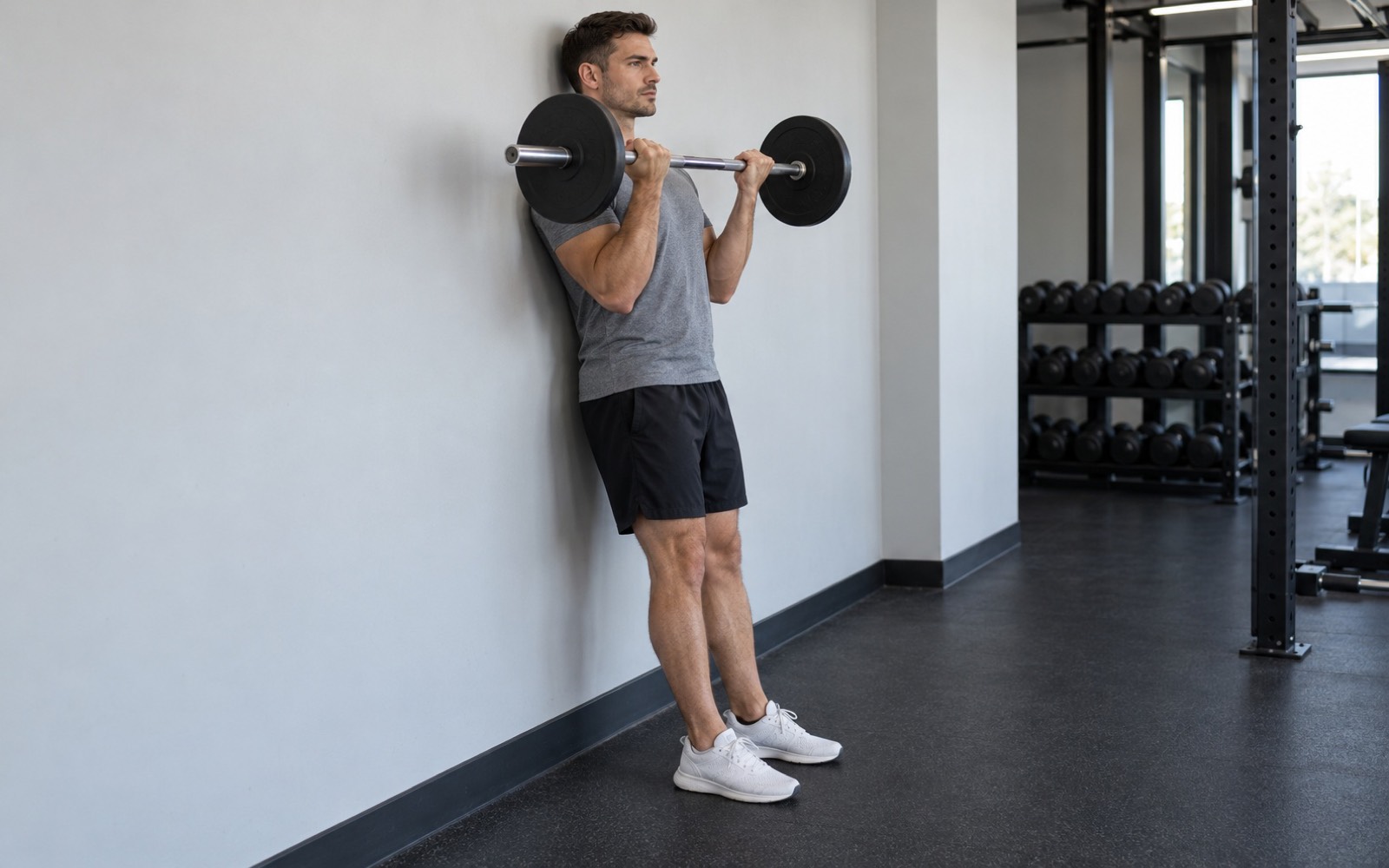
for your first two weeks, do your dumbbell sets with your back against a wall: shoulder blades and glutes pressed to it, heels 20–25 cm (8–10 in) from the wall. That's the stance used in strict curl competitions. If your shoulder blades come off the wall, you helped with your torso and the weight is too heavy for now. This test fixes your technique right away and prepares you for section 06.
Dumbbell bicep curls: standing, seated, with supination and alternating
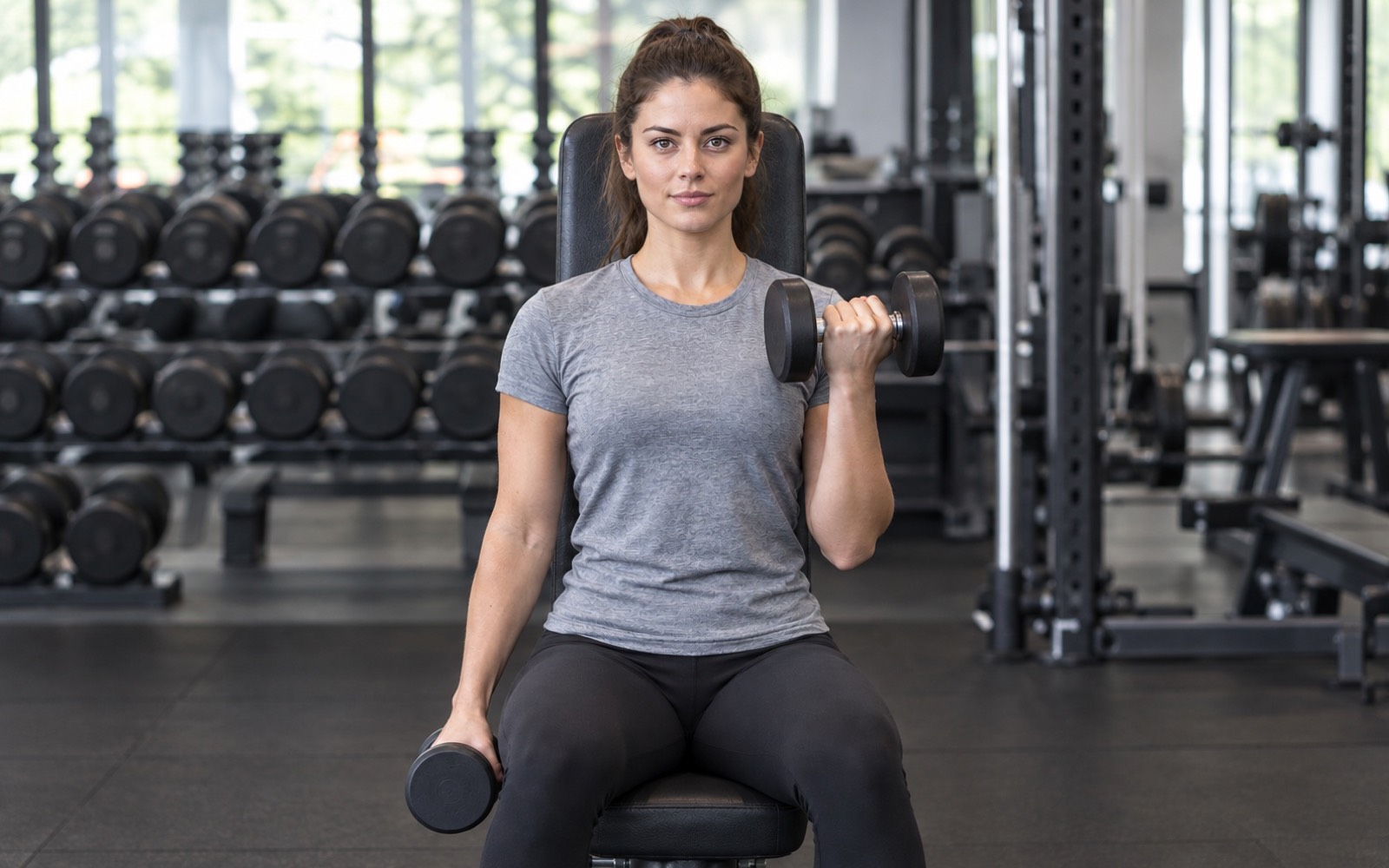
The technique with dumbbells is the same, except you can rotate your palms during the rep: at the bottom they face each other, at the top they face the ceiling, and that rotation adds the biceps' second job, supination.
Both arms together. The closest thing to a barbell: both dumbbells go up at the same time, elbows against your ribs. It's easy to count reps and keep the tempo.
Alternating. While one arm curls, the other rests at the bottom. This lets you use a slightly heavier dumbbell, and you can start with your weaker arm so the stronger one doesn't set the pace.
With supination. At the bottom your palm faces your thigh; halfway up you turn it to face the ceiling, and at the top your pinky is slightly higher than your thumb. This is the same underhand grip that loaded the biceps 19% more than an overhand grip in Coratella's 2023 measurements, just with the rotation added.
Seated on a bench with a back support. Your back is supported, it's harder to swing your torso, and your lower back gets a rest. It's a good option if standing curls pull on your back, and for the last sets, when you're tempted to help with your torso.
Standing. Your core works more, the weight is usually a bit higher, and it's easier to progress.
Standing or seated: which is better. No difference has been found for biceps growth. ACSM's 2026 position stand, which pulls together 137 systematic reviews, found that equipment type and exercise complexity didn't consistently affect muscle growth. It doesn't compare standing with seated curls directly, but the same logic applies: choose by comfort. Seated is easier for a beginner to keep the torso still, and standing makes it easier to add weight.
Dumbbells or a barbell. In 2018, Marcolin and colleagues compared three variations in 12 men with at least 3 years of training, each at 65% of their max in that variation: a one-arm dumbbell curl, a straight bar and an EZ bar. With the EZ bar, the biceps and brachioradialis were more active than with the dumbbell through the whole range; on the way down, the biceps was also more active with the straight bar than with the dumbbell. That's a reason to watch your range of motion with dumbbells. There's no need to give them up: dumbbells let you supinate, train each arm separately and don't need a rack. At home they cover the first six weeks of the plan in section 07 completely.
Grip and bar: straight bar, EZ bar, narrow, wide, reverse
An underhand grip loads the biceps hardest; with an overhand grip the biceps backs off and the brachioradialis and brachialis take a bigger share, while the difference between a straight bar and an EZ bar is small for the muscles and the EZ bar is easier on the wrists.
An EZ bar is a bar with a wavy bend that sets your hands at a slight angle to each other. A straight bar forces your palms to face straight up, and for some people that makes their wrists ache.
| Grip or bar | What it loads more | What the measurements showed | Who it's for |
|---|---|---|---|
| Straight bar, underhand | biceps | similar to the EZ bar for the muscles; the difference is small (Marcolin, 2018) | anyone whose wrists don't ache |
| EZ bar | biceps and brachioradialis | more active than with a dumbbell through the whole range (Marcolin, 2018) | anyone from day one; easier on the wrists |
| Dumbbells with supination | biceps, plus palm rotation | underhand grip +19% versus overhand (Coratella, 2023) | home training, alternating work, arms of different strength |
| Neutral grip, hammer curls | less biceps, bigger share for the brachialis and brachioradialis | biceps 12% less active than with an underhand grip (Coratella, 2023) | arm thickness from the side, forearms |
| Overhand grip, reverse curl | least biceps, bigger share for the brachioradialis, brachialis and wrist extensors | biceps 19% less active, front delt 6% more active (Coratella, 2023) | forearms and grip; a weak choice for biceps growth |
| Narrow or wide grip | gyms link them to different biceps heads | not measured in the studies reviewed here | by wrist comfort; a wide grip is more comfortable on an EZ bar |
Straight bar or EZ bar. Marcolin put it plainly in 2018: choosing between them is a matter of comfort. The difference in biceps activity between the two bars is small, and your wrists sit in a natural position on the EZ bar. The gym advice "straight bar for beginners, EZ bar for advanced lifters" isn't backed by the measurements. If you have an EZ bar, start with it.
Reverse curl. The name is misleading. With an overhand grip the biceps works 19% less, and a larger share of the load goes to the brachioradialis and brachialis. It's an exercise for the forearm and for arm thickness on the thumb side. It's useful, but it does little for biceps growth, and the weight you can use is noticeably lower than with an underhand grip.
How to rotate grips. Coratella suggests rotating grips to vary the load. Two are enough for a beginner: underhand as your main curl and hammer curls as an extra.
Variations: hammer curls, preacher curls, incline curls, concentration curls, cable curls, band curls, chin-ups
All the variations are the same elbow bend; they differ in shoulder position and grip. Shoulder position decides which part of the range works the biceps hardest, and grip decides which of the three muscles takes more of the load.
In 2009, Oliveira and colleagues recorded long-head biceps activity in 22 men with at least a year of training. The weight was light, 40% of their isometric max, meaning the greatest effort they could produce with the arm held still. There were three positions: standing; sitting on an incline bench with the torso tilted back 50° and the arm hanging freely; and on a preacher bench, with the upper arm brought forward 50°. Standing and on the incline bench, the biceps worked the same way through the whole range and reached 95% of max toward the end of the lift. On the preacher bench it peaked at 80%, only at the very start with a straight arm, and then activity dropped. The authors' conclusion: standing and incline curls are better for biceps strength, and the preacher curl loads a short part of the movement.
| Variation | How it's different | What it gives you | What the measurements showed |
|---|---|---|---|
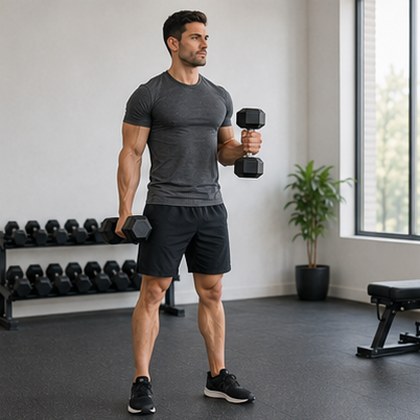
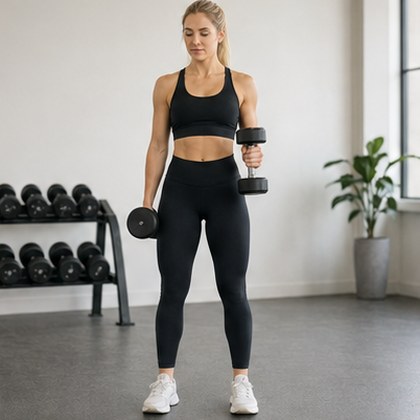
| Hammer curls | neutral grip, dumbbells held like a hammer | brachialis and brachioradialis, arm thickness from the side | biceps 12% less active than with an underhand grip (Coratella, 2023) |
| Preacher curl | upper arm brought forward and resting on an angled pad | load at the straight-arm end; your torso can't help | peak of 80% only at the start of the movement (Oliveira, 2009); training the initial half of the range gave +42.8% strength versus +19.0% in 19 women over 8 weeks (Pedrosa, 2023) |
| Incline dumbbell curl | seated with your back on a reclined bench, arms hanging, upper arm behind your torso | the biceps is stretched and works through the whole range | like standing, up to 95% of max (Oliveira, 2009) |
| Seated concentration curl | elbow braced against your inner thigh | full isolation, light weight, a finishing set | — |
| Low cable curl | the cable pulls down for the whole set | the load doesn't drop off at the top | — |
| Band curl | you stand on a band; resistance increases toward the top | home and travel; easy at the bottom, hard at the top | — |
| Zottman curl | up with an underhand grip, down with an overhand grip | biceps on the way up, forearm on the way down | — |
| Close-grip chin-ups | bodyweight, palms facing you | a foundational biceps movement without equipment | — |
Preacher curl. It loads exactly that bottom, stretched part of the range, and you can't help yourself with your torso. In 2023, Pedrosa and colleagues trained 19 untrained women for 8 weeks with dumbbell preacher curls, 3 times a week, 4–5 sets of 8–10 reps to failure. One arm worked in the initial half of the range, from a straight arm to 68°, and the other in the final half, from 68° to 135°. The initial half produced bigger cross-sectional area gains in the lower part of the biceps and a bigger increase in full-range max: +42.8% versus +19.0%. So on the preacher bench, don't cut the range short at the bottom, and lower your arm all the way.
Incline curl. Your upper arm sits behind your body, the biceps is stretched even more than when standing, and in Oliveira's measurements it works through the whole range. The weight here is lower than standing, and that's normal.
What a beginner should pick. One basic curl, with a barbell, EZ bar or standing dumbbells, plus one variation with a different shoulder position, incline or preacher, 3 sets of each. Add hammer curls when you want thicker arms and stronger forearms. A band helps when you travel: a ½-inch (13 mm) loop band gives 5–16 kg (10–35 lb) of resistance, enough for the first weeks of the plan. Close-grip chin-ups are the foundation for biceps without equipment; section 10 explains how to work toward them if you can't do one yet.
 Hammer curl, men’s version
 Hammer curl, women’s version
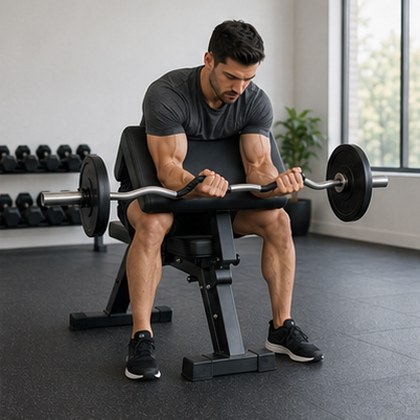 Preacher curl, men’s version
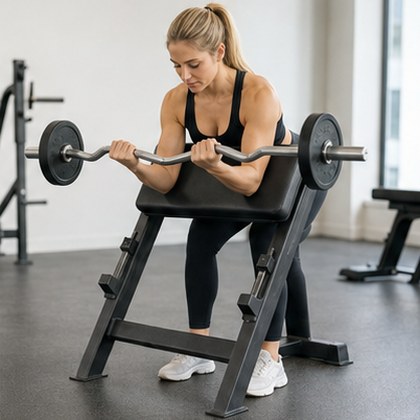 Preacher curl, women’s version
The strict curl: rules, standards and how to tell where you are
A strict curl is the competition version: you stand with your back against a wall, shoulder blades and glutes pressed to it, heels no more than 25–30 cm (10–12 in) from the wall, legs straight, and lift the bar for one rep up to your chin using only your arms.
Rules. They differ slightly between federations, but the idea is the same. Under IPAF rules, your heels are no more than 30 cm (12 in) from the wall; competition descriptions on Sports.ru and in the DDX blog say no more than 25 cm (10 in). You start with straight arms, the bar against your thighs, knees straight. The judge raises a hand and gives a command: "Start" under IPAF rules, "Curl" in the Sports.ru and DDX descriptions. You curl the bar in an arc up to your chin or throat, hold it, and lower it on the "Down" command. The attempt doesn't count if your shoulder blades or glutes come off the wall, your feet move, your knees bend, you push the bar with your thighs, or you lower it before the command. According to Sports.ru, the Russian Powerlifting Union uses a straight 20 kg (44 lb) Olympic bar, while WRPF and AWPC use a curved EZ or WZ bar. Allowed gear is a belt up to 10 cm (4 in) wide, wrist wraps and a singlet. The "extreme curl" is a separate event with looser technique and higher standards: for men in the 75 kg class, the WRPF entry-level rank without drug testing is 42.5 kg (94 lb) versus 35 kg (77 lb) in the strict curl. This article covers only the strict curl.
WRPF 2026 standards, untested division. These federations grade lifters by sports ranks: 3rd, 2nd and 1st class, then Candidate for Master of Sport (CMS), Master of Sport (MS) and Master of Sport, International Class (MSIC). An abridged version of the table from the Sports.ru blog:
| Class | 3rd class | 2nd class | 1st class | CMS | MS | MSIC |
|---|---|---|---|---|---|---|
| Men, 60 kg (132 lb) | 30 | 35 | 40 | 45 | 52.5 | 62.5 |
| Men, 75 kg (165 lb) | 35 | 42.5 | 50 | 57.5 | 65 | 75 |
| Men, 82.5 kg (182 lb) | 40 | 47.5 | 55 | 62.5 | 70 | 80 |
| Men, 90 kg (198 lb) | 45 | 52.5 | 60 | 67.5 | 75 | 85 |
| Women, 52 kg (115 lb) | 22.5 | 25 | 27.5 | 30 | 35 | 40 |
| Women, 60 kg (132 lb) | 27.5 | 30 | 32.5 | 35 | 40 | 45 |
All numbers are in kilograms for a single rep; multiply by 2.2 for pounds. In the drug-tested division the standards are lower: in the 75 kg class, the 3rd-class rank is 32.5 kg (71.5 lb) and MSIC is 67.5 kg (149 lb), according to T—Zh. The Russian Powerlifting Union, AWPC and IPAF have their own tables, and before a meet you should check the website of the federation you're competing in.
How much you lift relative to bodyweight. To see where you stand, you need a benchmark for regular people as well as competition tables. The Strength Level website collects user results: for the barbell curl it has 752,509 verified lifts from 2016–2026. These are self-reported results with no lab behind them, but they work as a "where am I" guide. The levels are set for a one-rep max, and averaged across all bodyweights they're a fraction of bodyweight: for men, beginner 0.25, novice 0.40, intermediate 0.60, advanced 0.80; for women, 0.10, 0.25, 0.40 and 0.55. The site also has a table for specific bodyweights; we took the numbers from it and put the WRPF 3rd-class rank in the same weight class next to them:
| Bodyweight | Beginner | Novice | Intermediate | Advanced | WRPF 3rd class in this weight class |
|---|---|---|---|---|---|
| Man, 60 kg (132 lb) | 15 kg (33 lb) | 24 kg (53 lb) | 36 kg (79 lb) | 50 kg (110 lb) | 30 kg (0.50 of bodyweight) |
| Man, 70 kg (154 lb) | 18 kg (40 lb) | 28 kg (62 lb) | 41 kg (90 lb) | 57 kg (126 lb) | 32.5 kg in the 67.5 kg class (0.48) |
| Man, 80 kg (176 lb) | 22 kg (49 lb) | 33 kg (73 lb) | 46 kg (101 lb) | 63 kg (139 lb) | 40 kg in the 82.5 kg class (0.48) |
| Man, 90 kg (198 lb) | 25 kg (55 lb) | 36 kg (79 lb) | 51 kg (112 lb) | 68 kg (150 lb) | 45 kg (0.50) |
| Woman, 50 kg (110 lb) | 6 kg (13 lb) | 12 kg (26 lb) | 20 kg (44 lb) | 31 kg (68 lb) | 22.5 kg in the 52 kg class (0.43) |
| Woman, 60 kg (132 lb) | 8 kg (18 lb) | 14 kg (31 lb) | 23 kg (51 lb) | 34 kg (75 lb) | 27.5 kg (0.46) |
| Woman, 70 kg (154 lb) | 9 kg (20 lb) | 16 kg (35 lb) | 26 kg (57 lb) | 37 kg (82 lb) | — |
The levels come from the Strength Level barbell curl table, the ranks from the WRPF table, and we calculated the fractions of bodyweight ourselves. What the table shows: the 3rd-class rank is about half your bodyweight on the bar for men and 0.43–0.46 of bodyweight for women. For men that sits between the "novice" and "intermediate" levels; Strength Level describes a novice as someone who has trained the movement for at least six months and an intermediate lifter as someone with at least two years. For women the 3rd-class rank is even higher, between "intermediate" and "advanced". Don't treat it as a beginner's target.
How to estimate your max without a one-rep test. Take a weight you can curl cleanly for 10 reps and multiply it by 1.33. That's the Epley formula: your max equals the weight times one plus the number of reps divided by 30. Example: 25 kg (55 lb) for 10 reps gives a max of about 33 kg (73 lb). At a bodyweight of 75 kg (165 lb) that's 0.44, just a couple of kilograms short of the 35 kg (77 lb) 3rd-class rank. Keep in mind that federation tables are written for a curl against a wall with a judge, and at home the same weight will feel easier.
How much weight to use: an 8-week plan for women and men
Women should start with 3 kg (6.5 lb) dumbbells and men with 6 kg (13 lb), 3 sets of 10 reps with 2–3 reps left in the tank, adding reps up to 12 first and then weight.
Why not 1–2 kg (2–4 lb). A dumbbell that's too light grows the muscle about half as well. In 2018, Lasevicius and colleagues trained 30 men for 12 weeks: one arm always curled at 20% of max, and the other at 40%, 60% or 80%, with total volume load equalized. Elbow flexor cross-sectional area grew by 11.4% at 20% and by about 25% at 40%, 60% and 80%, almost the same across the three heavier options. Strength grew better at 60% and 80%. In the Strength Level table, the beginner level for the dumbbell curl is 4 kg (9 lb) per dumbbell for a 60 kg (132 lb) woman and 8 kg (17.5 lb) for an 80 kg (176 lb) man. For them, a 1–2 kg dumbbell is exactly that 20–25% of max. Hence the rule: the weight should make 10–12 reps take real effort, with the last two feeling like you want to put the weights down.
Why not 10 kg (22 lb) right away. Elbows, wrists and technique. In the first weeks you're teaching your body to keep your elbows still, and extra weight teaches it the opposite: swinging.
The progression rule. It comes from ACSM's 2009 position stand: a beginner needs a weight that allows 8–12 reps, and once you can do 1–2 reps more than your target, you increase the weight by 2–10%. Light dumbbells have a catch: going from 3 to 4 kg is a 33% jump, more than three times the upper limit. So after you move to a heavier dumbbell, your reps drop back to 10 and build up to 12 again. With a barbell the steps are smaller: two 1.25 kg (2.75 lb) plates add 2.5 kg (5.5 lb), which is 10–12% at 20–25 kg (44–55 lb), and you can add weight every 1–2 weeks.
Eight weeks of bicep curls in numbers. Two workouts a week, 3 working sets each. Tonnage is the amount of work per session: sets × reps × total weight, with both dumbbells counted together. For example, 3 × 10 × (2 × 3 kg) = 180 kg (397 lb).
| Week | Women | Tonnage | Men | Tonnage | What changed |
|---|---|---|---|---|---|
| 1 | dumbbells 2 × 3 kg (6.5 lb), 3 × 10 | 180 kg (397 lb) | dumbbells 2 × 6 kg (13 lb), 3 × 10 | 360 kg (794 lb) | start |
| 2 | 2 × 3 kg, 3 × 12 | 216 kg (476 lb) | 2 × 6 kg, 3 × 12 | 432 kg (952 lb) | +2 reps per set |
| 3 | 2 × 4 kg (9 lb), 3 × 10 | 240 kg (529 lb) | 2 × 8 kg (17.5 lb), 3 × 10 | 480 kg (1,058 lb) | weight +33% |
| 4 | 2 × 4 kg, 3 × 12 | 288 kg (635 lb) | 2 × 8 kg, 3 × 12 | 576 kg (1,270 lb) | +2 reps |
| 5 | 2 × 5 kg (11 lb), 3 × 10 | 300 kg (661 lb) | 2 × 10 kg (22 lb), 3 × 10 | 600 kg (1,323 lb) | weight +25% |
| 6 | 2 × 5 kg, 3 × 12 | 360 kg (794 lb) | 2 × 10 kg, 3 × 12 | 720 kg (1,587 lb) | +2 reps |
| 7 | 2 × 6 kg (13 lb) or a 12.5 kg (27.5 lb) EZ bar, 3 × 10 | 360 kg (794 lb) | barbell 22.5 kg (49.5 lb): 20 kg bar + 2 × 1.25 kg, 3 × 10 | 675 kg (1,488 lb) | women +20%; men switch to a barbell, +12.5% over the pair of dumbbells |
| 8 | 2 × 6 kg, 3 × 12 | 432 kg (952 lb) | barbell 25 kg (55 lb), 3 × 10 | 750 kg (1,653 lb) | women +2 reps, men +11% weight |
Over 8 weeks, the work per session grows 2.4 times for women, from 180 to 432 kg (397 to 952 lb), and 2.1 times for men, from 360 to 750 kg (794 to 1,653 lb). That's more than in the Romanian deadlift on a similar plan, because with light dumbbells every step is a 20–33% jump. These are our own calculations.
This is a typical path, and nothing in it is mandatory. If you can't do 12 clean reps, your elbows drift or your torso sways, stay on that week for another week or two. If 2 × 6 kg feels too easy in week 1 and you have more than four reps left after 12, start with 2 × 8 kg (17.5 lb) and shift the plan two weeks ahead. Women don't need a barbell: 2 × 6 kg in weeks 7–8 is almost the same as a 12.5 kg EZ bar, which is a bar of about 7.5 kg (16.5 lb) plus two 2.5 kg (5.5 lb) plates.
How this connects to section 06. A man curling 25 kg (55 lb) for 10 reps in week 8 has an estimated max of about 33 kg (73 lb) by the Epley formula; at 75 kg (165 lb) bodyweight that's 0.44, the "novice" level on Strength Level. A woman curling 6 kg for 12 reps has an estimated max of about 8 kg (18 lb) per dumbbell; for a 60 kg (132 lb) woman that's also "novice": Strength Level's dumbbell curl benchmarks for a 60 kg woman are 4, 7, 12, 18 and 24 kg (9, 15, 26, 40 and 53 lb) from beginner to elite.
Are curls alone enough. 3 sets twice a week is 6 sets for the biceps, and for muscle growth ACSM's 2026 position stand names 10 or more sets a week. Rows and pull-ups make up the rest: the biceps works in them, though less than in curls, as Mannarino showed in 2021. What to do once these eight weeks are done is covered in our guide to progressive overload.
How many sets and reps, and how often per week
For a beginner, 3 sets of 8–12 reps twice a week at the end of the workout is enough, with 2–3 reps left in the tank and 1–2 minutes of rest.
Reps. ACSM's 2009 position stand recommends a weight that allows 8–12 reps for beginners. Light weights for high reps grow the biceps about as well as the usual 8–12. In 2015, Schoenfeld and colleagues trained 18 experienced men for 8 weeks: one group did 8–12 reps and the other 25–35, all to failure, 3 sets of 7 exercises 3 times a week. Elbow flexor thickness grew by 5.3% in the first group and by 8.6% in the second, and the difference wasn't statistically significant. Squat strength grew noticeably more in the heavy group: 19.6% versus 8.8%. Schoenfeld's 2017 meta-analysis of 21 studies confirmed it: light and heavy loads taken to failure grow muscle equally, and heavy loads are better for maximal strength. A meta-analysis is a study that pools the results of many studies. For growth, both 8–12 and 25–35 reps work if the set is taken close to real fatigue; for strength and competition standards you need heavy loads, 80% of max and above, as ACSM's 2026 position stand says. The one exception is very light loads at 20% of max, covered in section 07.
Sets per week. ACSM's 2026 position stand: muscles grow more with 10 or more sets per muscle per week, and strength improves with two or more sessions a week. Training to failure didn't give a consistent extra benefit in the same position stand, so leaving 2–3 reps in the tank is a perfectly good working mode. Count rows in too: 6 sets of curls plus 4–6 sets of rows and pull-ups cover the target.
Rest. 1–2 minutes between sets, as ACSM recommended in 2009 for muscle growth.
Can you train biceps every day. You can train them more often than twice a week, as long as the total stays at those same 10–12 sets, just spread over three or four days. Going heavy every day is a bad idea: the tendons around the elbow recover more slowly than muscles, and your elbow will let you know soon. ACSM advised beginners to train 2–3 times a week in 2009; it makes sense to schedule heavy biceps sets with at least one rest day between them.
Where curls go in a workout. At the end, after rows, pull-ups and presses. ACSM's 2009 position stand recommends doing large muscle groups and multi-joint exercises before small muscle groups and single-joint exercises. Biceps and triceps on the same day is a common pairing, and a superset of curls and extensions saves time.
In the Sportygram app (go.sportygram.com; the interface and the coach are in Russian for now), the workout diary includes the barbell curl, dumbbell curl, hammer curl, preacher curl, concentration curl, cable curl, band curl, Zottman curl and close-grip chin-ups, each with technique photos. You can ask the virtual coach, Alex, in chat to add hammer curls to Wednesday; he shows a confirmation card, and once you confirm, the exercise appears in your plan. Log your weight and reps in the diary, and the weight history shows when it's time to add more.
Mistakes: where you feel it → what to fix
A good bicep curl feels like a burn in the front of your upper arm by rep 8–10; if your forearms tire first, your elbow aches, the front of your shoulder pulls or your lower back does, your technique has drifted.
| Where you feel it | What's wrong | What to fix |
|---|---|---|
| Forearms give out before the biceps | wrists bent, bar held with curled wrists, grip on a straight bar too narrow | straight wrists, bar at the base of your fingers, EZ bar: for the muscles it's like a straight bar (Marcolin, 2018) |
| Front of the shoulder near the collarbone | elbows drift forward and up, the front delt does the lift | elbows back to your ribs, don't swing the bar to your shoulders at the top, forearm slightly above horizontal |
| Lower back | swinging your torso, dipping under the weight, a bar heavier than it should be | take off 10–20% of the weight, the wall test from section 02, seated curls with a back support |
| Elbow, inner or outer side | jerking out of the bottom, snapping into a straight arm at the bottom, too many curls per week, heavy overhand grip | lower over 2 seconds, straighten smoothly at the bottom, EZ bar or dumbbells, fewer sets; if it doesn't settle in 2–3 weeks, see a doctor |
| "I can't feel my biceps" | short range without straightening at the bottom, elbows drifting, weight too heavy | full range: the stretched half gave +8.9% versus +3.4% (Sato, 2021); a 1-second squeeze at the top; lighter weight |
| Shoulders creep up to your ears, your neck gets tired | your traps are holding the weight | set your shoulders down before the set, lighter bar |
| The bar tilts to one side | one arm is stronger than the other | alternating dumbbell curls, weaker arm first, pick the weight for the weaker arm |
Cheat curls. That's the gym name for using your body to get the weight moving: you lean forward slightly and throw the bar up with your lower back and legs. In 2025, Augustin and colleagues tested what this does. 25 untrained people out of 30 finished the study, 11 men and 14 women: 8 weeks, twice a week, 4 sets of 8–12 reps to failure of one-arm dumbbell curls. One arm worked strictly, lifting in about a second with no swing, and the other used cheating, as explosively as possible. Biceps thickness at one measurement site grew by 5.8% in the strict arm and by 8.0% in the cheating arm, and at the other site by 5.6% and 5.9%; statistically there was no difference. Arm circumference went up by 1.6% and 1.9%. Meanwhile, the volume load in cheat curls was roughly double every week: in the first week, 22,751 kg (50,157 lb) across the group versus 11,641 kg (25,664 lb). The only complaints were muscle soreness in the first weeks and a faster heart rate while swinging, though the authors warn that constant swinging may raise injury risk. So with cheating, the biceps grew the same as with strict form, only the volume load was twice as high, and your lower back and elbows carried part of it. A beginner is better off working strictly: the growth is the same and your back takes less load. A little momentum on the last one or two reps won't hurt an experienced lifter, but it shouldn't be the basis of your training.
How to build biceps at home: dumbbells, a band, a pull-up bar and no equipment
At home you train biceps with the same curls, using dumbbells, a band or a backpack, and without equipment you still have chin-ups and rows.
Dumbbells. The plan in section 07 works entirely at home through week 6, and adjustable dumbbells up to 10–12 kg (22–26 lb) cover a year. A full home workout with hammer curls in the exercise list is in our dumbbell workout at home.
Band. Stand on the middle of the band, grab the ends with an underhand grip, elbows at your sides, and curl as you would with a barbell. Resistance increases toward the top: at the bottom the band barely pulls, at the top it's stretched the most. So alternate it with dumbbells or use it as a second, finishing exercise. A long loop band ½ inch (13 mm) thick gives 5–16 kg (10–35 lb) of resistance, which is enough for the first weeks.
Backpack. A 1.5-liter (50 oz) water bottle weighs about 1.5 kg (3.3 lb), so four bottles give you 6 kg (13 lb). Hold the backpack by its straps with an underhand grip and curl. Adding one bottle at a time is easier than buying new dumbbells every two weeks.
Pull-up bar. Close-grip chin-ups are the main compound biceps movement without dumbbells. If you can't do one yet, start with a band under your knees or with negatives: step up onto a support and lower yourself over 5 seconds. The path to your first rep is laid out in our guide to your first pull-up.
Push-ups "for biceps". People search for this, and the answer is simple: push-ups load your chest, triceps and front delts, and the biceps barely works in them. Without a pull-up bar, use an inverted row under a table with an underhand grip, sometimes called an Australian pull-up: lie under a sturdy table, grab the edge with your palms facing you, and pull your chest up to the tabletop.
How fast can you build biceps. In studies, muscle growth in beginners shows up in measurements after 5–8 weeks. In Sato's 2021 study, elbow flexor thickness grew by 8.9% in 5 weeks, and in Mannarino's 2021 study by 11% in 8 weeks with 4–6 sets twice a week. Arms don't grow in a day, a week or "a month before summer", but after three months of the plan in section 07 you'll see the difference in the mirror and on a tape measure.
Safety: elbows, wrists, shoulders, lower back — who should be careful and when to see a doctor
The bicep curl is one of the safest exercises in the gym; if something hurts after it, it's usually the tendons around the elbow and wrist, and that happens when the weight grows faster than your technique.
Elbow. Pain on the inner side of the elbow, where the wrist flexors attach, most often comes from bent wrists and a heavy grip. Pain on the outer side comes from overhand curls and heavy hammer curls. Pain in the crease of the elbow, right at the biceps tendon, comes from jerking out of the bottom. In all three cases the steps are the same: cut the weight and number of sets for 1–2 weeks, switch to an EZ bar or dumbbells, and lower over 2 seconds. The most serious injury, a rupture of the biceps tendon at the elbow, is rare. According to Kelly's 2015 analysis of a large US insurance database, it happens in 2.55 cases per 100,000 people per year, and 95% of those injured are men. In the same authors' local sample, the average age was 46, and the risk was higher in smokers and people with a high body mass index. The tendon usually tears when a heavy weight suddenly forces a bent arm straight, so jerks and dropping the weight are the most dangerous. Signs: a pop with sharp pain, the "ball" of the biceps shifting up toward the shoulder, and weakness turning your palm up. With these, see an orthopedic doctor the same day.
Wrists. Keep your wrists straight and the bar at the base of your fingers. If they ache on a straight bar, an EZ bar or dumbbells solve it. Wrist wraps are only needed at competition weights.
Shoulders. Don't let your elbows drift forward, or your shoulder joint takes part of the work. If your shoulder hurts, variations where your upper arm is fixed help: seated curls with a back support or the preacher curl.
Lower back. No cheating. If your back pulls, curl seated. With a herniated disc or lower back pain, choose seated curls with a back support and a light weight, and discuss the load with your doctor. Which exercises help with back pain and which to hold off on is covered in our guide to lower back pain exercises.
Age. Strength training is safe for healthy adults of any age. In ACSM's 2026 position stand, an analysis of more than 38,000 people showed no increase in the risk of serious adverse events. If you have joint disease, high blood pressure or heart disease, agree on the program with your doctor; in that case it's easier to start seated with a back support and the lightest dumbbells.
When to see a doctor. A pop and sharp pain during a set. Elbow pain that doesn't go away after 2–3 weeks of rest. Numbness in your fingers. Swelling around the elbow or wrist. In all other cases, lowering the weight and watching your technique is enough.
Questions and answers
Which is better for bicep curls, a barbell or dumbbells, and which bar should you use?
For the muscles, the difference is small. In Marcolin's 2018 measurements, the EZ bar and straight bar loaded the biceps almost equally, and in ACSM's 2026 position stand, equipment type didn't consistently affect muscle growth. A barbell lets you add weight in steps of 1.25–2.5 kg (2.75–5.5 lb), dumbbells let you supinate and work each arm separately, and an EZ bar is easier on the wrists. For a beginner: dumbbells or an EZ bar.
How much weight should a woman curl?
3 kg (6.5 lb) dumbbells, 3 sets of 10 reps, and by week 8 of our plan 2 × 6 kg (13 lb) or a 12.5 kg (27.5 lb) EZ bar. 1–2 kg (2–4 lb) dumbbells are too light: in Lasevicius's 2018 study, 20% of max produced half as much growth as 40–80%. Add weight once 12 reps come out clean with your elbows staying put.
What are the strict curl standards?
In the WRPF 2026 untested table, the men's 75 kg (165 lb) class has 35 kg (77 lb) for the 3rd-class rank, 57.5 kg (127 lb) for CMS and 75 kg (165 lb) for MSIC; for women in the 60 kg (132 lb) class, 3rd class is 27.5 kg (60.5 lb) and MS is 40 kg (88 lb). The rules: back against the wall, shoulder blades and glutes pressed to it, heels no more than 25–30 cm (10–12 in) away, one rep up to your chin on the judge's commands. For men, 3rd class is about half your bodyweight, which on the Strength Level scale sits between "novice" and "intermediate", meaning six months to two years of training the movement.
How many times a week should you train biceps, and can you do it every day?
Two or three times a week, 10 or more sets a week including rows and pull-ups, as ACSM recommends in 2026. Going heavy every day is a bad idea: the tendons around the elbow take longer to recover than muscles. Leave at least one rest day between two heavy biceps sessions.
Are standing or seated curls better?
No difference has been found for muscle growth. In ACSM's 2026 position stand, equipment type and exercise complexity didn't consistently affect results. Standing and seated curls load the same muscle through the same range. Seated with a back support, it's harder to swing and your lower back gets less tired; standing, it's easier to add weight and your core works more. If your back pulls after a standing set, switch to seated curls.
Why aren't my biceps growing?
The usual reasons: fewer than 10 sets a week, a weight that hasn't gone up in months, a short range without straightening at the bottom, only rows without dedicated curls, and no training log. In Sato's 2021 study, the stretched half of the range gave +8.9% thickness versus +3.4%, and in Mannarino's 2021 study curls gave 11.06% growth versus 5.16% from rows. Go through the plan in section 07 and log every set.
Why does my elbow hurt after bicep curls?
Most often it's bent wrists, jerking out of the bottom, too many curls per week, or a heavy overhand grip. Cut the weight and sets for 1–2 weeks, switch to an EZ bar or dumbbells, and lower over 2 seconds. If the pain doesn't go away in 2–3 weeks, you felt a pop, or the "ball" of the muscle shifted up, see a doctor: a tendon rupture is rare, 2.55 cases per 100,000 per year according to Kelly's 2015 study, but it shouldn't wait.
How do you build biceps at home without a barbell?
Dumbbells on the plan in section 07, a band under your feet, a backpack with water bottles and close-grip chin-ups on a pull-up bar. Without a bar, an inverted row under a table with an underhand grip works. Push-ups barely load the biceps, so don't count on them.
The bottom line
- A bicep curl is bending your elbow against a weight: shoulders and elbows stay still, your arm is straight at the bottom, your forearm ends slightly above horizontal at the top, and the bar doesn't swing up to your shoulders.
- The biceps brachii does most of the work, with help from the brachialis and brachioradialis. An underhand grip loads the biceps 19% more than an overhand grip (Coratella, 2023); overhand curls and hammer curls are forearm and brachialis exercises.
- The bottom, stretched half of the range gave +8.9% thickness versus +3.4% (Sato, 2021), so straighten your arm at the bottom; preacher and incline curls are variations built for that part of the movement.
- A strict curl is done against a wall with your shoulder blades and glutes pressed to it; the WRPF 3rd-class rank is about half of bodyweight for men, between "novice" and "intermediate" on Strength Level, and 0.43–0.46 of bodyweight for women.
- Start with 3 kg (6.5 lb) dumbbells for women and 6 kg (13 lb) for men, 3 × 10; reps go up to 12 first, then the weight. Over 8 weeks, tonnage grows 2.4 and 2.1 times.
- 3 sets of 8–12 reps twice a week at the end of the workout, 10 or more sets a week counting rows (ACSM, 2026). With cheat curls the biceps grew the same as with strict form, only the volume load was about twice as high (Augustin, 2025).
- A pop with sharp pain, the muscle's "ball" shifting up, or elbow pain lasting more than 2–3 weeks means it's time to see a doctor.
Checklist: before a set of bicep curls
- Wrists straight, bar resting at the base of your fingers.
- Elbows against your ribs for the whole set, not drifting forward.
- Arm straightens fully at the bottom, smoothly, without a snap.
- Forearm slightly above horizontal at the top, bar not at your shoulders.
- 1–2 seconds up, 2 seconds down.
- Torso doesn't swing: shoulder blades and glutes stay against the wall.
- A weight that leaves 2–3 reps in the tank.
- Sets and weight logged in your diary.
Sources
- Coratella G., Tornatore G., Longo S., Toninelli N., Padovan R., Esposito F., Cè E. Biceps Brachii and Brachioradialis Excitation in Biceps Curl Exercise: Different Handgrips, Different Synergy. Sports (Basel), 2023. — 10 bodybuilders, two-arm low-cable curls with an 8-rep weight (straight handle for underhand and overhand grips, rope for neutral): on the way up, the biceps was 19% more active with an underhand grip than with an overhand grip and 12% more active than with a neutral grip; the brachioradialis was also 5–6% more active with an underhand grip; the front delt was 6% more active with an overhand grip and 9% with a neutral grip; no difference for the biceps on the way down.
- Marcolin G., Panizzolo F.A., Petrone N., Moro T., Grigoletto D., Piccolo D., Paoli A. Differences in electromyographic activity of biceps brachii and brachioradialis while performing three variants of curl. PeerJ, 2018. — 12 men with at least 3 years of training, 65% of max in each variation: with the EZ bar, the biceps and brachioradialis were more active than with a dumbbell through the whole range; on the way down, the biceps was also more active with the straight bar than with a dumbbell; the difference between the straight bar and EZ bar was small, and the authors call the choice a matter of comfort.
- Oliveira L.F., Matta T.T., Alves D.S., Garcia M.A.C., Vieira T.M.M. Effect of the shoulder position on the biceps brachii EMG in different dumbbell curls. Journal of Sports Science & Medicine, 2009. — 22 men with at least a year of training, long head of the biceps, 40% of isometric max: standing and seated on an incline bench with the torso reclined 50°, the biceps worked the same through the whole range and reached 95% of max at the end of the lift; on the preacher bench it peaked at 80%, only at the start of the movement.
- Sato S., Yoshida R., Kiyono R., Yahata K., Yasaka K., Nunes J.P., Nosaka K., Nakamura M. Elbow Joint Angles in Elbow Flexor Unilateral Resistance Exercise Training Determine Its Effects on Muscle Strength and Thickness of Trained and Non-trained Arms. Frontiers in Physiology, 2021. — 32 untrained people (two groups of 12 and 8 controls), 5 weeks, twice a week, 3 × 10 one-arm dumbbell preacher curls: 0–50° of elbow bend gave +8.9% elbow flexor thickness and +16.2% isometric strength; 80–130° gave +3.4% thickness with no significant strength gain.
- Pedrosa G.F., Simões M.G., Figueiredo M.O.C., Lacerda L.T., Schoenfeld B.J., Lima F.V., Chagas M.H., Diniz R.C.R. Training in the Initial Range of Motion Promotes Greater Muscle Adaptations Than at Final in the Arm Curl. Sports (Basel), 2023. — 19 untrained women, preacher bench, 8 weeks, 3 times a week, 4–5 sets to failure: training in the initial half of the range (0–68°) gave bigger cross-sectional area gains in the lower part of the biceps and a bigger increase in full-range max, +42.8% versus +19.0%.
- Mannarino P., Matta T., Lima J., Simão R., Freitas de Salles B. Single-Joint Exercise Results in Higher Hypertrophy of Elbow Flexors Than Multijoint Exercise. Journal of Strength and Conditioning Research, 2021. — 10 untrained men, 8 weeks, twice a week, 4–6 sets of 8–12 to failure: dumbbell curls gave +11.06% elbow flexor thickness, bent-over dumbbell rows +5.16%.
- Augustin F., Piñero A., Enes A., Mohan A.E., Sapuppo M., Coleman M., Wolf M., Androulakis Korakakis P., Swinton P.A., Nippard J., Schoenfeld B.J. Do Cheaters Prosper? Effect of Externally Supplied Momentum During Resistance Training on Measures of Upper Body Muscle Hypertrophy. International Journal of Exercise Science, 2025. — 25 untrained people out of 30 who started, 8 weeks, twice a week, 4 × 8–12 to failure: biceps thickness at two sites +5.8% and +5.6% with strict curls, +8.0% and +5.9% with cheating, statistically the same; arm circumference +1.6% and +1.9%; volume load with cheating roughly double every week (in week 1, 22,751 kg versus 11,641 kg across the group).
- Lasevicius T., Ugrinowitsch C., Schoenfeld B.J., Roschel H., Tavares L.D., De Souza E.O., Laurentino G., Tricoli V. Effects of different intensities of resistance training with equated volume load on muscle strength and hypertrophy. European Journal of Sport Science, 2018. — 30 men, 12 weeks, arm curls with equalized volume load: elbow flexor cross-sectional area +11.4% at 20% of max, +25.3% at 40%, +25.1% at 60%, +25% at 80%; strength grew better at 60% and 80%.
- Schoenfeld B.J., Peterson M.D., Ogborn D., Contreras B., Sonmez G.T. Effects of Low- vs. High-Load Resistance Training on Muscle Strength and Hypertrophy in Well-Trained Men. Journal of Strength and Conditioning Research, 2015. — 18 trained men, 8 weeks: 8–12 reps gave +5.3% elbow flexor thickness, 25–35 reps +8.6%, with no significant difference; squat strength grew more in the heavy group, 19.6% versus 8.8%.
- Schoenfeld B.J., Grgic J., Ogborn D., Krieger J.W. Strength and Hypertrophy Adaptations Between Low- vs. High-Load Resistance Training: A Systematic Review and Meta-analysis. Journal of Strength and Conditioning Research, 2017. — A meta-analysis of 21 studies: light and heavy loads taken to failure produce the same muscle growth, and maximal strength grows more with heavy loads.
- American College of Sports Medicine. Progression models in resistance training for healthy adults. Medicine & Science in Sports & Exercise, 2009. — Beginners should use a load allowing 8–12 reps and train 2–3 times a week, adding 2–10% once 1–2 extra reps are achievable; a slow-to-moderate tempo for beginners, moderate meaning 1–2 seconds up and down; 1–2 minutes of rest for hypertrophy; multi-joint exercises before single-joint ones.
- Currier B.S., D'Souza A.C., Singh M.A.F. et al. American College of Sports Medicine Position Stand. Resistance Training Prescription for Muscle Function, Hypertrophy, and Physical Performance in Healthy Adults: An Overview of Reviews. Medicine & Science in Sports & Exercise, 2026. — 137 systematic reviews, more than 30,000 participants: 10 or more sets per muscle per week for muscle growth; for strength, 2 or more sessions a week and loads of 80% of max and above; equipment type, exercise complexity and training to failure made no consistent difference; strength training is safe for healthy adults of any age, and in an analysis of more than 38,000 people the risk of serious adverse events didn't rise.
- Kelly M.P., Perkinson S.G., Ablove R.H., Tueting J.L. Distal Biceps Tendon Ruptures: An Epidemiological Analysis Using a Large Population Database. American Journal of Sports Medicine, 2015. — Rupture of the biceps tendon at the elbow: 2.55 cases per 100,000 person-years in a US national insurance database, 95% men; in the local sample the average age was 46, and the risk was higher in smokers and people with a high body mass index.
- Bystrov D. WRPF biceps curl standards for 2026 (in Russian). Sports.ru, 2026. — WRPF rank tables for the strict and extreme curl by weight class for men and women, drug-tested and untested; Sports.ru, blog. **Strict barbell curls: technique, standards, rules** (in Russian). — Heels no more than 25 cm from the wall, judge's commands, reasons an attempt doesn't count, bar type by federation, belt up to 10 cm; federation tables and rules, not a scientific source.
- T—Zh. Barbell curl standards for men (in Russian). — WRPF standards in the 75 kg class, drug-tested and untested; a federation table.
- IPAF. Strict biceps curl rules (in Russian); DDX Fitness. Strict barbell curls (in Russian). — Position against the wall, heels no more than 30 cm away under IPAF and 25 cm in the DDX description, "Start" and "Down" commands under IPAF, reasons an attempt doesn't count, wrist wraps and belt; federation rules, not a scientific source.
- Strength Level. Barbell Curl Standards and Dumbbell Curl Standards. — A database of user self-reports, 752,509 verified barbell curl lifts from 2016–2026; levels as a fraction of bodyweight and tables by bodyweight, with the dumbbell figure for one dumbbell; level descriptions by training experience; a "where am I" guide, not a scientific source.
This article is for informational purposes only and is not a substitute for medical advice.