
in McCurdy's 2018 study, the gluteus maximus worked at 65.6% of its maximum in the Bulgarian split squat, versus 40.3% in the barbell squat and 40.5% in the stiff-leg deadlift; the hamstrings worked at 40.1% versus 24.4% in the squat. The front leg carries 84% of the load (Helme, 2022), so this is a one-leg exercise. The bench goes at knee height or a little lower, usually a 40–45 cm (16–18 in) bench. Distance to it: one leg length if you're after your quads, and 1.3 leg lengths if you're after your glutes (Arakawa, 2025).Start with two weeks of bodyweight, 3 × 8–10 per leg, then dumbbells: 3 kg (6.6 lb) for women and 6 kg (13 lb) for men. Over our 8-week plan, work per session doubles.
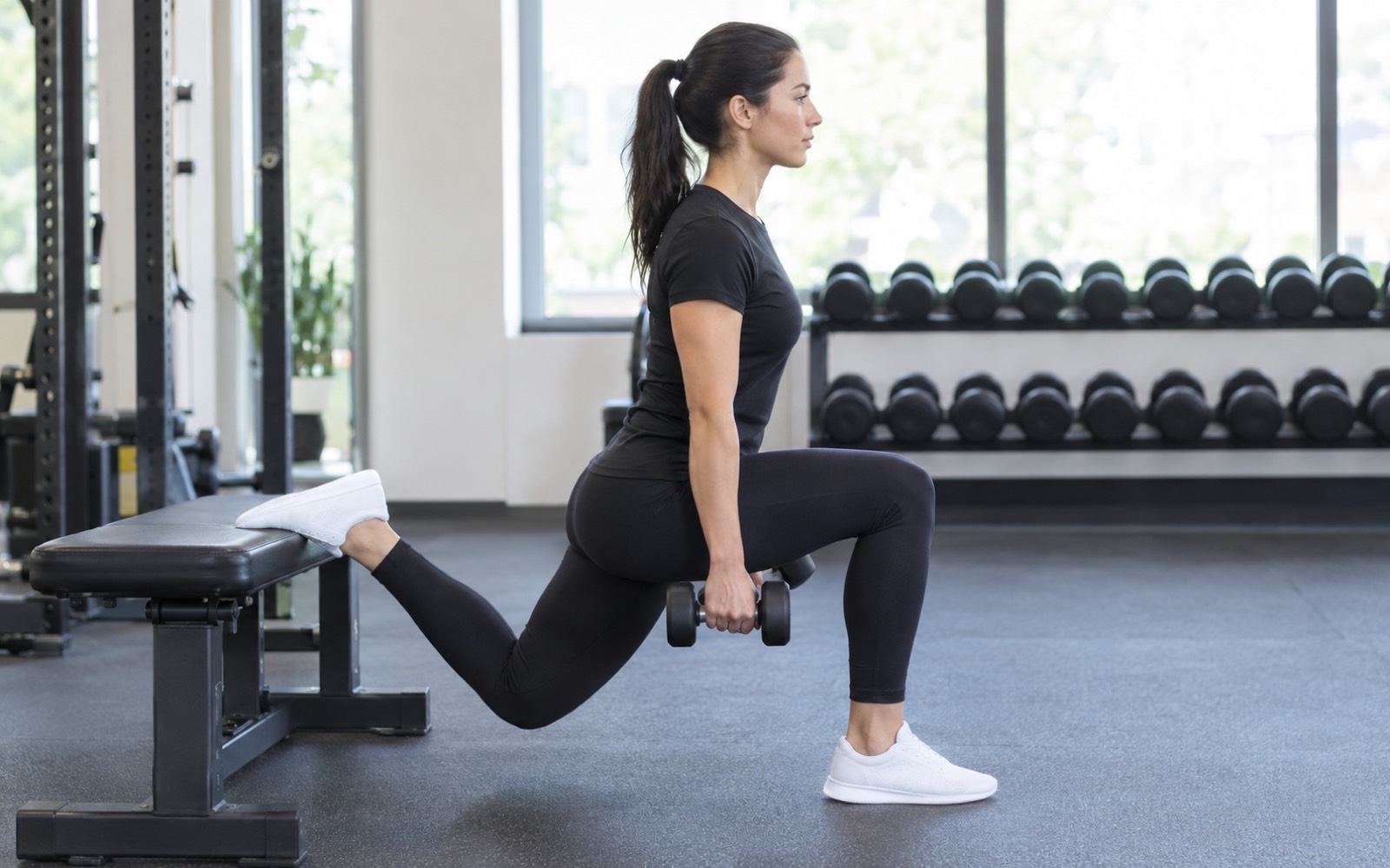
A Bulgarian split squat is a single-leg squat where your other foot rests on a bench behind you, on your toes or the top of your foot. You lower yourself until the thigh of your front leg is parallel to the floor, then stand back up through your heel. The back leg barely helps: in Helme's 2022 measurements, the front foot carried 84% of the total vertical force. That's why the glutes and thighs of the working leg get a load that a two-leg squat would split in half. A beginner is fine with 3 sets of 8 reps per leg, no weight, twice a week. After two weeks, add dumbbells: 3 kg (6.6 lb) each for women, 6 kg (13 lb) each for men. Below: the form step by step, how to set the bench height and the distance to it, dumbbell, barbell and at-home versions, the mistakes you can feel, and an 8-week plan.
What a Bulgarian split squat is and how it differs from a lunge
A Bulgarian split squat is a single-leg squat where your other foot rests on a bench behind you. The front foot stays flat on the floor, the back foot sits on the raised surface and keeps you balanced. You drop your hips straight down, the back knee heads toward the floor, then you stand up by pushing the floor away with your front foot. There's no stepping in this movement: both feet stay planted for the whole set.
The exercise goes by several names. In gyms it's the Bulgarian split squat, the Bulgarian lunge, or the Bulgarian squat. In research papers it's usually the rear-foot elevated split squat, or RFESS. That last name is the most accurate, because it describes exactly what's happening: a split squat with the back foot raised onto a platform.
The word "lunge" is a loose fit here. In a regular lunge you step forward or backward and return to standing, so every rep starts with a step. In a Bulgarian split squat you set up once and then squat on one leg. That's why both the balance demand and the load feel closer to a single-leg squat than to a lunge.
The name is usually traced to Angel Spassov, a coach of the Bulgarian weightlifting team. In 1989 he lectured in the US at the invitation of the National Strength and Conditioning Association (NSCA) and co-wrote an article with sports historian Terry Todd about the "Bulgarian secrets" of leg training. Whether Bulgarian weightlifters actually did this exercise is still debated, so treat the name as a label that stuck.
Bulgarian split squat muscles worked
The Bulgarian split squat builds the gluteus maximus and the quadriceps of the front leg, while the hamstrings, the gluteus medius and the muscles of the foot keep you balanced and help out. Meanwhile, the back leg is stretched along the front of the hip and barely pushes.
| Muscle | What it does | Where you feel it |
|---|---|---|
| Gluteus maximus (front leg) | extends the hip, lifting you out of the bottom | the glute of the front leg, especially at the bottom and in the first third of the rise |
| Quadriceps: four heads, including the rectus femoris | extends the knee of the front leg | front of the front thigh, stronger near the knee |
| Hamstrings: biceps femoris, semitendinosus, semimembranosus | help extend the hip and steady the knee | back of the front thigh, noticeable in a wide stance |
| Gluteus medius and minimus | keep your pelvis from tipping sideways while you're on one leg | side of the glute, sometimes burning from the first reps |
| Adductors | stabilize the thigh from the inside | inner thigh of the front leg |
| Calves and foot muscles | hold your balance and keep your heel down | calf and arch of the foot, strongest in the first two weeks |
| Abs and spinal erectors | hold your torso, keep it from tipping forward or sideways | mild fatigue in your abs and lower back |
| Hip flexors of the back leg: iliopsoas, rectus femoris | stretched while you're at the bottom | a pull along the front of the back thigh, near the groin |
The key study here is McCurdy's from 2018. Eighteen women with strength training experience did three exercises with an 8-rep load: the Bulgarian split squat, the barbell squat and the stiff-leg deadlift, with electromyography sensors on the gluteus maximus and the hamstrings. In the Bulgarian split squat, the gluteus maximus worked at 65.6% of maximal voluntary contraction, in the squat at 40.3%, in the deadlift at 40.5%. Hamstrings: 40.1% versus 24.4% in the squat and 29.9% in the deadlift. What this means for you: at a load of the same difficulty, your glute works roughly 1.6 times harder in a Bulgarian split squat than in a squat. One caveat: these are activity readings in experienced women, and they predict muscle growth over months only indirectly.
Earlier, in 2010, McCurdy compared the same two exercises in 11 female college athletes: each did 3 reps at 85% of her 3-rep max. The Bulgarian split squat produced more activity in the gluteus medius and the hamstrings, the squat more in the quadriceps. If quads are your main goal, the barbell squat does the better job; the Bulgarian split squat gives more to the glutes and hamstrings.
How much the back leg contributes has been argued over for years: some coaches believe it helps a lot, others that it's just a kickstand. Helme measured it directly in 2022: 26 men did Bulgarian split squats on two force plates, one under each foot, with increasing load up to a 5-rep max, 715 reps in total. The front foot produced an average of 84.36% of all vertical force, and as the weight went up, the back leg's share didn't grow. Two things follow for you: the weight in a Bulgarian split squat is weight on one leg, and you can't compare it directly with your squat.
Bulgarian split squat vs. lunge vs. squat
A Bulgarian split squat differs from a lunge in that the back leg rests on a bench and barely helps, and from a squat in that one leg carries all the weight while your back is free of a barbell. We covered forward, reverse and stationary lunges in our lunge guide, and the barbell squat in our squat form guide. Here, just the comparison.
| Bulgarian split squat | Forward or reverse lunge | Split squat (both feet on the floor) | Barbell squat | |
|---|---|---|---|---|
| What the back leg does | rests on a bench, balances, gives about 16% of the force (Helme, 2022) | steps and pushes off on the return | stands on the floor and helps noticeably | works equally with the other leg |
| Which muscles work hardest | gluteus maximus and medius, hamstrings (McCurdy, 2010 and 2018) | quads and glutes, depends on step length | quads; biceps femoris less active than in the Bulgarian version (DeForest, 2014) | quadriceps (McCurdy, 2010) |
| Knee bend at the bottom | less than in a squat: about 96° versus 105° (Mackey, 2021) | depends heavily on the step | same as the Bulgarian version | more than in the Bulgarian version |
| Lower back load | lower: weight in your hands, back free | lower | lower | higher: barbell on your back |
| Balance | the hardest | hard, especially stepping forward | moderate | easy |
| Typical load | dumbbells, half your squat weight or less | dumbbells | dumbbells, barbell | barbell |
| Best for | glutes and thighs, uneven legs, when your back doesn't want a barbell | beginners as a first single-leg exercise | a stepping stone from lunges to the Bulgarian version | whole-body strength, a foundation lift |
What raising the back foot actually changes was measured by DeForest in 2014. Nine trained men did a barbell squat at 85% of their max, then a split squat with both feet on the floor and a Bulgarian split squat with half that weight. Biceps femoris activity and peak force under the front foot were higher in the Bulgarian split squat than in the split squat, while gluteus maximus and rectus femoris didn't differ between the three exercises. Note that: the glute worked the same in a squat at 85% of max and in a Bulgarian split squat with half the weight. The sample is small, nine people, but the direction is clear: to load the glute the way a heavy squat does, about half the weight is enough in a Bulgarian split squat.
Mackey and Riemann looked at the joints in 2021. Twenty trained men did barbell squats at 70% of their max and Bulgarian split squats at 35% of that same max. In both exercises the hip joint was loaded significantly more than the knee and ankle, and in the Bulgarian split squat the knee moment was even smaller than the ankle moment. The knee bent less: about 96° at the bottom versus 105° in the squat. Knee travel past the toes wasn't measured in this study. The authors' conclusion: the Bulgarian split squat suits the early stages of knee rehab and anyone who needs to train hip extension on its own. Half the squat weight here simply means half the weight on one leg; it doesn't follow that "the Bulgarian split squat is twice as easy."
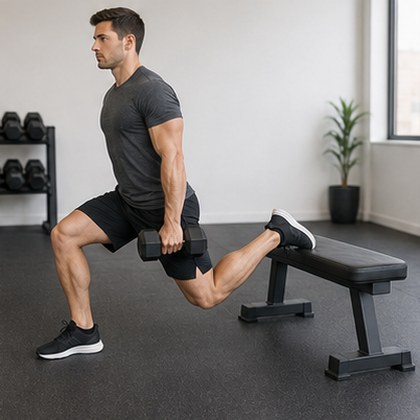 Bulgarian split squat
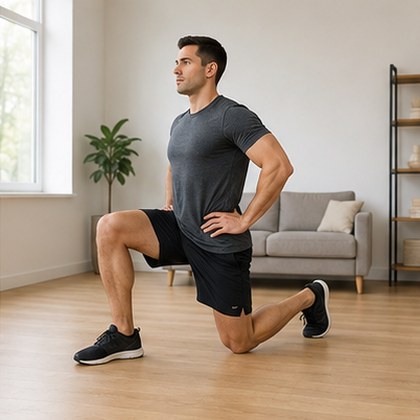 Static lunge
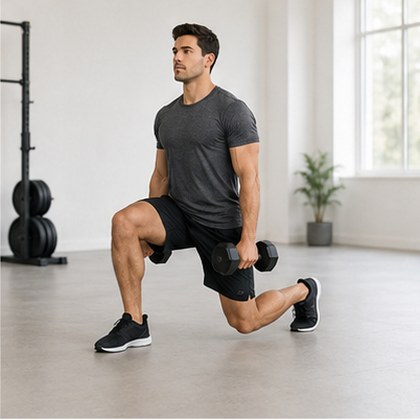 Dumbbell lunge
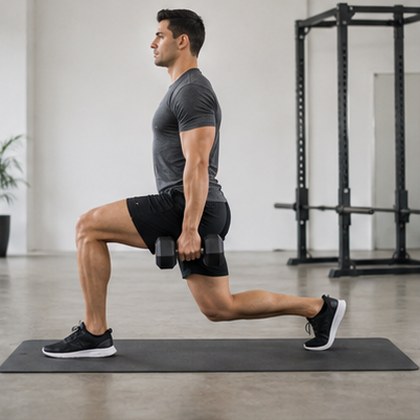 Walking lunge
Bench height and distance: how to set them for your body
The bench should be at knee height or a little lower, and your front foot should stand where your shin is roughly vertical at the bottom and your back knee hangs under your hips or slightly behind them. These two settings decide whether your glutes do the work or your knee starts to complain.
Height. A standard flat gym bench is 40–45 cm (16–18 in). For anyone 165 cm (5 ft 5 in) and taller, that's knee height or a bit lower. The researchers in Aygun-Polat's 2025 study set it up the same way: bench height was matched to each participant's shin length. If you're shorter, the bench will sit above your knee: your pelvis tilts, and the front of your back thigh starts pulling before your glutes get tired. In that case use a step platform, a low box or a stair at about half your shin height, roughly 20–30 cm (8–12 in). Too low is also a problem: the back leg starts helping, and the exercise turns into a regular split squat.
Distance. There are measurements for this. Arakawa and colleagues in 2025 studied two stances in 9 strength-trained students after 4 weeks of practicing the technique: a narrow one, where the distance between the feet equals leg length from hip joint to ankle, and a wide one, where that distance equals 1.3 leg lengths. They worked without weight, motion-capture cameras recorded the movement, and a force plate sat under each foot. In the wide stance, the back leg created a moment of 76–86 N·m that added work for the hip extensors of the front leg, meaning the glutes; in the narrow stance it was 49–71 N·m. The authors' conclusion: the Bulgarian split squat lets you load the hip extensors while keeping your torso almost upright. That's convenient for your lower back, which doesn't need a deep forward lean under load. For you it means: wider stance, more glutes; narrower stance, more quads and knee.
Why a narrow stance hits the knee is visible in Escamilla's 2008 work on regular forward lunges. Eighteen people did weighted lunges with a 12-rep load, with a short step and a long step. At 70–90° of knee bend, the load on the kneecap in the short lunge was significantly higher than in the long one. They measured lunges, and there's no direct measurement for the Bulgarian split squat, but the mechanics are similar: the closer your foot is to the bench, the further your knee travels forward and the harder it presses on the kneecap at the bottom.
You don't have to measure your leg. As a rough guide, take half your height: at 170 cm (5 ft 7 in), a narrow stance is about 85 cm (33 in) between the feet, a wide one about 110 cm (43 in). It's an estimate by proportion: some people have longer legs, some shorter. The test below is more precise.
The distance test. Get into your stance without weight and sink to the bottom. Film yourself from the side on your phone, or look at a mirror side-on. Three signs the distance is right: the shin of your front leg is roughly vertical or tilted slightly forward, your front heel is pressed into the floor, and your back knee hangs under your hips or slightly behind. If your heel lifts and your knee has traveled well past your toes, move half a foot length away from the bench. If your pelvis tilts and the front of your back thigh pulls, the stance is too wide or the bench is too high. If the back knee hangs well behind your hips but there's no pulling and your pelvis is level, you're fine: that's a wide stance with a glute emphasis.
How to do a Bulgarian split squat: step by step
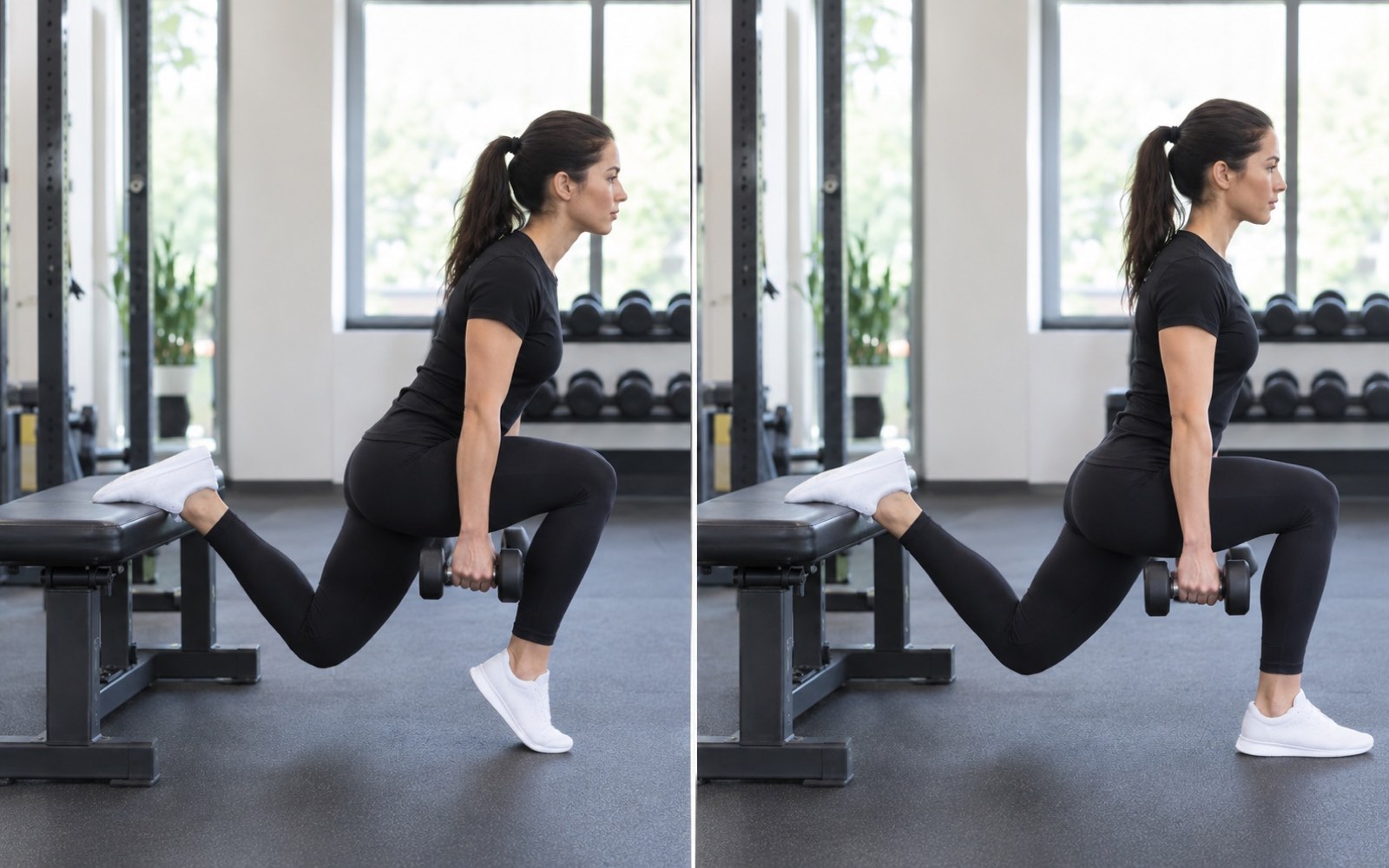
Stand with your back to a bench at one leg length away, put the toes of your back foot on it, lower until your back knee is 5–10 cm (2–4 in) off the floor, and stand up through the heel of your front leg. Step by step:
- Bench and distance. A bench at knee height or slightly lower. Stand with your back to it and measure off one leg length, roughly two of your own steps to start. Check the distance with the test from section 04.
- Back foot. Place it on the bench on your toes or on the top of your foot. The top of the foot is more stable and easier on your toes; toes give the foot more work and slightly more range. Try both and pick the one where your foot doesn't slide.
- Front foot. Pointing straight ahead, flat on the whole sole. Width equals hip width: if your feet line up on a single line, you'll wobble. Weight sits between your heel and midfoot.
- Hands and weight. For the first two weeks, no weight, hands on your hips or out in front for balance. Then dumbbells in your hands at your sides.
- Torso. Back flat, torso tilted slightly forward, ribs down, abs braced. Eyes forward and slightly down.
- Lowering. Take 2 seconds. Hips go down, the front knee bends, the back knee drops toward the floor. The front shin stays roughly vertical.
- The bottom. Front thigh parallel to the floor or slightly below, knee over the middle of your foot, back knee 5–10 cm (2–4 in) off the floor. It doesn't touch.
- Standing up. Take 1–2 seconds, pushing the floor away with your heel and midfoot of the front leg. The back leg doesn't push, it only balances.
- Breathing. Breathe in before you lower, breathe out in the second half of the rise. With light dumbbells, breathe normally; just don't let your stomach go slack at the bottom.
- Leg order. Weaker leg first, then the stronger one. Rest 0–30 seconds between legs and 90–120 seconds between sets.
The tempo comes from the 2009 American College of Sports Medicine (ACSM) position stand: it recommends a slow-to-moderate tempo for beginners, moderate meaning 1–2 seconds up and the same down. In a Bulgarian split squat it's worth slowing the descent a little, because the bottom is where your balance has to catch you.
Depth. Thigh parallel is the reference point. If your pelvis tilts at the bottom or your back knee hits the floor, stop higher; if you're level and nothing pulls, go down to almost touching. Depth usually improves over the first 3–4 weeks, as your foot and gluteus medius learn to hold balance.
Holding on or not. In your first sessions you can hold a rack, a wall or a chair back with one hand: the leg still gets its load, and you won't fall. Let go once 3 × 8 comes out steady.
for your first three workouts, film yourself from the side without weight, 3 reps per leg. If your front heel lifts, move half a foot length away from the bench. If the front of your back thigh pulls before your glutes get tired, lower the bench one level or step closer. If your torso tips sideways, set your feet at hip width. The video shows this on the first rep; by feel you'd only notice it a week later.
Bulgarian split squat with dumbbells, a barbell, in a Smith machine, or with a kettlebell
Start with dumbbells held at your sides: it's easier to balance, you add weight in 1–2 kg (2–4 lb) steps, and you don't need a rack. The other options come later and depend on your setup.
Dumbbells at your sides. The simplest and most reliable version: two dumbbells pull down and help you hold your torso, and the weight is easy to change. If you wobble, hold one dumbbell only in the hand on the side of your front leg and grab a support with the other. Grip becomes the limit at around 2 × 20 kg (44 lb); until then, the barbell can wait.
One dumbbell at your chest, goblet style. Hold the dumbbell vertically with both hands against your chest: your torso stays more upright and your back is unloaded. This is the option for home, where there's one dumbbell or a backpack, and for anyone whose back rounds with dumbbells at their sides. In terms of load, a 6 kg (13 lb) dumbbell at the chest equals a pair of 3 kg (6.6 lb) dumbbells in the hands.
Barbell on your back. Switch when 12 kg (26 lb) dumbbells and up have become light. A barbell loads your torso and back more, balance is harder to hold, and you need a rack next to the bench: unrack, two steps back to the bench, foot up. A beginner doesn't need this version, and with lower back pain it's better to stay with dumbbells.
Smith machine. The bar runs on rails, you barely need to balance, and you can go heavier. The front foot stands slightly ahead of the bar, otherwise the knee travels too far forward. The downside is that the bar path is dictated by the machine. Liao in 2023 compared, in 75 recreationally trained men, how rep speed changed with load in the barbell and Smith machine Bulgarian split squat: the load-velocity profiles turned out not to be interchangeable, with a spread of 14% and more. A Smith machine weight doesn't carry over to a barbell one to one; pick it fresh.
Kettlebell. Hold it at your chest by the horns or in one hand at your shoulder; the load is the same as a dumbbell at the chest. Kettlebells go up in 4 kg (9 lb) steps, which makes adding weight harder.
Resistance band. Stand on the middle of the band with your front foot and hold the ends at your shoulders. Resistance grows toward the top and is almost absent at the bottom. It's a handy substitute for dumbbells when traveling. For adding weight week to week, it doesn't work.
| Equipment | When to use it | Upside | Downside |
|---|---|---|---|
| Dumbbells at your sides | from week 3, up to a 20 kg (44 lb) pair | easier balance, 1–2 kg (2–4 lb) steps | grip tires before your legs at heavy weights |
| Dumbbell at the chest | at home, with a rounding back | more upright torso, one dumbbell | limited by the weight of one dumbbell |
| Barbell on your back | when 12 kg (26 lb) dumbbells feel light | you can go heavier | needs a rack, loads your back |
| Smith machine | when you want balance out of the picture | safe, heavy loads | fixed bar path, weight doesn't carry over (Liao, 2023) |
| Kettlebell | in a home gym with kettlebells | comfortable chest hold | 4 kg (9 lb) steps |
| Resistance band | when traveling | light, fits in a bag | little load at the bottom |
Bulgarian split squats at home with a chair or a couch
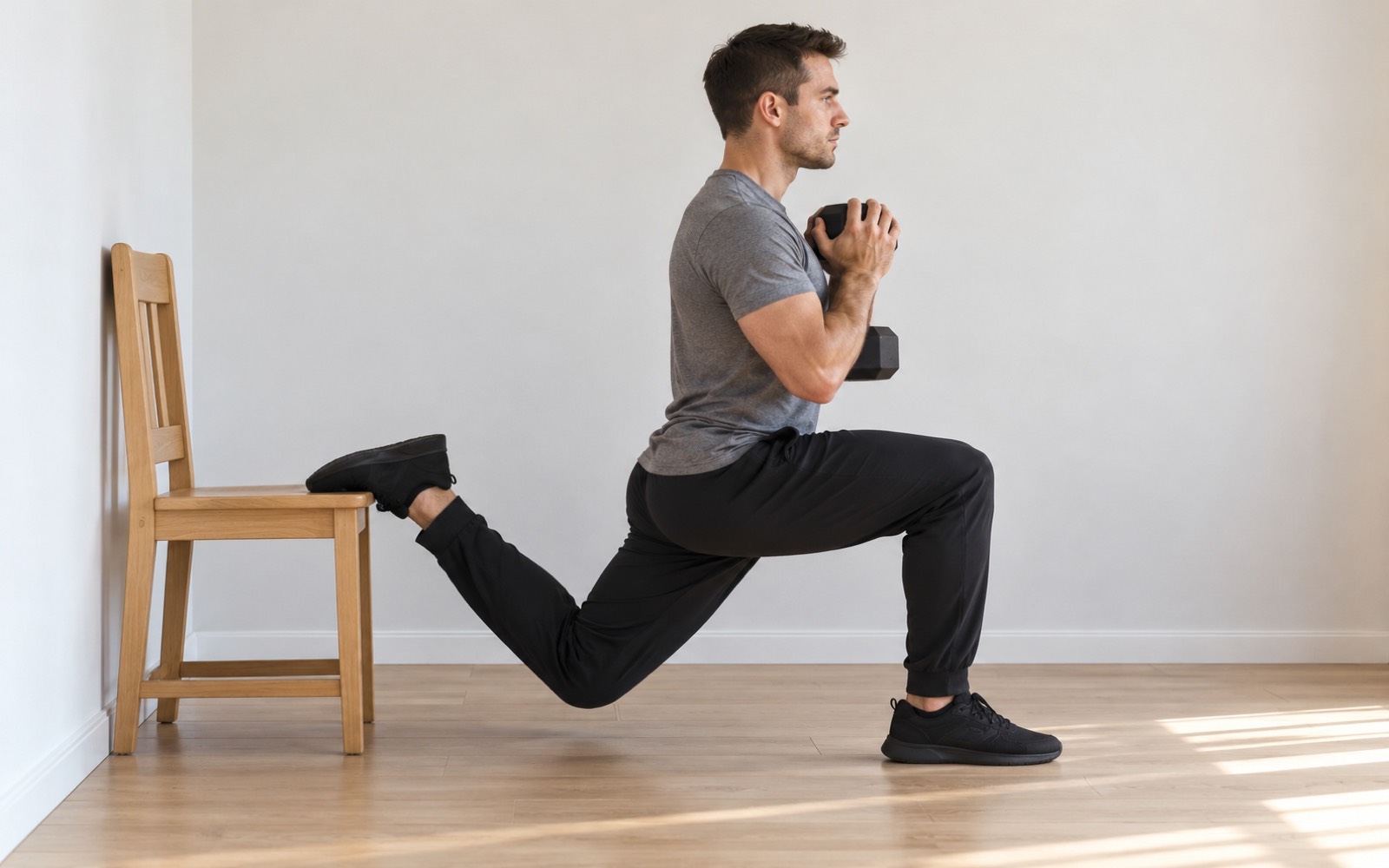
At home, a chair, a stool or a couch 40–45 cm (16–18 in) high serves as the bench, but the chair has to stand with its back against a wall so it doesn't slide out from under your foot. That's the first thing to check; the rest of the form doesn't change.
What works. A sturdy four-legged chair braced against a wall; the edge of a couch, if it's not too soft; a low stool; a stair; a step platform. Height as in the gym: knee or slightly lower. If you're shorter, a child's chair or a 10–15 cm (4–6 in) stack of books under your toes works: the exercise becomes almost a regular split squat, which is useful in the first weeks anyway.
What doesn't work. An office chair on wheels, a one-legged stool, a soft bed your foot sinks into, and any support you can't push with your foot without it moving.
How to add load. A backpack with books or water bottles: a 1.5-liter (50 oz) bottle weighs about 1.5 kg (3.3 lb), so four bottles give you 6 kg (13 lb), a man's starting weight in our plan. Hold the backpack against your chest by its straps or wear it on your back. One dumbbell at your chest, two bottles at your sides or a water jug also work. For balance, hold a door frame with your free hand.
Is light weight enough? Yes, as long as the set ends close to failure. Schoenfeld in 2017 pooled 21 studies and compared muscle growth at loads up to 60% of max and above 60%: when sets were taken to failure, muscles grew the same, and the only difference was in maximal strength, which grows better from heavy weight. With 3–5 kg (6.6–11 lb) dumbbells or a backpack, your muscles grow if you end the set 2–3 reps short of failure. With light weight that will mean 15–20 reps instead of 10, and that's fine.
Unstable supports. Versions with the back foot in suspension straps or on a stability ball are for people who already do the exercise confidently on a bench. A beginner needs a solid support first: you're learning to balance on one leg, and a swinging back leg only gets in the way.
A full home workout where the Bulgarian split squat already has its place next to the Romanian deadlift and the floor press is in our dumbbell workout at home. The dumbbell range there for Bulgarian split squats is 2.5–7.5 kg (5.5–16.5 lb) for women and 6–12 kg (13–26 lb) for men, and our 8-week plan fits inside it.
How to shift the load: glutes or quads
To get more from your glutes, step further from the bench and lean your torso forward with a flat back; to get more from your quads, stand closer and keep your torso more upright. Those are the two main settings; bench height is the third.
We covered distance in section 04: in the wide stance, the moment from the back leg in Arakawa's 2025 study was 76–86 N·m versus 49–71 N·m in the narrow one, and it adds work for the hip extensors. For torso lean there's a separate study. Aygun-Polat and colleagues in 2025 measured electromyography of eight muscles in 21 trained female athletes across four Bulgarian split squat variations: torso upright or leaning forward, back foot on a bench or in suspension straps. They worked without weight, arms crossed over the chest, with the lean set by a goniometer at 40° forward. The lean raised activity in the gluteus maximus, the biceps femoris and the rectus femoris; straps instead of a bench raised activity in the spinal erectors. The lean in this study means the torso at an angle to the floor with a flat back; a rounded back with the head hanging down is something else entirely.
| Goal | Distance to the bench | Torso | Bench height | Where you'll feel it |
|---|---|---|---|---|
| Quads | one leg length, narrow stance | upright | knee height | front of the front thigh (Arakawa, 2025; Aygun-Polat, 2025) |
| Glutes and hamstrings | 1.3 leg lengths, wide stance | forward lean up to 40° with a flat back | knee height or slightly lower | glute and back of the front thigh (Arakawa, 2025; Aygun-Polat, 2025) |
| Balance and foot strength | one leg length | upright | half a shin | foot, calf, side of the glute (McCurdy, 2010) |
Two notes on the table. First: the forward lean with a flat back is the same hip hinge as in a Romanian deadlift: hips go back, back stays flat, chest faces forward and down. If your back rounds, the load moves into your lower back. Second: in Arakawa's narrow stance, a more upright torso increased the back leg's moment, so even the "quad" version loads the glutes noticeably. You won't get a pure quad exercise out of the Bulgarian split squat; for that there are leg extensions and the leg press.
If glutes are the goal, pair the Bulgarian split squat with an exercise that loads the glute at the top of the movement: the hip thrust or the glute bridge. In the Bulgarian split squat the glute works hardest at the bottom, in the stretched position, and the two exercises complement each other. How to build a program out of them is covered in our guide to how to grow your glutes: the Bulgarian split squat sits in workout B there at 3 × 8–10 per leg.
Mistakes: where you feel it → what to fix
Most Bulgarian split squat mistakes give themselves away by where you feel them. A correct set is felt in the glute and thigh of the front leg; anything else is a signal to adjust your stance.
| Where you feel it | What's wrong | The fix |
|---|---|---|
| Front knee, at the front, under the kneecap | you're standing too close, the knee travels far past the toes, the heel lifts | move half a foot length away from the bench, weight on the heel, sit your hips straight down |
| Front knee, on the inside | the knee caves inward, the foot rolls in | point the knee at the second toe, take lighter weight, put a band above your knees |
| Back knee | you're hitting the floor with it, or the top of your foot is pressing on a hard edge | stop 5 cm (2 in) off the floor, put a folded mat under the knee, a towel on the edge of the bench |
| A pull along the front of the back thigh, near the groin | the bench is too high or the stance too wide; your pelvis is tilted and arched | lower the bench, step closer, tuck your pelvis, ribs down |
| Lower back | your torso is falling forward or arching, abs are slack | ribs down, abs braced, lighter weight, dumbbell to your chest |
| Wobbling sideways, can't stay up | feet on one line, weight on the toes | set feet at hip width, weight across the whole foot, hold on with a hand at first |
| Calf and arch of the foot burning | your foot is learning to balance | normal for the first 2 weeks, it passes on its own |
| Shin of the back leg, foot slipping | slippery bench or an awkward foot angle | switch to the top of the foot instead of toes, lay a towel on the bench |
| Nothing in the glute | narrow stance, upright torso, too little depth | move half a foot length away, lean your torso forward with a flat back, go lower |
On the knee going past the toes. Most instructions treat it as a ban. For us it's a guideline, and here's where it came from. Fry in 2003 measured, in 7 men, a parallel barbell squat with bodyweight on the bar in two versions: with the knees free and with a barrier that kept the knees from passing the toes. With free knees, the knee moment was 150 N·m and the hip moment 28 N·m. With the barrier, the knee moment dropped to 117 N·m, but the hip moment rose to 303 N·m, more than tenfold. The load doesn't disappear; it moves to the hips and lower back. They measured a squat, and the logic in the Bulgarian split squat is the same: shin roughly vertical, heel on the floor, a slight forward travel of the knee is fine. What's bad is a big forward travel with the heel lifting, and then the distance to the bench is the culprit.
On back knee pain. The most common complaint in search suggestions, and the answer is simple. The back knee hurts for two reasons: you're hitting the floor with it at the bottom, or you've placed the top of your foot on a hard bench edge and the edge is digging into your shin. The first is fixed by stopping 5 cm (2 in) off the floor or a mat under the knee, the second by a towel on the edge or switching to your toes. If instead the pull runs along the front of the thigh all the way to the knee, that's a hip flexor stretch: the bench is a bit too high or the stance a bit too wide.
How much weight to use: an 8-week plan for women and men
For the first two weeks use no weight; from week 3, dumbbells of 3 kg (6.6 lb) each for women and 6 kg (13 lb) each for men; then add 1–2 kg (2–4 lb) per dumbbell once all three sets of 10 reps per leg come out clean with 2–3 reps to spare.
The progression rule comes from the 2009 ACSM position stand: a beginner needs a load that allows 8–12 reps, and once you can do 1–2 reps more than planned, the weight goes up by 2–10%. With 3 kg (6.6 lb) dumbbells, a 1 kg (2.2 lb) step is an instant +33%, which is why in our plan reps drop back to 8 after every new dumbbell and climb back up to 10. The two weeks without weight are for distance and balance: most early failures in the Bulgarian split squat come from the stance, and the muscles have nothing to do with it.
Eight weeks in numbers. Two sessions a week, 3 working sets per leg in each, 90–120 seconds of rest between sets. Volume is the work per session: the weight of both dumbbells × reps × sets × 2 legs. For example, 2 × 3 kg × 8 reps × 3 sets × 2 legs = 288 kg (635 lb).
| Week | Women | Volume | Men | Volume | What changed |
|---|---|---|---|---|---|
| 1 | bodyweight, 3 × 8 per leg | — | bodyweight, 3 × 8 per leg | — | start: learning distance and balance |
| 2 | bodyweight, 3 × 10 | — | bodyweight, 3 × 10 | — | +2 reps |
| 3 | 2 × 3 kg (6.6 lb) dumbbells, 3 × 8 | 288 kg (635 lb) | 2 × 6 kg (13 lb) dumbbells, 3 × 8 | 576 kg (1,270 lb) | first weight |
| 4 | 2 × 3 kg, 3 × 10 | 360 kg (795 lb) | 2 × 6 kg, 3 × 10 | 720 kg (1,585 lb) | +2 reps |
| 5 | 2 × 4 kg (9 lb), 3 × 8 | 384 kg (845 lb) | 2 × 8 kg (17.5 lb), 3 × 8 | 768 kg (1,695 lb) | weight +33% |
| 6 | 2 × 4 kg, 3 × 10 | 480 kg (1,060 lb) | 2 × 8 kg, 3 × 10 | 960 kg (2,115 lb) | +2 reps |
| 7 | 2 × 5 kg (11 lb), 3 × 8 | 480 kg (1,060 lb) | 2 × 10 kg (22 lb), 3 × 8 | 960 kg (2,115 lb) | weight +25% |
| 8 | 2 × 5 kg, 3 × 10 | 600 kg (1,325 lb) | 2 × 10 kg, 3 × 10 | 1,200 kg (2,645 lb) | +2 reps |
From week 3 to week 8, work per session grew by 108% in both groups: from 288 to 600 kg (635 to 1,325 lb) for women and from 576 to 1,200 kg (1,270 to 2,645 lb) for men. In the weeks when the weight changes, volume doesn't grow or grows only a little, because there are fewer reps. That's by design: volume climbs again afterward through added reps.
If you don't have 3 and 5 kg (6.6 and 11 lb) dumbbells, hold one dumbbell at your chest at twice the weight: 6, 8 and 10 kg (13, 17.5 and 22 lb) for women, 12, 16 and 20 kg (26, 35 and 44 lb) for men, and the volume stays the same. If 10 clean reps on both legs aren't happening in a given week, stay on it one more week. The weaker leg sets the pace: weight goes up only once it has done all the reps.
This is a typical path, not a required standard: some people get through it in 6 weeks, others need 10. What to do after week 8 is covered in our guide to progressive overload.
How many sets, reps and times a week
A beginner is fine with 3 sets of 8–10 reps per leg twice a week, stopping 2–3 reps short of failure, with 90–120 seconds of rest between sets.
The 8–12 rep range and the 1–2 minute rest come from the 2009 ACSM position stand, which also recommends 2–3 strength sessions a week for beginners. In 2026 ACSM published a new position stand that pooled 137 systematic reviews: for muscle growth, 10 or more sets per muscle group per week; for strength, loads from 80% of max, 2–3 sets, two sessions a week or more, and a full range of motion. Training to failure didn't produce a consistent difference in that review, which is why we recommend stopping 2–3 reps short of it.
What this means for your glutes. Bulgarian split squats at 3 sets twice a week make 6 sets. Fill the gap to 10 with glute bridges, hip thrusts or Romanian deadlifts: 2 sets in each of the two sessions. That way the whole week is covered by four exercises.
Can the Bulgarian split squat replace the squat? For muscle growth, yes. Kassiano in 2025 pooled a meta-analysis of 9 studies selected from 703 papers: muscle growth from unilateral and bilateral exercises didn't differ. Strength grows specifically: bilateral exercises build bilateral strength better, unilateral ones build unilateral strength. If you want leg and glute muscle, the Bulgarian split squat replaces the squat completely; if you want a squat PR, you'll have to squat.
There's a direct test too. Speirs in 2016 split 18 academy rugby players into two groups: for 5 weeks one did only Bulgarian split squats, the other only barbell squats, 2 sessions a week each. Both groups improved their squat max, their Bulgarian split squat max, their 40 m sprint and their agility test, with no difference between groups. The Bulgarian group got stronger in the squat without squatting. These are young athletes over a short period, but for anyone who's out of squatting for a month or two because of their back, it's good news.
Can you do them every day? There's no point. Leg muscles need 48 hours after strength work, and with daily Bulgarian split squats you'll show up on tired legs every time. Twice a week, three if you like with light weight.
Order and placement in your workout. Weaker leg first: it sets the rep count, and the stronger leg doesn't run ahead. Rest 0–30 seconds between legs, 90–120 between sets. On leg day, put Bulgarian split squats first or second, while your balance is fresh: after heavy squats, your foot and gluteus medius are already tired, and the wobble gets worse.
In the Sportygram app (go.sportygram.com; the interface and the coach are in Russian), the Bulgarian split squat is in the workout diary among 142 exercises with technique photos. The plan is laid out by day, and if a session needs to move, you can ask the virtual coach, Alex, in chat to shift leg day to Friday; he shows a confirmation card, and once you confirm, the plan is rearranged. You log sets and weight as you go, and the history shows when 10 reps have gotten easy and it's time for the next dumbbell.
Who should be careful with Bulgarian split squats, and when to see a doctor
Bulgarian split squats are fine for almost anyone who can stand on one leg without pain, and you should stop with sharp knee pain, a painful click, or pain that doesn't ease in two days. We're not prescribing anything here, only pointing out what to watch for.
- Knees. By Mackey's 2021 measurements, the knee bends less in a Bulgarian split squat than in a squat, about 96° versus 105°, and the load mostly lands on the hip joint. That's why old knee problems often tolerate the Bulgarian split squat better than the squat. The condition is no pain. If it pulls under the kneecap, step further from the bench, sit your hips back, and don't go below parallel. If the pain stays, see a doctor, and swap the exercise until then.
- Lower back. Don't put a barbell on your back; work with dumbbells and keep your torso with a flat back. A forward lean with a rounded back is the only version in which a Bulgarian split squat loads your lower back noticeably.
- Balance and age. After 60 and with any balance problems, hold a rack or a wall with one hand: your legs don't get a break from it, but the risk of falling goes away. Start with a low support at half a shin and no weight.
- Pregnancy and the first months after birth. Only with the doctor managing your pregnancy. Usually depth is reduced, weight is removed, and a chair is placed for hand support.
- Uneven leg strength. Helme in 2019 tested a 5-rep max in the Bulgarian split squat on each leg in 26 men and showed that it reliably catches the difference between legs; the authors consider a difference above 3.5% meaningful. If one leg does 1–3 more reps than the other, that's common. Do the weaker leg first, match reps to it, and the gap closes within a couple of months.
See a doctor if knee or hip pain came on suddenly with a click mid-set, if the knee is swollen, if the pain doesn't ease after 2–3 days of rest, or if it radiates into your shin and foot. Aching muscle fatigue the next day is soreness; it goes away on its own in a few days and isn't a reason to see anyone.
Questions and answers
What muscles do Bulgarian split squats work?
The gluteus maximus and the quadriceps of the front leg, with the hamstrings and the gluteus medius helping and holding the pelvis. In McCurdy's 2018 study, the gluteus maximus worked at 65.6% of its maximum versus 40.3% in the barbell squat, and the hamstrings at 40.1% versus 24.4%. The hip flexors of the back leg are stretched the whole time, which is why the front of that thigh pulls.
How is a Bulgarian split squat different from a regular lunge?
The back leg rests on a bench and barely helps: by Helme's 2022 measurements, the front foot carries 84% of the force. There's no step; both feet stay planted for the whole set. The biceps femoris works harder than in a split squat with both feet on the floor (DeForest, 2014), and balance is harder to hold. Forward and reverse lunge form is covered in our separate lunge guide.
How high should the bench be, and can you do it at home with a chair?
Knee height or slightly lower: a standard 40–45 cm (16–18 in) bench suits anyone 165 cm (5 ft 5 in) and taller; shorter people do better with a stair or a box at half a shin. At home, a chair, a stool or the edge of a couch at the same height works, with the chair braced against a wall so it can't slide. An office chair on wheels and a soft bed don't work.
What weight should a woman start with, and how many reps?
Two weeks without weight, 3 sets of 8–10 reps per leg, then 3 kg (6.6 lb) dumbbells in each hand or one 6 kg (13 lb) dumbbell at your chest. Add 1 kg (2.2 lb) per dumbbell once all three sets of 10 come out clean on both legs with 2–3 reps to spare. By our plan, week 8 is 2 × 5 kg (11 lb) and 600 kg (1,325 lb) of volume per session.
Why does the front of my back thigh pull, or my back knee hurt?
The front pulls, near the groin, when the bench is too high or the stance too wide: the pelvis tilts, and the hip flexors of the back leg stretch more than they should. Lower the bench or step closer and tuck your pelvis. The back knee hurts when you hit the floor with it or rest your foot on a hard edge: stop 5 cm (2 in) off the floor, put a mat under the knee, a towel on the edge of the bench.
Can your knee go past your toes?
A little, yes. Fry in 2003 measured in the squat that when the knee is kept from passing the toes, the knee moment drops from 150 to 117 N·m, but the hip moment rises from 28 to 303 N·m, and that load moves into the hips and lower back. The guideline for the Bulgarian split squat: shin roughly vertical, heel on the floor, a slight forward travel of the knee is fine. If the knee has traveled far and the heel has lifted, you're standing too close to the bench.
Can you do Bulgarian split squats every day?
There's no point: leg muscles need 48 hours to recover, and every day you'd be training on tired legs. Twice a week at 3 sets makes 6 sets, and for growth ACSM in 2026 calls for 10 or more sets per muscle per week. Fill the remaining 4 with glute bridges, hip thrusts or Romanian deadlifts.
What can you do instead of Bulgarian split squats?
Reverse lunges, a split squat with both feet on the floor, a single-leg squat to a box, or a single-leg leg press. For glutes, the hip thrust and the glute bridge. The barbell squat grows muscle just as well as unilateral exercises, as Kassiano's 2025 meta-analysis of 9 studies showed; the only difference is which strength grows more, bilateral or unilateral.
The bottom line
- A Bulgarian split squat is a single-leg squat with the back foot on a bench. The front leg carries 84% of the load (Helme, 2022), so the weight here is weight on one leg.
- The gluteus maximus works at 65.6% of its maximum versus 40.3% in the squat, the hamstrings at 40.1% versus 24.4% (McCurdy, 2018). Quads work harder in the squat (McCurdy, 2010).
- Bench at knee height or slightly lower, 40–45 cm (16–18 in) for anyone 165 cm (5 ft 5 in) and up. Distance: one leg length for quads, 1.3 leg lengths for glutes (Arakawa, 2025). A forward lean with a flat back adds to the glutes (Aygun-Polat, 2025).
- Start with two weeks of bodyweight at 3 × 8–10 per leg, then dumbbells: 3 kg (6.6 lb) for women and 6 kg (13 lb) for men. Over 8 weeks, volume grows from 288 to 600 kg (635 to 1,325 lb) and from 576 to 1,200 kg (1,270 to 2,645 lb).
- Twice a week, 3 sets of 8–10 with 2–3 reps in reserve. Fill up to 10 glute sets a week with bridges or deadlifts (ACSM, 2026). For muscle growth, the Bulgarian split squat replaces the squat (Kassiano, 2025; Speirs, 2016).
- The knee can travel slightly past the toes: if you hold it back, the load moves into the hips and lower back (Fry, 2003). The guideline is a vertical shin and a heel on the floor.
- Front of the back thigh pulling: lower bench or narrower stance. Back knee hurting: don't touch the floor, mat under the knee. Sudden pain with a click or swelling: see a doctor.
Checklist: before a set of Bulgarian split squats
- The bench is at knee height or slightly lower and doesn't move when you push it.
- Distance checked from the side: front shin vertical, heel on the floor.
- Feet at hip width, each on its own track.
- Back foot on toes or the top of the foot, not slipping.
- Torso with a flat back, ribs down, abs braced.
- Back knee stops 5–10 cm (2–4 in) off the floor.
- Weaker leg first; reps are matched to it.
- The weight leaves 2–3 reps in reserve, and it's logged in your diary.
Sources
- McCurdy K., Walker J., Yuen D. Gluteus Maximus and Hamstring Activation During Selected Weight-Bearing Resistance Exercises. Journal of Strength and Conditioning Research, 2018. — 18 strength-trained women, 8-rep load: gluteus maximus in the Bulgarian split squat at 65.6% of maximum versus 40.3% in the squat and 40.5% in the stiff-leg deadlift; hamstrings at 40.1% versus 24.4% and 29.9%.
- McCurdy K., O'Kelley E., Kutz M., Langford G., Ernest J., Torres M. Comparison of Lower Extremity EMG Between the 2-Leg Squat and Modified Single-Leg Squat in Female Athletes. Journal of Sport Rehabilitation, 2010. — 11 female college athletes, 3 reps at 85% of 3-rep max: higher gluteus medius and hamstring activity in the Bulgarian split squat, higher quadriceps activity and quad-to-hamstring ratio in the squat.
- DeForest B.A., Cantrell G.S., Schilling B.K. Muscle Activity in Single- vs. Double-Leg Squats. International Journal of Exercise Science, 2014. — 9 trained men: squat at 85% of max, split squat and Bulgarian split squat at half that weight; biceps femoris and peak vertical force higher in the Bulgarian split squat than in the split squat; gluteus maximus and rectus femoris didn't differ between the three exercises.
- Helme M., Emmonds S., Low C. Is the Rear Foot Elevated Split Squat Unilateral? An Investigation Into the Kinetic and Kinematic Demands. Journal of Strength and Conditioning Research, 2022. — 26 men, two force plates, 715 reps with loads up to a 5-rep max: the front foot produces 84.36 ± 3.6% of vertical force, and the back leg's share doesn't change as the load grows.
- Arakawa H., Nakashima H., Li X., Tanimoto M. Rear Leg-derived Moment Contributes to Resistance Against Hip Extension in Bulgarian Split Squats. International Journal of Exercise Science, 2025. — 9 strength-trained students, no weight, 4 weeks of practice, motion capture and two force plates: narrow stance equals leg length, wide stance equals 1.3 leg lengths; the back leg's moment is 76–86 N·m in the wide stance versus 49–71 N·m in the narrow one, adding work for the hip extensors with an almost upright torso.
- Aygun-Polat E., Guzel N.A., Guruhan S., Polat Y., Karatas N. Targeted muscle activation in Bulgarian split squat variations: effects of trunk position and suspension-based execution. BMC Sports Science, Medicine and Rehabilitation, 2025. — 21 trained female athletes, no weight, electromyography of eight muscles, bench height matched to shin length: a 40° forward torso lean raised activity in the gluteus maximus, biceps femoris and rectus femoris; suspension straps instead of a bench raised activity in the spinal erectors.
- Mackey E.R., Riemann B.L. Biomechanical Differences Between the Bulgarian Split-Squat and Back Squat. International Journal of Exercise Science, 2021. — 20 trained men, squat at 70% of max and Bulgarian split squat at 35% of it: in both exercises the hip joint is loaded significantly more than the knee and ankle; the knee bends less in the Bulgarian split squat than in the squat, about 96° versus 105°; knee travel past the toes wasn't measured.
- Kassiano W., Nunes J.P., Costa B., Ribeiro A.S., Loenneke J.P., Cyrino E.S. Comparison of Muscle Growth and Dynamic Strength Adaptations Induced by Unilateral and Bilateral Resistance Training: A Systematic Review and Meta-analysis. Sports Medicine, 2025. — 9 studies out of 703: muscle growth from unilateral and bilateral exercises didn't differ; strength grows specifically, bilateral from bilateral exercises and unilateral from unilateral ones.
- Speirs D.E., Bennett M.A., Finn C.V., Turner A.P. Unilateral vs. Bilateral Squat Training for Strength, Sprints, and Agility in Academy Rugby Players. Journal of Strength and Conditioning Research, 2016. — 18 academy rugby players, 5 weeks of 2 sessions, Bulgarian split squats only or squats only: both groups improved squat max, Bulgarian split squat max, 40 m sprint and agility, with no difference between groups.
- American College of Sports Medicine. Progression models in resistance training for healthy adults. Medicine & Science in Sports & Exercise, 2009. — Beginners: a load allowing 8–12 reps, 2–3 sessions a week, 1–2 minutes of rest; add 2–10% once 1–2 extra reps are achievable; moderate tempo is 1–2 seconds up and 1–2 seconds down.
- Currier B.S., D'Souza A.C., Singh M.A.F. et al. American College of Sports Medicine Position Stand. Resistance Training Prescription for Muscle Function, Hypertrophy, and Physical Performance in Healthy Adults: An Overview of Reviews. Medicine & Science in Sports & Exercise, 2026. — 137 systematic reviews: for muscle growth, 10 or more sets per muscle per week; for strength, loads from 80% of max, 2–3 sets, two or more sessions a week, full range of motion; training to failure isn't required.
- Schoenfeld B.J., Grgic J., Ogborn D., Krieger J.W. Strength and Hypertrophy Adaptations Between Low- vs. High-Load Resistance Training: A Systematic Review and Meta-analysis. Journal of Strength and Conditioning Research, 2017. — 21 studies: when sets are taken to failure, muscles grow the same at loads up to 60% and above 60% of max; maximal strength grows better from heavy loads.
- Fry A.C., Smith J.C., Schilling B.K. Effect of knee position on hip and knee torques during the barbell squat. Journal of Strength and Conditioning Research, 2003. — 7 men, parallel barbell squat with bodyweight on the bar: with free knees, knee moment 150.1 N·m and hip moment 28.2 N·m; with a barrier keeping the knees behind the toes, 117.3 and 302.7 N·m.
- Escamilla R.F., Zheng N., Macleod T.D. et al. Patellofemoral joint force and stress between a short- and long-step forward lunge. Journal of Orthopaedic & Sports Physical Therapy, 2008. — 18 people, forward lunge with a 12-rep load: at 70–90° of knee bend, the load on the kneecap in the short step is significantly higher than in the long one.
- Liao K., Bian C., Chen Z. et al. Repetition velocity as a measure of loading intensity in the free weight and Smith machine Bulgarian split squat. PeerJ, 2023. — 75 recreationally trained men: the load-velocity profiles of the barbell and Smith machine Bulgarian split squat aren't interchangeable, with a spread of 14% and more.
- Helme M., Bishop C., Emmonds S., Low C. Validity and Reliability of the Rear Foot Elevated Split Squat 5 Repetition Maximum to Determine Unilateral Leg Strength Symmetry. Journal of Strength and Conditioning Research, 2019. — 26 men: a 5-rep max test in the Bulgarian split squat on each leg reliably measures the strength difference between legs; meaningful asymmetry lies outside 96.5–103.5%.
This article is for informational purposes only and is not a substitute for medical advice.