

a cheat meal is one pre-planned meal of food you love, eaten without counting calories. Fat loss follows your weekly deficit, so with a deficit of 500 calories a day, a dinner that's 1,000 calories bigger than usual takes less than a third of the week's result.The extra 2–4 lb (1–2 kg) on the scale the next morning is mostly glycogen with water, plus salt. By our math, a whole pizza with a cola adds no more than 130 g (about 4.6 oz) of body fat. A cheat meal barely speeds up your metabolism: even three days of carb overfeeding raised energy expenditure by only 7% (Dirlewanger, 2000). If you wait for your cheat meal like a rescue and eat until you feel sick, start by making your deficit gentler.
A cheat meal is a meal you plan ahead of time while dieting, where you eat what you normally don't allow yourself and don't count calories. Most often it's a pizza, a burger with fries, sushi or a slice of cake, once a week or less. You don't need one to lose weight: fat comes off from the calorie deficit you build up over a week, and one free dinner usually fits inside that deficit. Below you'll find how a cheat meal differs from a cheat day and a refeed, how often to have one and how many calories it can cost, what the scale will show the morning after pizza or sushi (we ran the numbers on six ordinary examples), and how to tell when a free meal has turned into a binge.

What is a cheat meal in simple terms
A cheat meal is one meal, planned in advance, where you eat what you usually limit and don't track calories. It has a start and an end: it's one lunch or dinner, and after it you go back to your normal way of eating.
The term took hold in bodybuilding and fitness circles, where athletes spend months on a strict diet before a competition, and from there it spread across social media. In 2017 a team of researchers led by Pila looked at what cheat meals look like online. They analyzed 600 images out of 1.6 million posts tagged #cheatmeal. Very large portions showed up in 54.5% of the images, and very high-calorie food in 71.3%. By volume, many of these "meals" were closer to a binge episode than to an ordinary dinner.
Cheat meals stopped being a bodybuilder habit a long time ago. Ganson's 2022 survey included 2,717 Canadians aged 16–30. At least one cheat meal in the past year was reported by 60.9% of men and 53.7% of women. The most common size was 1,000–1,499 calories per meal. Among people who had cheat meals at all, they happened on average more than once a week: over 30 days, women had 7.1 cheat meals and men 5.9. Men more often chose protein-heavy food (31% versus 12% of women), and women more often chose sweets (79% versus 62% of men). In Murray's 2018 survey of 248 young people around 19 years old, 89.1% had cheat meals.
The worst thing about a cheat meal is its name. The word "cheat" suggests you broke a rule and now you're guilty. Tsang's 2025 review collected eight studies on cheat meals that the authors found in five scientific databases up to October 2024. The authors note that a free meal framed as breaking the rules or as a reward for strict dieting is linked to signs of disordered eating. When the free meal is planned in advance as part of the diet, the studies more often saw benefits: people were less hungry and more satisfied with their diet. That's why we'll sometimes call it a free meal below. The meaning is the same, just without the feeling that you're cheating on someone.
You'll also see it written as "cheat-meal" or "cheatmeal", and some coaches prefer "free meal", "treat meal" or "planned indulgence". It's all the same thing.
Cheat meal vs cheat day vs refeed vs diet break: what's the difference
A cheat meal is one free meal with no calorie target, and a cheat day is a whole free day. A refeed lasts 1–3 days: calories go up to maintenance or slightly above, usually from carbs, but to set numbers. A diet break is anywhere from 4 days to several weeks at maintenance. Maintenance means the number of calories you burn in a day: at that intake your weight stays put.
These definitions come from Tsang and colleagues in their 2025 review. Here's how the four approaches compare side by side.
| Cheat meal | Cheat day | Refeed | Diet break | |
|---|---|---|---|---|
| How long it lasts | one meal | one day | 1–3 days | 4 days to several weeks |
| How many calories | no target, as much as you want | no target | maintenance or 5–10% above it | maintenance |
| What you eat | anything | anything | set numbers, focus on carbs, protein as usual | set numbers, normal food |
| Why people usually do it | a break from restriction, a celebration, dinner with friends | same | support training and well-being on a long diet when body fat is already low | a rest from the deficit, less hunger |
| What's known | weight still drops, hunger is lower, data on muscle are mixed (Tsang, 2025) | eats the most of the weekly deficit, 62% of the week by our math | muscle may be kept slightly better, but the data are disputed (Campbell, 2020; Peos, 2020) | fat comes off the same, resting energy expenditure drops less (Poon, 2025) |
The main difference between the left and right halves of the table is the numbers. Cheat meals and cheat days have no calorie target, so their cost depends on your appetite that evening. Refeeds and diet breaks are planned at a specific calorie intake, and almost all the research on the benefits of diet pauses was done on them.
The most recent summary of these pauses is Poon's 2025 meta-analysis: 12 randomized trials, 881 people. Dieting with breaks and refeeds reduced weight, fat, BMI and waist size just as well as continuous dieting. Resting energy expenditure dropped noticeably only on continuous dieting; with breaks the drop was smaller, especially in people with excess weight. You can't transfer these results directly to a free cheat meal: in the trials people ate to a plan, with no "as much as I want".
In trained people the picture is similar. In the 2021 ICECAP trial by Peos and colleagues, 61 people, 32 of them women, dieted for 12 weeks: one group without pauses, the other in 3-week blocks with a week at maintenance in between. Fat, muscle, strength and resting expenditure changed the same way, but the second group was less hungry. How to set up breaks like these and what the MATADOR study found is covered in detail in our guide to cutting without losing muscle.
One more mix-up: searches for "refeed" often bring up "refeeding syndrome". That's a medical condition that can happen when a person starts eating again after severe starvation. It has nothing to do with a refeed in sports nutrition.
Do you need a cheat meal to lose weight
No, a cheat meal isn't required: fat comes off from your weekly calorie deficit, and a free meal doesn't help weight loss by itself. It's useful for people it helps stick to the plan, and it gets in the way for people who slide into overeating.
The clearest experiment was run by Coelho do Vale, Pieters and Zeelenberg in 2016. 36 people dieted for two weeks. Some ate 1,500 calories every day; others ate 1,300 calories six days in a row and 2,700 calories on the seventh. Over the week both groups got the same 10,500 calories, and they lost the same amount of weight. But people in the second group kept their self-control and motivation better, and the diet felt easier to them. The authors concluded that indulgences help you stay on track when they're planned ahead.
Tsang's 2025 review shows a similar picture: in all four studies on the physiology of cheat meals, weight went down because the weekly deficit held. The clearest example is Davoodi's 2014 trial: 74 people with overweight and obesity spent six weeks alternating 11 days of restriction with 3 days of free eating. After four weeks they were less hungry and more satisfied with their diet than people who simply cut calories. They also stuck with the diet better: by the count in Tsang's review, 15.7% of that group dropped out, compared with 36.8% on the regular diet.
The psychology behind this is simple. In 1999 Westenhoefer and colleagues analyzed questionnaires from 54,517 participants in a weight-loss program and a separate sample of 1,838 people in Germany. Rigid control of eating, where your favorite foods are banned completely, was linked to a higher BMI and frequent binge episodes. Flexible control, where anything is allowed but in small amounts, was linked to a lower BMI, rare binges and a better chance of losing weight over a year. A cheat meal is one way to add some flexibility to a strict diet.
A cheat meal is more likely to help if:
- you've been losing weight for several months, and going without your favorite food is getting harder;
- it's easier for you to follow the plan when there's a clear free dinner ahead;
- you have a party or a get-together coming up and want to enjoy it without counting.
A cheat meal is more likely to get in the way if:
- after a free dinner it's hard to stop, and it stretches into the whole of Sunday;
- you eat until you feel heavy and then "punish" yourself with fasting or an extra workout;
- you've had binge episodes before;
- your deficit is small, and one big dinner eats almost the whole week (more on this in section 07).
If you already eat flexibly and there's room for chocolate or a slice of pizza in your diet, you don't need a separate cheat meal: there's nothing to make up for. The need for a "day of freedom" usually shows up when everything is off-limits the rest of the week.
Does a cheat meal boost your metabolism
Not in any meaningful way: after overeating, energy expenditure goes up for a short time, but that increase is many times smaller than the calories you ate.
The study most often cited for a metabolic "boost" is Dirlewanger's from 2000. Ten healthy women ate 40% above their needs for three days: in one version the extra came from carbs, in the other from fat. After carb overfeeding, leptin rose by 28% and total daily energy expenditure by 7%. Leptin is a hormone made by fat tissue that tells the brain how much energy the body has in storage. Resting metabolism didn't change. After fat overfeeding, neither leptin nor expenditure changed. And even in the carb version, the rise in leptin wasn't linked to the rise in expenditure.
Here's what that means in calories. If you burn 2,000 calories a day, 7% is about 140 calories. Meanwhile, a cheat meal adds 1,000–1,500 calories on top of a normal dinner. So even in the best case, the extra expenditure gives back about a tenth of the extra food, and only after three days of overeating in a row.
The "leptin rises by 30%" figure that floats around popular articles looks like this result with the study conditions stripped out: three days in a row, carbs, and 40% above your needs. Tsang's 2025 review cites data showing that thyroid hormones lowered by dieting returned to baseline only after 7–10 days of higher intake. One free dinner is clearly not enough for that.
There's a more encouraging study too. In Campbell's 2020 trial, 27 trained people dieted for seven weeks with a deficit of about 25% and four strength sessions a week. One group ate more carbs on two consecutive days every week. Fat loss was about the same, while lean mass dropped by 0.4 kg (0.9 lb) in the refeed group and by 1.3 kg (2.9 lb) in the continuous group; resting expenditure fell by 38 calories versus 78 calories. But in the same year, 2020, Peos and colleagues reanalyzed the data, and the only significant difference left was in "dry" lean mass, with water excluded. On top of that, the study was funded by a sports nutrition company, and the first author sat on its scientific advisory board. It's too early to make a rule out of a study on 27 people.
Poon's 2025 meta-analysis is also about breaks with set calories, and it doesn't show that a free cheat meal protects your metabolism. What actually raises the calories you burn and how the body adapts to a long diet is covered in our article on metabolism myths.
Two more numbers from popular articles, "metabolism slows by 30% on a diet" and "people with cheat meals lose weight 1.5 times faster", we checked and couldn't find any research behind them. In the Coelho do Vale study, where weekly calories were equal, weight came off the same.
Why did I gain weight after a cheat meal, and when will it go away
The jump on the scale the next morning is mostly glycogen with water, salt and food still in your gut. In our examples, one cheat meal can add anywhere from zero to 130 g (4.6 oz) of fat, and a cheat day up to 220 g (7.8 oz). The water leaves on its own over a few normal days.
Where the water comes from:
- Glycogen. This is the carb store in your muscles and liver, and it's stored together with water. In Fernández-Elías's 2015 study, muscle biopsies in 9 trained people showed at least 3 g of water for every gram of glycogen. So 100 g of carbs that go into storage can add about 400 g (14 oz) on the scale.
- There's a lot of room for glycogen. In Acheson's 1988 study, three men first had their glycogen stores emptied with diet and exercise, and then were overfed carbs for a week. Glycogen stores reached about 15 g per kilogram of body weight, and about 500 g of carbs went into glycogen before the body started turning them into fat to any real extent. On a deficit your stores are usually not full, so after a carb-heavy dinner there's room to top them up.
- Salt. The body keeps blood sodium within narrow limits, normally 135–145 mmol per liter (according to MedlinePlus). Until your kidneys clear the extra salt, water is held along with it: by our math, up to 0.12 L (about 4 fl oz) for every extra gram of salt.
- Food in your gut. A big dinner has weight until it's digested. We didn't include this in the table below.
Less fat gets stored than you might think. In Horton's 1995 study, 16 men ate 50% above their needs for two weeks. With carb overfeeding, the body stored 75–85% of the extra energy and burned the rest. With fat overfeeding, it stored 90–95%, and expenditure barely changed.
To show what makes up the jump on the scale, we took six ordinary scenarios. Here are the assumptions: a person with maintenance of 2,300 calories eats 1,800 calories a day, a deficit of 500 calories a day and 3,500 calories a week. The cheat meal replaces a normal dinner of 550 calories, 50 g of carbs and 1.5 g of salt. The cheat day replaces the whole planned day: 1,800 calories, 180 g of carbs and 5 g of salt. These "normal" numbers are our assumption for the example.
What the scale will show the morning after a cheat meal, and how much of it is fat (our math)
| What you ate | calories | carbs, g | salt, g | body fat, max, g (oz) | glycogen with water, up to, kg | water from salt, up to, kg | scale gain next morning, up to, kg (lb) |
|---|---|---|---|---|---|---|---|
| Double cheeseburger, fries 145 g (5 oz), cola 0.5 L (17 oz) | 1,480 | 145 | 3.8 | 55 (1.9) | 0.4 | 0.3 | 0.7 (1.5) |
| Whole 12-inch (30 cm) pizza, 691 g (24 oz), cola 0.5 L (17 oz) | 2,060 | 285 | 9.5 | 130 (4.6) | 0.9 | 1.0 | 1.9 (4.2) |
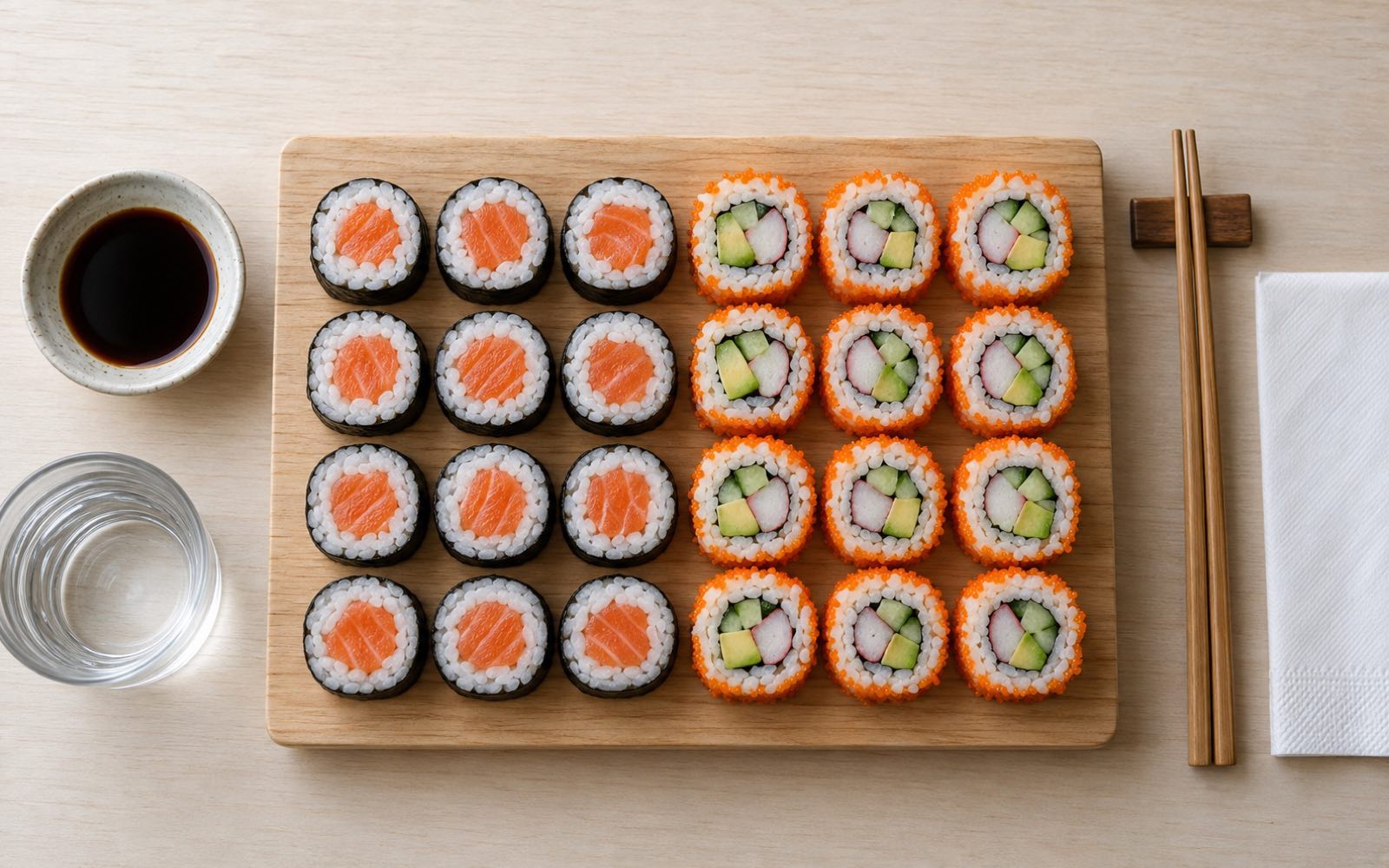
| Sushi rolls, 24 pieces (salmon and California), soy sauce 48 g (3 tbsp) | 730 | 125 | 13.8 | 0 | 0.3 | 1.5 | 1.8 (4.0) |
| Pasta in cream sauce 500 g (18 oz), 2 glasses of red wine | 1,330 | 85 | 7.4 | 35 (1.2) | 0.1 | 0.7 | 0.9 (2.0) |
| Two slices of chocolate cake (350 g, 12 oz), ice cream 100 g (3.5 oz) | 1,410 | 205 | 2.8 | 45 (1.6) | 0.6 | 0.2 | 0.8 (1.8) |
| Cheat day: 4 pancakes, a whole pizza, cola 0.5 L, 2 slices of cake | 3,980 | 540 | 14.4 | 220 (7.8) | 1.4 | 1.2 | 2.6 (5.7) |
How we calculated it. Dish composition and portion sizes come from the USDA FoodData Central database. Body fat is the calories above maintenance for that day divided by 7.7 calories per gram (the "7,700 calories per kilogram" rule, or 3,500 calories per pound). Glycogen with water is the carbs above a normal dinner multiplied by 4: a gram of glycogen plus 3 g of water. Water from salt is based on a blood sodium concentration of about 140 mmol per liter. All three numbers are ceilings: some carbs are burned right away, your kidneys clear the salt, and the following deficit days use up both the glycogen and the stored fat.
What the table shows:
- The extra 2–4 lb the next morning is almost entirely water. For pizza with cola, the ceiling for fat is about 130 g (4.6 oz), while the scale can show up to 1.9 kg (4.2 lb).
- The jump on the scale depends more on salt and carbs than on calories. Sushi is the best example: 730 calories fit within the day's budget, so there's no extra fat at all. But there are 13.8 g of salt (about 5,400 mg of sodium), almost three times the 5 g a day the WHO recommends. That's where up to 1.5 kg (3.3 lb) of water and the classic "bloated after a cheat meal" feeling come from.
- A cheat day costs more than any single meal. It takes 62% of the weekly deficit, while the meals in the table take 5 to 43%.
- Alcohol isn't stored as glycogen, so the water jump after pasta and wine is small. But your body processes alcohol first. In Suter's 1992 study of eight men, alcohol on top of their normal diet cut fat burning over 24 hours by 36%, so the fat from a cream sauce is more likely to go into storage that evening.
When the water leaves. In Orsama's 2014 study, 80 adults weighed themselves regularly at home, 4,657 weigh-ins in total. Weight started climbing on Saturday, peaked on Sunday and Monday, and went down from Tuesday. The people who were losing or maintaining weight "rolled back" from the weekend to the weekday level most strongly, and the authors consider these swings normal. For you, this means Monday's weight after a Saturday cheat meal tells you nothing; look at it after 3–5 normal days.
Sometimes it goes the other way: a day or two after a cheat meal, the scale shows less than before it. There's no solid research that explains this. The simplest explanation is ordinary water fluctuation against the deficit that's still running: in Orsama's data, people who were losing weight got back onto their downward trend by midweek. It doesn't happen every time, and it's not something to turn into a weight-loss method.
For the other reasons your weight jumps around, from sleep to your cycle, see why your weight fluctuates.
don't judge your progress by the morning after a cheat meal. Weigh yourself at the same time on an empty stomach and compare this week's average weight with last week's. If the average is going down, the cheat meal isn't getting in your way.
How many calories can a cheat meal be without losing progress
Our rule of thumb: a free meal shouldn't take more than a third to a half of your weekly deficit. With a deficit of 500 calories a day, that's roughly 1,000–1,500 calories above a normal dinner; with a deficit of 300 calories, about 700 calories. This is our own calculation; there's no separate study with this target.
Where the numbers come from. A deficit of 500 calories a day is 3,500 calories a week. A third is about 1,170 calories, a half is about 1,750. We rounded down to 1,000–1,500 calories to leave a margin for counting errors. With a deficit of 300 calories a day, the week adds up to 2,100 calories, and a third of that is only 700. So with a small deficit your choice is either a more modest meal or a less frequent one, every two weeks.
Here's what the examples from the table in section 05 "cost" if your normal dinner was 550 calories:
- pasta in cream sauce and two glasses of wine: +780 calories, 22% of the weekly deficit;
- two slices of chocolate cake with ice cream: +860 calories, 25%;
- a double cheeseburger with fries and a cola: +930 calories, 27%;
- a whole 12-inch pizza with a cola: +1,510 calories, 43%;
- 24 sushi rolls with soy sauce: +180 calories, 5%;
- a cheat day: +2,180 calories on top of the planned day, 62%.
Pasta, cake and the burger fit within the target with room to spare, and a whole pizza sits at the upper edge. If you split the same pizza with someone, half a pizza without the cola comes to about 920 calories, which is just a normal dinner with a small extra. For comparison, in Ganson's 2022 survey the most common cheat meal among young Canadians was 1,000–1,499 calories in total, so a typical free dinner fits the target. An "eat until you can't move" dinner and all-you-can-eat formats go past it.
For this target to work, you need to know your maintenance and your deficit. How to work them out step by step is covered in how to calculate a calorie deficit. It also helps to log the free dinner in whatever food diary you use: then you'll see how much you actually ate and won't have to guess. In the Sportygram app (the interface is in Russian), the profile calculates your calorie target, and in the food diary you can find dishes in a database of about 101,000 foods or scan a barcode on packaged food.
How often should you have a cheat meal when losing weight
With a moderate deficit of about 500 calories a day, no more than once a week. With a small deficit or on your last few pounds, once every two weeks, or a little of your favorite food every day instead of a cheat meal.
We calculated how much of your weekly deficit is left after different numbers of free meals. In parentheses is how many extra calories each option adds, based on the table in section 05. Each cell shows the weekly deficit left first, then roughly how much fat that gives you per month: the remainder over 30 days divided by 7,700 calories per kilogram (3,500 per pound).
How much of your weekly deficit is left after cheat meals (our math)
| Cheat meals per week | deficit 300 calories a day | deficit 500 calories a day | deficit 700 calories a day |
|---|---|---|---|
| No cheat meals | 2,100 cal, about 1.2 kg (2.6 lb) | 3,500 cal, about 1.9 kg (4.2 lb) | 4,900 cal, about 2.7 kg (6.0 lb) |
| 1 × burger, fries and cola (+930) | 1,170 cal, about 0.7 kg (1.5 lb) | 2,570 cal, about 1.4 kg (3.1 lb) | 3,970 cal, about 2.2 kg (4.9 lb) |
| 1 × whole pizza (+1,510) | 590 cal, about 0.3 kg (0.7 lb) | 1,990 cal, about 1.1 kg (2.4 lb) | 3,390 cal, about 1.9 kg (4.2 lb) |
| 2 × burger, fries and cola (+1,860) | 240 cal, about 0.1 kg (0.2 lb) | 1,640 cal, about 0.9 kg (2.0 lb) | 3,040 cal, about 1.7 kg (3.7 lb) |
| 1 × cheat day (+2,180) | almost no deficit (−80 cal) | 1,320 cal, about 0.7 kg (1.5 lb) | 2,720 cal, about 1.5 kg (3.3 lb) |
| 2 × whole pizza (+3,020) | no deficit (−920 cal) | 480 cal, about 0.3 kg (0.7 lb) | 1,880 cal, about 1.0 kg (2.2 lb) |
What this means in practice:
- with a deficit of 300 calories a day, even one big cheat meal a week takes more than half of your result, and two wipe out the week;
- with a deficit of 500 calories, once a week works: with a burger you're left with about 1.4 kg (3.1 lb) of fat a month instead of 1.9 kg (4.2 lb);
- a weekly cheat day on a small deficit eats the whole week;
- with a deficit of 700 calories a day, even two pizzas a week leave about 1 kg (2.2 lb) of fat a month.
The 7,700 calories per kilogram figure (3,500 per pound) is a rough rule. Hall showed in 2008 that it's roughly right when the body carries more than 30 kg (66 lb) of fat, and that for people with less fat it overstates the deficit needed. So the "fat per month" in the table is a ballpark figure.
The Coelho do Vale study from section 03 was set up exactly on a "once a week" schedule. In real life people have cheat meals more often: in Ganson's survey, more than once a week on average, and about 7 times over 30 days for women.
The cheat meal you don't notice is the weekend. In Racette's 2008 study, 48 adults aged 50–60 weighed themselves every morning for a year. Before the program started, their weight went up by 0.06 kg (0.13 lb) a day over the weekend and didn't change on weekdays: on Saturday they ate more, and on Sunday they moved less. Once they started dieting, weight loss stalled over the weekends. If every weekend turns into two free days, that's already two cheat days a week, even if the word "cheat meal" never came up.
Holidays work the same way, only for longer. In 2000 Yanovski followed 195 adults: over the holiday season from mid-November to January, they gained an average of 0.37 kg (0.8 lb), and by the next fall that gain hadn't gone away. Under a pound looks like nothing, but if a gain like that stays every year, after a few years it becomes noticeable.
Can you have a cheat meal once a month? Yes, calorie-wise it's the gentlest option. But if you spend a whole month piling up restrictions and counting the days until your free dinner, that's a sign your diet is too strict. What to do about it is in section 10.
How to do a cheat meal right: 9 rules
Plan the meal ahead, keep it to one meal, eat normally with protein during the day, serve one plate and eat slowly. The next day, go back to your usual plan without fasting or "working it off".
- Plan ahead. Decide which day and what you'll eat at least a couple of days in advance. A spontaneous slip that gets labeled a cheat meal after the fact usually feels worse. In Murray's 2018 survey, people planned cheat meals precisely to cope with cravings and keep up a strict diet. Tsang's 2025 review separately describes the broken-rule effect: when an indulgence feels like a failure, a person gets upset, loses motivation and overeats more easily afterward.
- One meal, no sequel. Dinner is over, the cheat meal is over. By our table, a cheat day takes 62% of the weekly deficit, and a whole pizza with a cola 43%.
- Don't starve all day to "save up" for the evening. Have breakfast and lunch as usual, with protein (more in the tip below).
- One plate. Serve a portion and put the rest away. Buffets and all-you-can-eat formats quickly turn a free dinner into overeating.
- Eat slowly and enjoy it. Enjoyment is the whole point. Sit down at the table, put your phone away and notice the taste.
- Expect water on the scale. Salty food gives the biggest jump the next morning: 24 sushi rolls with soy sauce, up to 1.8 kg (4 lb) with zero fat, by our math.
- Count alcohol as calories. Two 180 ml (6 oz) glasses of red wine are about 300 calories on top of dinner, and after them it's harder to stop at one plate.
- Time of day doesn't matter much. There's no solid evidence that a morning cheat meal is better than an evening one, and none behind the popular advice to eat "no later than 3–4 hours before bed". You can have a free meal on a training day: in one of the studies in Tsang's 2025 review, days of free carb-heavy eating changed neither how hard a strength session felt nor the number of reps people completed.
- Next morning, a normal breakfast. No "fasting day", no double workout, no cutting water or salt. Compare your weight with the weekly average, as in the tip from section 05.
a few hours before your free dinner, have a normal protein-rich lunch, such as meat, fish, eggs or cottage cheese, and don't come to the pizza hungry. On a full stomach, two or three slices are enough for the taste. When you sit down hungry, it's easy to eat six just because you're hungry.

Can you have a cheat meal while cutting, on keto or with intermittent fasting
When cutting, people who are already lean usually do better with a refeed built on carbs and normal protein than with a free meal. On keto, a carb-heavy cheat meal gives the biggest water jump on the scale. With intermittent fasting, you simply put the free meal inside your eating window.
Cutting. The goal of a cut is to lose fat and keep muscle, so protein matters every day, and free-for-all food often has little of it. Tsang's 2025 review cites two Brazilian studies of bodybuilders who alternated five days of deficit with two free carb days. In one, lean mass made up 48% of the weight lost; in the other, 50% in one of the groups. The review authors don't consider that any better than in ordinary weight-loss studies. A refeed with set numbers looks more reasonable, although the data on it are modest: in Campbell's 2020 study, the muscle advantage after reanalysis held only for "dry" lean mass, and in ICECAP 2021 there was no advantage at all, though hunger was lower (more in section 04).
Keto. After a long stretch with almost no carbs, your glycogen stores are nearly empty, and according to Fernández-Elías (2015), each gram of glycogen is stored with at least 3 g of water. That's why after pizza or cake on keto the scale can jump more than for someone on a regular diet, even though no more fat is stored overnight. We won't repeat popular figures like "a cheat meal knocks you out of ketosis for so many days": there's no reliable source behind them.
Intermittent fasting. The logic here is the same as on any diet: what matters is your calorie balance over the week. Put the free meal in your usual eating window and don't stretch the window for it.
When a cheat meal turns into a binge: signs and what to do
It's a warning sign if you count the days until your cheat meal, eat until you feel heavy and sick, can't stop, eat in secret, and afterward feel guilty and "punish" yourself with fasting or workouts. Usually this means your diet is too strict, and the place to start is a gentler deficit.
Cheat meals have a dark side, and researchers write about it directly. In Ganson's 2022 survey, cheat meals were linked to signs of eating disorders, including binge eating. In Murray's 2018 study, the frequency of cheat meals in men was linked to binge episodes. Tsang's 2025 review adds that the risk is higher when the free meal is framed as a reward for strictness or as breaking the rules.
Popular articles sometimes claim "70% of cheat meals lead to binge eating". That's a misreading of Pila's 2017 study: there, 54.5% of images showed very large portions and 71.3% showed high-calorie food, and those are two different things.
Signs of binge eating according to the NHS, the UK's health service:
- you eat a very large amount in a short time and can't stop, even when you're full;
- you eat when you're not hungry;
- you eat very fast;
- you eat alone or in secret;
- after eating you feel down, guilty, ashamed or disgusted with yourself.
One holiday dinner that leaves you stuffed doesn't mean anything yet. It's a concern when episodes like this keep repeating.
What to do:
- Make your deficit gentler. The stricter the diet, the stronger the pull to "let loose": in Westenhoefer's 1999 data, rigid bans went hand in hand with frequent binges. Raise your calories to a moderate deficit you can live on without gritting your teeth all the time.
- Bring your favorite foods back into weekdays, a little at a time. The 80/20 rule suggests getting about 80% of your calories from ordinary whole foods and leaving 20% for whatever you want. On a 2,000-calorie diet, that's up to 400 calories of favorite food every day. For sweets, the WHO gives a guideline: free sugars under 10% of calories, which is about 50 g, or 12 teaspoons, at 2,000 calories.
- Watch your hunger. If you're hungry all the time, your deficit is probably too big. That's a reason to recalculate your calories and to check whether you're getting enough protein.
- Don't punish yourself. After overeating you need a normal breakfast and a normal day, without fasting or penalty workouts.
When to see a doctor. If the signs from the NHS list keep coming back and you can't control your eating, talk to your doctor or a mental health professional. It's a medical problem, and it's treatable. The NHS advises seeing a doctor as soon as possible if you recognize yourself in that list. If you've had an eating disorder in the past, discuss cheat meals with a specialist ahead of time.
Questions and answers
Can I have a cheat meal once a week and still lose weight?
Yes, if your deficit is moderate, about 500 calories a day, and the cheat meal stays one meal. By our math, a burger with fries and a cola once a week leaves you about 1.4 kg (3.1 lb) of fat a month instead of 1.9 kg (4.2 lb). With a deficit of 300 calories a day, a big cheat meal takes more than half of your result, so it's better to have it less often or keep it smaller.
How many calories can a cheat meal be?
The rule of thumb is no more than a third to a half of your weekly deficit: with a deficit of 500 calories a day, that's roughly 1,000–1,500 calories above a normal dinner, and with 300 calories, about 700. A "4,000-calorie cheat meal" is already a whole cheat day: by our table it takes 62% of the week at a 500-calorie deficit and the whole week at a 300-calorie deficit.
Why do I sometimes weigh less after a cheat meal?
There's no solid explanation in the research. Most likely it's ordinary water fluctuation against a deficit that keeps running: in Orsama's 2014 data, people who were losing weight got back onto their downward trend by midweek after the weekend. It doesn't happen every time, so it's not worth turning into a method.
What should I do the day after a cheat meal?
Have a normal breakfast and follow your usual plan, and drink water when you're thirsty. You don't need fasting days, "detox" days or penalty workouts: the water from glycogen and salt leaves on its own. Compare your weight with the weekly average after 3–5 days.
Can a cheat meal break a weight loss plateau?
There's no solid evidence for it. Energy expenditure after overeating goes up by a few percent and not for long, and a plateau is more often explained by a deficit that has become smaller than you think. What to check first is covered in weight loss plateau. If you've been dieting for a long time and it's hard going, a diet break at maintenance makes more sense: according to Poon's 2025 meta-analysis, fat comes off just as well with breaks like that.
What's the best thing to eat for a cheat meal?
Whatever you really want, as one portion. If you're choosing, go for food with more carbs than fat: with fat overfeeding the body stores 90–95% of the extra energy, and with carbs 75–85% (Horton, 1995). And remember the salt: sushi and pizza will show more water on the scale.
Does your cycle affect weight after a cheat meal?
Yes, water shifts across the menstrual cycle even without any cheat meal. In White's 2011 study, 62 women tracked their symptoms for a year, 765 cycles in total: fluid retention felt strongest on the first day of the period. So compare your weight after a cheat meal with the same days of your previous cycle. If your period is late or stops altogether on a strict diet, that's a reason to see a gynecologist.
Do I need a cheat meal if I eat clean or lose weight without banning foods?
If there's already room for your favorite foods in your diet, you don't need a separate cheat meal: there's nothing to make up for. According to Westenhoefer's 1999 data, a flexible approach is linked to fewer binge episodes and a better chance of losing weight.
The bottom line
- A cheat meal is one pre-planned meal of food you love, eaten without counting calories. A cheat day is the same for a whole day, and a refeed is 1–3 days to set numbers with a focus on carbs.
- Fat loss follows your weekly deficit: with a deficit of 500 calories a day, a dinner 1,000 calories bigger than usual takes less than a third of the week, and a cheat day takes 62%.
- The extra 2–4 lb (1–2 kg) the next morning is mostly glycogen with water, plus salt. After a whole pizza with a cola there's no more than 130 g (4.6 oz) of body fat, and after 24 sushi rolls there's no fat at all, with up to 1.8 kg (4 lb) of water (our math).
- A cheat meal barely speeds up your metabolism: three days of carb overfeeding raised expenditure by 7%, about 140 calories if you burn 2,000.
- With a moderate deficit, have a cheat meal no more than once a week; with a small deficit, once every two weeks or a little of your favorite food every day.
- Weekends work like a cheat day you don't notice: without a diet, weight went up by 0.06 kg (0.13 lb) a day over the weekend.
- If you wait for your cheat meal like a rescue, eat until you feel sick or eat in secret, make your deficit gentler, and if binge episodes keep repeating, see a doctor.
Checklist: how to have a cheat meal without losing progress
- Find out your maintenance calories and your deficit.
- Decide whether you need a cheat meal at all: if you eat flexibly and without bans, you don't.
- Pick the day and the dish in advance, at least a couple of days ahead.
- Estimate the calories: a free meal shouldn't take more than a third to a half of your weekly deficit.
- Have breakfast and lunch as usual, with protein.
- Serve one plate and eat slowly.
- Next morning, go back to your usual plan without fasting or penalty workouts.
- Compare your weekly average weight; the morning after a cheat meal doesn't count.
- If it's hard to stop after free dinners, make your deficit gentler and bring your favorite foods back into weekdays in small amounts.
Sources
- Tsang J. H., Poon E. T., Trexler E. T., Wong S. H., Zheng C., Sun F. The Role of Cheat Meals in Dieting: A Scoping Review of Physiological and Psychological Responses. Nutrition Reviews, 2025. — 8 studies on cheat meals found up to October 2024; definitions of cheat meal, cheat day, refeed and diet break; weight drops on the diet, data on muscle and metabolism are mixed; framing a cheat meal as a violation or a reward is linked to signs of disordered eating; in the bodybuilder studies, lean mass made up 48% and 50% of losses; thyroid hormones recovered after 7–10 days of higher intake.
- Poon E. T., Tsang J. H., Sun F., Zheng C., Wong S. H. Effects of intermittent dieting with break periods on body composition and metabolic adaptation: a systematic review and meta-analysis. Nutrition Reviews, 2025. — 12 randomized trials, 881 people: with breaks and refeeds, weight and fat come off the same, and resting expenditure drops less.
- Ganson K. T., Cunningham M. L., Pila E., Rodgers R. F., Murray S. B., Nagata J. M. Characterizing cheat meals among a national sample of Canadian adolescents and young adults. Journal of Eating Disorders, 2022. — 2,717 people aged 16–30: a cheat meal in the past year for 60.9% of men and 53.7% of women, most often 1,000–1,499 calories, on average more than once a week; link with signs of eating disorders.
- Murray S. B., Pila E., Mond J. M. et al. Cheat meals: A benign or ominous variant of binge eating behavior?. Appetite, 2018. — 248 young people: 89.1% had cheat meals; in men, frequency was linked to binge episodes but not to distress.
- Pila E., Mond J. M., Griffiths S., Mitchison D., Murray S. B. A thematic content analysis of #cheatmeal images on social media. International Journal of Eating Disorders, 2017. — 600 images out of 1.6 million: very large portions in 54.5%, high-calorie food in 71.3%.
- Coelho do Vale R., Pieters R., Zeelenberg M. The benefits of behaving badly on occasion: Successful regulation by planned hedonic deviations. Journal of Consumer Psychology, 2016. — 36 people, 2 weeks: 1,500 calories every day or 1,300 calories six days and 2,700 on the seventh; same weight loss, better self-control and motivation with a planned indulgence.
- Davoodi S. H., Ajami M., Ayatollahi S. A. et al. Calorie shifting diet versus calorie restriction diet: a comparative clinical trial study. International Journal of Preventive Medicine, 2014. — 74 people with overweight and obesity, 11 days of restriction and 3 free days, 6 weeks: after 4 weeks, less hunger and higher satisfaction, better adherence.
- Westenhoefer J., Stunkard A. J., Pudel V. Validation of the flexible and rigid control dimensions of dietary restraint. International Journal of Eating Disorders, 1999. — 54,517 weight-loss program participants and 1,838 people in Germany: rigid control linked to more frequent binges, flexible control to successful weight loss.
- Dirlewanger M., di Vetta V., Guenat E. et al. Effects of short-term carbohydrate or fat overfeeding on energy expenditure and plasma leptin concentrations in healthy female subjects. International Journal of Obesity, 2000. — 10 women, 3 days of 40% overfeeding: with carbs, leptin +28% and expenditure +7%; with fat, no change.
- Campbell B. I., Aguilar D., Colenso-Semple L. M. et al. Intermittent Energy Restriction Attenuates the Loss of Fat Free Mass in Resistance Trained Individuals. A Randomized Controlled Trial. Journal of Functional Morphology and Kinesiology, 2020. — 27 trained people, 7 weeks, 2 carb days a week: lean mass −0.4 kg versus −1.3 kg, resting expenditure −38 versus −78 calories. The study was funded by the Dymatize Athletic Nutrition Institute.
- Peos J., Brown A. W., Vorland C. J., Allison D. B., Sainsbury A. Contrary to the Conclusions Stated in the Paper, Only Dry Fat-Free Mass Was Different between Groups upon Reanalysis. Journal of Functional Morphology and Kinesiology, 2020. — Reanalysis of Campbell's data: only the difference in dry lean mass remained significant.
- Peos J. J., Helms E. R., Fournier P. A. et al. Continuous versus Intermittent Dieting for Fat Loss and Fat-Free Mass Retention in Resistance-trained Adults: The ICECAP Trial. Medicine & Science in Sports & Exercise, 2021. — 61 trained people, 12 weeks of deficit in 3-week blocks: fat, muscle, strength and expenditure the same as with continuous dieting, less hunger.
- Fernández-Elías V. E., Ortega J. F., Nelson R. K., Mora-Rodriguez R. Relationship between muscle water and glycogen recovery after prolonged exercise in the heat in humans. European Journal of Applied Physiology, 2015. — Muscle biopsies in 9 people: each gram of glycogen is stored with at least 3 g of water.
- Acheson K. J., Schutz Y., Bessard T. et al. Glycogen storage capacity and de novo lipogenesis during massive carbohydrate overfeeding in man. American Journal of Clinical Nutrition, 1988. — 3 men, a week of carb overfeeding after depleting stores: glycogen capacity about 15 g per kg of body weight; about 500 g goes into glycogen before carbs are turned into fat to any real extent.
- Horton T. J., Drougas H., Brachey A. et al. Fat and carbohydrate overfeeding in humans: different effects on energy storage. American Journal of Clinical Nutrition, 1995. — 16 men, 14 days at 50% above their needs: with excess carbs, 75–85% of the extra energy is stored; with excess fat, 90–95%.
- Suter P. M., Schutz Y., Jequier E. The effect of ethanol on fat storage in healthy subjects. New England Journal of Medicine, 1992. — 8 men: alcohol on top of the normal diet (25% of daily energy) cut fat burning over 24 hours by 36%.
- Hall K. D. What is the required energy deficit per unit weight loss?. International Journal of Obesity, 2008. — The "7,700 calories per kg" rule is roughly right with more than 30 kg of body fat and overstates the deficit needed for people with less fat.
- Orsama A.-L., Mattila E., Ermes M. et al. Weight rhythms: weight increases during weekends and decreases during weekdays. Obesity Facts, 2014. — 80 adults, 4,657 weigh-ins: weight highest on Sunday and Monday, going down from Tuesday.
- Racette S. B., Weiss E. P., Schechtman K. B. et al. Influence of weekend lifestyle patterns on body weight. Obesity, 2008. — 48 adults aged 50–60: weight rose by 0.06 kg a day over weekends; on a diet, weight loss stalled over weekends.
- Yanovski J. A., Yanovski S. Z., Sovik K. N. et al. A prospective study of holiday weight gain. New England Journal of Medicine, 2000. — 195 adults: +0.37 kg over the holidays, and by the next fall the gain hadn't gone away.
- White C. P., Hitchcock C. L., Vigna Y. M., Prior J. C. Fluid Retention over the Menstrual Cycle: 1-Year Data from the Prospective Ovulation Cohort. Obstetrics and Gynecology International, 2011. — 62 women, 765 cycles: fluid retention felt strongest on the first day of the period.
- NHS. Binge eating disorder: overview, 2023. — Signs of binge eating and the advice to see a doctor.
- WHO. Healthy diet (fact sheet), 2026. — Free sugars under 10% of calories, about 50 g at 2,000 calories; salt under 5 g a day.
- MedlinePlus (NIH). Sodium blood test, 2025. — Normal blood sodium is 135–145 mEq/L; our water-from-salt calculation is built on this.
- USDA. FoodData Central, FNDDS database, 2024. — Calories, carbs and sodium of the dishes in the table in section 05.
This article is for informational purposes only and is not a substitute for medical advice. If you've had an eating disorder, have diabetes or are pregnant, talk to your doctor about free meals ahead of time.