

in Borges's 2018 study, at a 10-rep load the chest worked at 50.8% of max in the pullover, the triceps at 34.3%, and the lats at 22.7%. In the lat pulldown, those same lats hit 59.5%, so the pullover is a weak choice for back and a good one for chest and triceps. Elbows stay bent at 10–20°, and the angle doesn't change. Depth is wherever your chest is fully stretched while your ribs stay down: in Gill's 2020 data, healthy adults averaged 161.5° of shoulder flexion in men and 158.5° in women, so "upper arm level with the bench" isn't a target everyone can reach.Start with 4 kg (9 lb) for women and 8 kg (17.5 lb) for men, 3 × 10 twice a week; reps climb to 12 first, then weight goes up. Over our 8-week plan, training volume grows by 110%. We couldn't find a single study showing that pullovers expand an adult's rib cage.
A dumbbell pullover is a lying exercise where you hold one dumbbell with both hands above your chest, lower it behind your head with nearly straight arms, and bring it back. The movement happens at the shoulder joint, and your elbows hold one angle for the whole set. The pectoralis major does most of the work, the long head of the triceps helps, and the lats come in third: that's what EMG measurements of muscle activity show, and the numbers are below. A beginner needs one dumbbell: 4 kg (9 lb) for women, 8 kg (17.5 lb) for men, 3 sets of 10 twice a week. Below: form along and across the bench, a floor version for home, how far to lower the dumbbell, an 8-week weight plan, and a look at the "rib cage expansion" claim.
What a dumbbell pullover is and where it comes from
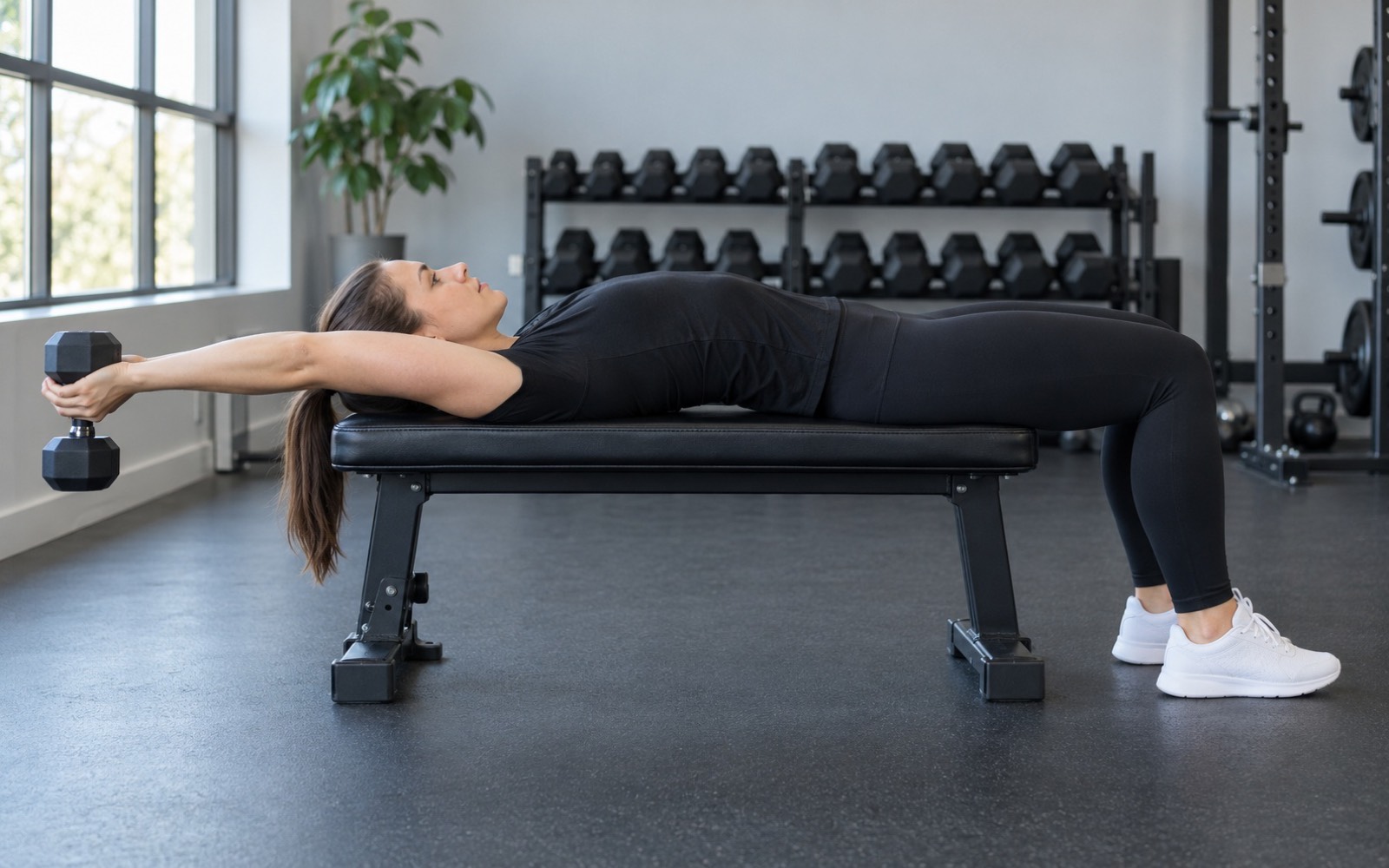
A pullover is loaded shoulder extension from an arms-behind-your-head position, lying on a bench or the floor. You lie on your back, dumbbell above your chest, arms nearly straight. You lower the dumbbell in an arc behind your head until your chest and armpits stretch, then bring it back over your chest along the same arc. Your elbows are slightly bent, and that angle doesn't change from the first rep to the last. One joint works, the shoulder, and that's the key difference from a press: in a press, your elbows bend and straighten; in a pullover, they only hold an angle.
The name describes the motion: you pull the dumbbell over your head and back to your chest. In the gym you'll hear it called the dumbbell pullover, the lying pullover, or just "pullovers".
The exercise is old. It was a staple of gyms in the first half of the 20th century. Back then lifters did it right after high-rep squats, while still gasping for breath, believing that stretched ribs would "expand the rib cage". That's where the second name, the "breathing pullover", comes from. We sort out what's true in that story in section 08. For now, the main point: the pullover has stayed in programs because it stretches your chest and triceps under load and works them from a position that other exercises never reach.
Muscles worked in the dumbbell pullover: chest vs. lats by the numbers
The main muscle in a dumbbell pullover is the pectoralis major, specifically its sternal portion; the long head of the triceps is second, and the lats work noticeably less than either of those two. That's what separates the measurements from the familiar "pullovers work chest and back equally".
| Muscle | What it does in the pullover | Where you feel it |
|---|---|---|
| Pectoralis major, sternal portion | pulls the upper arm forward and down from overhead, toward your stomach; the prime mover | a stretch across the whole lower chest, a squeeze in the middle at the top |
| Pectoralis major, clavicular portion | helps at the start of the lift, while your arms are still behind your head | upper chest, near the collarbones |
| Long head of the triceps | attaches at the shoulder blade and pulls the upper arm back; also holds the elbow angle | back of the upper arm, almost to the armpit |
| Latissimus dorsi and teres major | extend and adduct the upper arm; strongly stretched at the bottom | tension under the armpits and down the sides of the lower back |
| Rear deltoid | assists shoulder extension | back of the shoulder joint |
| Serratus anterior | keeps the shoulder blade pressed against the ribs | under the armpit, along the side of the ribs |
| Rectus abdominis | stops your ribs from flaring as the dumbbell goes behind your head | the abs, on heavy reps |
| Forearm and hand muscles | hold the dumbbell by its top plate | palms, thumbs |
What EMG shows. Electromyography (EMG) records the electrical activity of a muscle and shows what share of its maximum it's giving in a movement. In 2018, Borges and colleagues measured four exercises in 13 men with about two years of training, at a 10-rep load. In the lifting phase of the pullover, the pectoralis major worked at 50.8% of max, the long head of the triceps at 34.3%, and the latissimus dorsi at 22.7%. The lowering phase was lower: 27.5%, 20.5% and 8.4%. For comparison, the lats hit 59.5% in the lat pulldown, the chest 67.9% in the bench press, and the triceps 67.7% in the lying triceps extension. The authors put it plainly: the pullover is more effective for the chest than for the lats.
One of the first studies. In 2011, Marchetti and Uchida were among the first to measure the pullover: 8 men did it with a barbell loaded to 30% of body weight for 10 reps. The chest worked harder than the lats in both the lowering and the lifting phase. The authors explained this with leverage: at the bottom, the weight pulls the upper arm back, so the muscles that pull it forward and down are loaded the most.
Specifically with a dumbbell. Almost every pullover measurement has been done with a barbell. The dumbbell version was measured by Lacio and colleagues: in their 2021 study, 13 men with at least a year of training did dumbbell pullovers at 90% of their 10-rep load. With straight elbows, the sternal portion of the chest worked at 48.4%, the clavicular portion at 39.6%, and the triceps at 54.2% of max. The triceps was significantly more active than the clavicular portion, and the sternal portion was significantly more active than the clavicular one. So if the back of your upper arm is burning after pullovers, your form is fine: the long head of the triceps works seriously hard in this exercise. Why it pulls on the shoulder and how it grows in an overhead position is covered in our guide to skull crushers.
A recent review. In 2026, Di Fonza and colleagues pooled 23 studies on lat activity in strength exercises. Three of those papers covered the pullover, roughly 43 participants in total, and the overall conclusion is the same: the pullover primarily activates the pectoralis major and loads the lats noticeably less; their share depends heavily on the shoulder angle. The authors call the pullover a two-muscle exercise, and for anyone who needs the lats specifically, they point to the lat pulldown to the chest and other rows.
Why, if the lats extend the shoulder too. Gerling and Brown studied the architecture of the latissimus dorsi in 12 cadaver specimens in 2013. It's a muscle with long fascicles, 26.4 cm (10.4 in) on average, and a small cross-sectional area, 5.6 cm². It's built for moderate force over a large range of motion, and in shoulder flexion, by the authors' calculations, it operates on the plateau and the descending limb of its length–tension curve, that is, at the edge of its comfortable length. The sternal portion of the pectoralis major extends the shoulder from that same position too, and it's more comfortable there. That's how we explain the chest's lead in the measurements; Gerling's study didn't measure the pullover itself, this is a conclusion drawn from its data.
What this means for you: if you do pullovers "for back", you get a chest and triceps exercise with a small bonus for the lats. Nothing wrong with that, as long as you know which muscle is taking most of the load.
Pullover for chest or for back: how to shift the emphasis
You shift the emphasis with your elbow position and your choice of equipment, but you can't fully turn a lying dumbbell pullover into a back exercise: lying down, it stays a chest and triceps movement, and for the lats, the same pullover done standing at a cable works better.
Straight elbows vs. bent. In Lacio's 2021 study, straight and bent elbows showed no statistical difference for the chest: sternal portion 48.4% vs. 44.0%, clavicular portion 39.6% vs. 40.9%, triceps 54.2% vs. 56.1%. So "bend your elbows for chest, straighten them for back" is more of a gym legend than a fact. The only thing bending gives you is a shorter lever, which lets you lift more.
How much more. Washif and colleagues tested four barbell pullover variations in 7 national-level javelin throwers in 2024. The "regular" version there had slightly bent elbows, like in our form. The one-rep max in it was 30 kg (66 lb), or 0.40 of body weight; with straight arms 37 kg (81.5 lb); with elbows bent to roughly 45°, 44 kg (97 lb), 46% more than regular and 18% more than straight. At 85% of max, the lats worked at 29% in the regular version, 52% with straight arms, and 46% with bent, but with 7 participants that difference didn't reach statistical significance. You can't write "straight arms engage the back" based on these data: it's only a trend, the authors say so themselves, and they found no significant differences between variations.
Lying vs. standing at a cable. Muyor and colleagues in 2022 compared the lying barbell pullover with the standing straight-arm cable pulldown in 20 healthy active adults, at 30% of body weight for 8 reps. The pullover loaded the chest harder, especially its sternal and lower portions, plus the front deltoid and the abs. The lats and triceps worked harder at the cable. In both exercises, the lifting phase was more active than the lowering phase.
So here's the simple rule. Want chest and triceps? Do the lying dumbbell pullover. Want lats? Do the straight-arm pullover standing at a cable, or add a pulldown to the chest. We covered that form in our guide to the lat pulldown, and the cable pullover is in its Q&A section.
How to do a dumbbell pullover lying along a bench: step by step
Lie lengthwise on a bench, lift the dumbbell above your chest, bend your elbows slightly, lower it behind your head over 2–3 seconds until your chest is fully stretched, keep your ribs down, and bring the dumbbell back over your chest. Step by step:
- The dumbbell. Stand it on end on your thigh, lie back, and lift it above your chest with both hands. Use a diamond grip: both palms under the top plate, thumbs and index fingers locked around the handle. Don't hold the handle with one hand like a suitcase: it tilts your wrist and loads your biceps.
- Position on the bench. You lie lengthwise, the back of your head on the bench, not hanging off the end. Lower back on the bench, ribs down, shoulder blades pulled down. Feet flat on the floor, hip-width apart.
- Starting point. Dumbbell above the middle of your chest, arms nearly straight, elbows bent 10–20°. That's a soft elbow, like someone holding a big box in front of them.
- Lowering. Guide the dumbbell in an arc behind your head over 2–3 seconds. The elbow angle doesn't change; your shoulders rotate in the joint. Picture drawing a half-circle with the dumbbell from your chest to the wall behind your head.
- The bottom. Stop where your chest and armpits are strongly stretched while your ribs are still down. For most people, the upper arm is roughly level with the bench or slightly below at that point. How to find your own depth is in section 06.
- Lifting. Bring the dumbbell back over your chest along the same arc in 1–2 seconds. Pull with your chest: the cue "bring your elbows toward your ribs" helps you feel exactly that.
- The top. The dumbbell finishes above your chest. If you take it further, toward your face, the load disappears: the weight sits over the joint, and the muscles rest.
- Tempo. 2–3 seconds down, 1–2 up. The 2009 American College of Sports Medicine (ACSM) position stand recommends a slow-to-moderate tempo for beginners, with moderate meaning 1–2 seconds per phase. In the pullover, it's worth stretching the lowering a bit: the chest is loaded the most in the stretched position, and there's no reason to rush through it.
- End of the set. Bring the dumbbell back to your chest, set it on your thigh, and sit up. Don't drop it behind your head onto the floor: it lands on someone's feet.
Breathing. Inhale on the way down, exhale on the way up. With a light pullover there's no need to hold your breath. According to Hackett and Chow's 2013 review, breath-holding becomes unavoidable only at loads above 80% of max or when training to failure. A 10–12-rep pullover with reps in reserve is neither, so breathe steadily. The "breathing" pullover and its promises are in section 08.
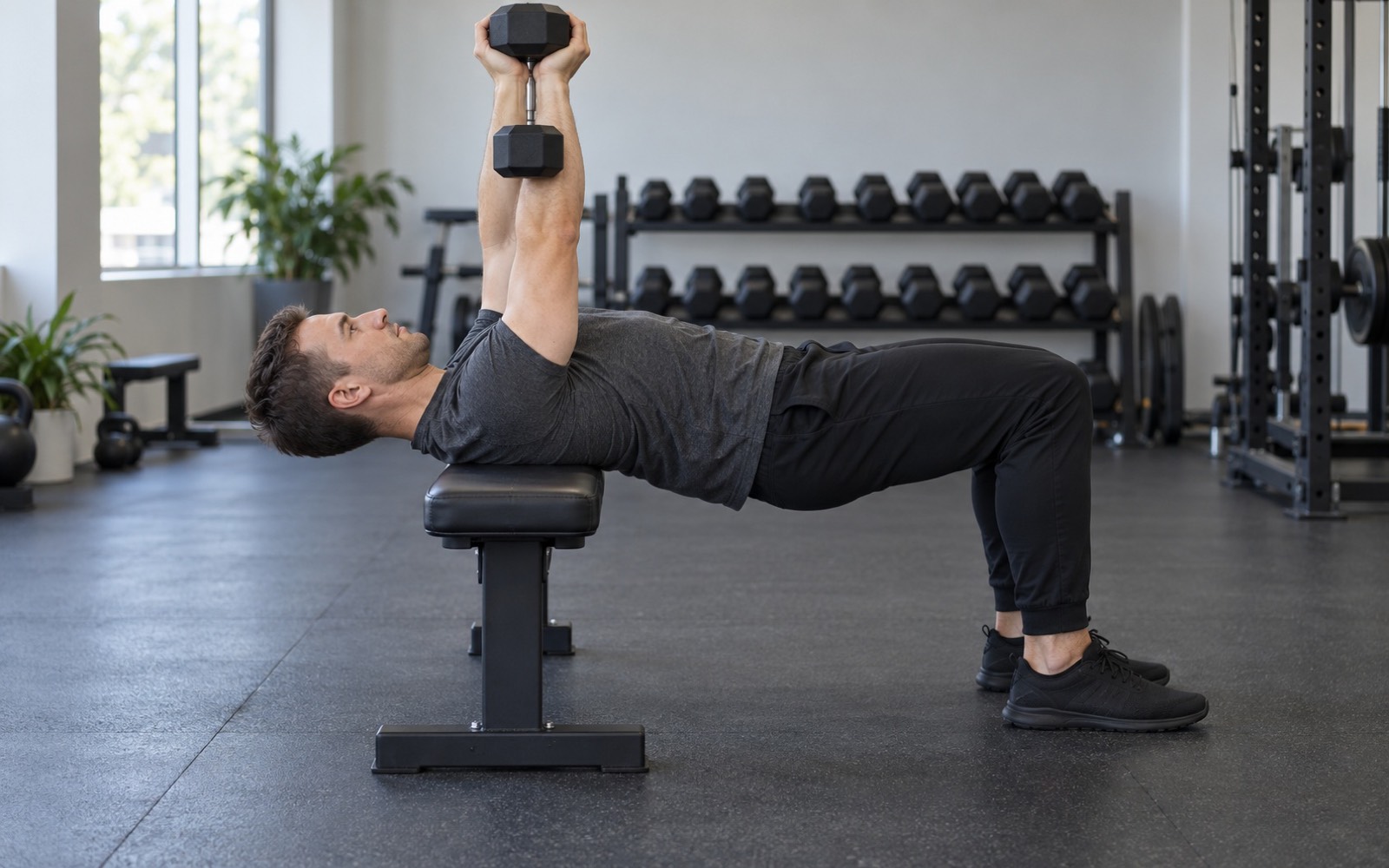
Across the bench. The second classic version: only your upper back and shoulder blades rest on the bench, your hips are slightly below your shoulders, feet flat on the floor, knees bent. The range of motion gets a bit longer because your torso "hinges" at the lower back and the dumbbell goes lower. That's both a plus and a minus: your hips pull your lower back into an arch, and keeping your ribs down gets harder. In your first weeks, keep your hips no lower than bench level and brace your abs for the whole set. The back of your head always hangs free in this version, so watch that your head doesn't tip back: that's exactly what tires out your neck. We recommend beginners start with the lengthwise version and try the cross-bench one after about six weeks, once your lengthwise depth stops improving.
a depth test with a light 2 kg (4.5 lb) dumbbell. Stand sideways to a mirror or film yourself on your phone, lie down and slowly lower the dumbbell until your ribs start to rise and your lower back begins to lift off the bench. That's your working depth for today. With your working weight, stop 5 cm (2 in) above it. Repeat the test in a month or two: depth usually improves.
Pullover on the floor, with a kettlebell, two dumbbells, a barbell, or at a cable
The form is the same in every version, shoulder extension with nearly straight arms; what changes is the equipment and what limits the range of motion. Here's the comparison in one table:
| Version | Range of motion | Lower back | Shoulders | What works harder | Who it's for |
|---|---|---|---|---|---|
| Lengthwise on a bench with a dumbbell (the base) | full, the dumbbell goes below head level | back stays on the bench, the arch is easy to control | load increases at the bottom | chest, triceps | beginners, the first month |
| Across the bench, hips below shoulders | slightly longer, the torso "hinges" | hips pull into an arch, needs core control | same as lengthwise | chest, a stronger stretch | experienced lifters, once lengthwise feels limited |
| On the floor | limited by the floor: the dumbbell or your elbows touch down | minimal, the floor won't let you arch | minimal: the floor itself limits depth | chest, triceps | home, past shoulder pain, the first weeks |
| Standing at a cable with straight arms | full | standing, torso in a slight lean | different: the arm moves from in front, not from behind the head | lats harder than in the lying pullover (Muyor, 2022) | when the goal is back |
| With elbows bent to 45° or more | shorter | same as lengthwise | shorter lever, you can lift more | triceps and chest; at about 45° the max is 46% higher than regular (Washif, 2024) | when you want to progress the weight |
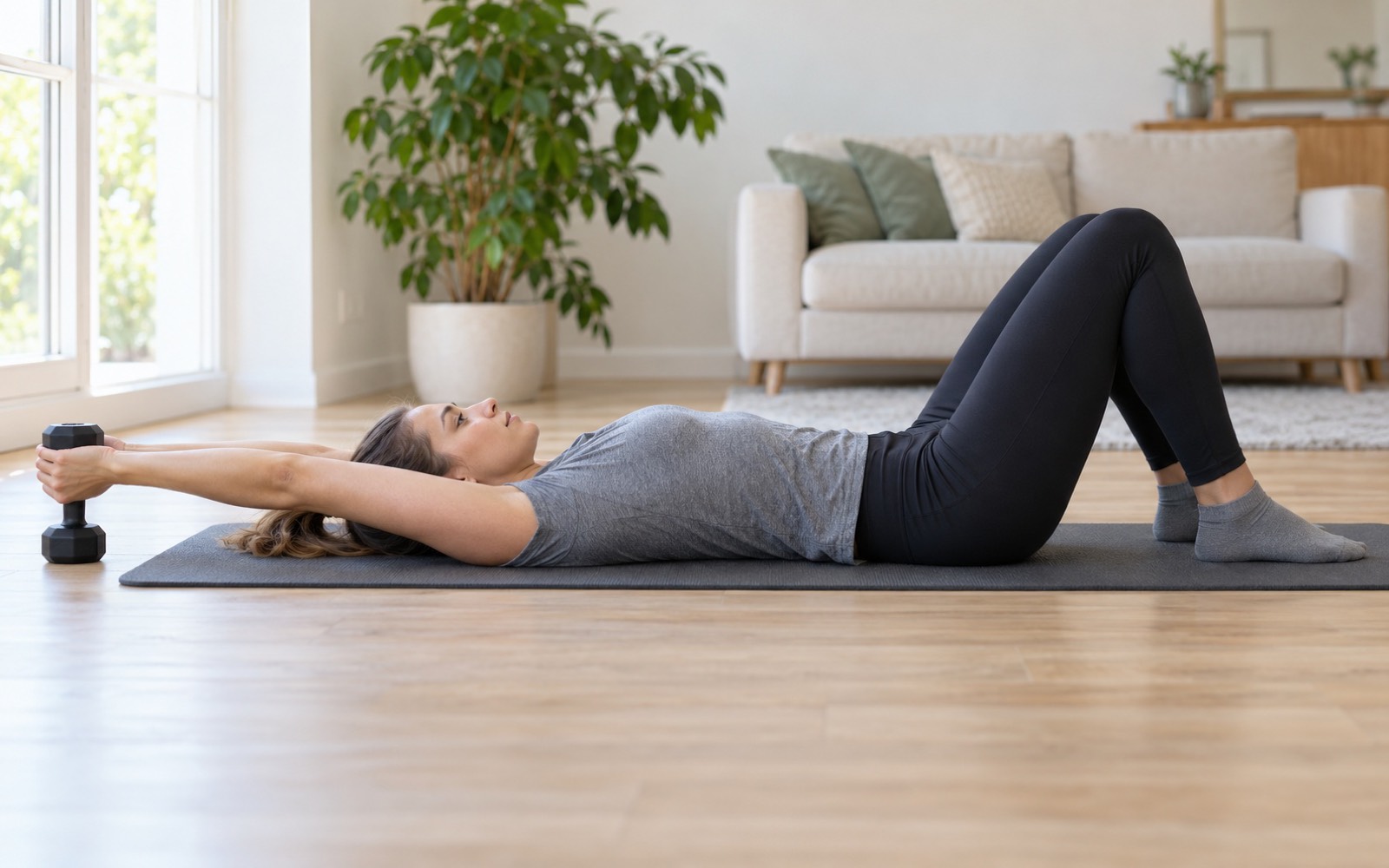
On the floor. Lie on a mat, bend your knees, feet flat on the floor, lower back pressed down. Dumbbell above your chest, lower it behind your head until the plate touches the floor. The range is shorter than on a bench, but the floor protects both your lower back and your shoulders: it won't let you arch, and you can't overstretch the shoulder. This is the best version for home, for the first two or three weeks, and for anyone whose shoulder has hurt in the past. No dumbbell? A 1.5-liter (50 oz) water bottle weighs about 1.5 kg (3.3 lb), and two bottles in a sturdy bag give you about 3 kg (6.6 lb). A full home routine with dumbbells, where the pullover goes second or third for the chest, is in our dumbbell workout at home.
With a kettlebell. Hold it by the handle with both hands, the bell pointing down toward your face. The grip is more comfortable than a heavy dumbbell, the center of mass sits lower, and the kettlebell naturally wants to travel in an arc. A weight guide: 8–12 kg (18–26 lb) for women, 12–16 kg (26–35 lb) for men, once you've mastered the 7 and 14 kg (15.5 and 31 lb) dumbbells from the plan in section 07.
With two dumbbells. Palms face each other, elbows closer to your body. This version helps when a single heavy dumbbell no longer fits a diamond grip. Keep the dumbbells parallel and don't let them drift apart at the bottom: if they drift, your elbows have flared, and the load has moved from your chest to your shoulder joints.
One arm. Dumbbell in one hand, the other hand on your ribs to feel whether they're flaring. Use half the weight you'd use with two hands. Useful when one side is noticeably weaker.
With a barbell. Narrow grip, 20–30 cm (8–12 in) between your hands, a straight bar or an EZ bar. A barbell is easier to hold at heavier weights, and it's what most of the research used. The range is slightly shorter: the bar hits your forearms sooner than a dumbbell does.
Standing at a cable. This is the "standing pullover" people search for, also known as the "cable pullover". Face the high pulley, torso in a slight lean, arms nearly straight, and pull the bar or rope from head height down to your thighs. Per Muyor's 2022 study, the lats and triceps work harder here than in the lying pullover, and the chest works less. In the Sportygram app's workout diary (go.sportygram.com; the interface and the coach are in Russian), the dumbbell pullover is listed with form photos, with separate sets shot for men and for women.
On a decline bench. Head down on a bench set to 15–30°, the dumbbell goes lower and the chest stretch is stronger. This one is for experienced lifters, with less weight than on a flat bench: blood rushes to your head, and you need to get up slowly after the set.
How far to lower the dumbbell and how much to bend your elbows
Lower the dumbbell until your chest and armpits are fully stretched, while your ribs stay down and your lower back doesn't lift, and keep your elbows bent at 10–20° without changing the angle. Here's where those guidelines come from.
Normal shoulder mobility. Gill and colleagues measured shoulder range of motion in 2,404 people aged 20 to 91 with no shoulder pain in 2020. Active flexion, that is, raising a straight arm forward and up, averaged 161.5° in men and 158.5° in women, and it decreased with age. "Upper arm level with the bench" in a pullover is about 180°. So far from everyone can reach parallel with the floor, and form has nothing to do with it. Your depth is where your shoulder runs out of mobility while your ribs are still down. Don't try to "push" lower by arching your lower back: that stretches your spine, and your chest gets nothing out of it.
Why depth matters more than weight. The pullover holds your chest and triceps in a stretched position under load, and that's the whole point. Maeo and colleagues trained 21 people for 12 weeks in 2023: one arm did cable elbow extensions overhead, the other alongside the body, 5 sets of 10 twice a week at 70% of max. The long head of the triceps grew 28.5% overhead vs. 19.6% alongside the body, and the whole triceps 19.9% vs. 13.9%. And the overhead weight was 34–39% lighter. The stretched position gave more growth with less weight.
Wolf's 2023 meta-analysis on range of motion showed something similar. Full range vs. partial gave a standardized difference of 0.12 in favor of full, which is trivial. But partial range specifically in the stretched position gave a difference of −0.28 in its favor for muscle growth, though with a wide confidence interval. What this means for the pullover: the bottom half of the movement, where the chest is stretched, is worth more than the top half. An extra 2 kg (4.5 lb) isn't worth losing 10 cm (4 in) of depth.
How to bend your elbows. The 10–20° angle doesn't change for the whole set. Fully locked elbows shift the load onto the elbow ligaments and the biceps: with a straight arm, the biceps is what keeps the joint from hyperextending. Heavily bent elbows, up to 90°, shorten the lever and let you lift more, but part of the work goes to the triceps, and the movement starts to look like a skull crusher. Per Lacio's 2021 study, there's no difference for the chest between straight and slightly bent elbows, so keep a soft angle and think about your chest.
Depth by feel. Three cues from your body:
| What you feel at the bottom | What it means | What to do |
|---|---|---|
| A stretch across the chest and under the armpits, tolerable | normal, that's your working depth | hold it, lower without jerking |
| Ribs rising, lower back lifting off the bench | too deep for your mobility | stop 5–10 cm (2–4 in) higher, press your ribs down |
| A sharp feeling at the front of the shoulder | the shoulder hit its limit or the elbows flared | stop 10–15 cm (4–6 in) higher, bring your elbows closer, use less weight |
How much weight to use and how many reps: an 8-week plan for women and men
Women should start with a 4 kg (9 lb) dumbbell, men with 8 kg (17.5 lb), 3 sets of 10 twice a week, adding reps up to 12 first, then weight. The pullover is a long-lever exercise, and even 4 kg (9 lb) held on outstretched arms behind your head feels much heavier than the same 4 kg at your chest.
The progression rule comes from the 2009 ACSM position stand: a beginner uses a weight for 8–12 reps, and once you can do 1–2 reps more than you need, you increase the weight by 2–10%. Dumbbells have the same catch as any light-weight exercise: the step between neighboring dumbbells is 1–2 kg (2–4 lb), which is an immediate +17–25%. That's why after every new dumbbell, reps drop back to 10 and climb to 12 again.
Eight weeks of pullovers, in numbers. Two sessions a week, 3 working sets each, one dumbbell held with both hands. Volume is the amount of work per session: sets × reps × dumbbell weight. For example, 3 × 10 × 4 kg = 120 kg (265 lb).
| Week | Women | Volume | Men | Volume | What changed |
|---|---|---|---|---|---|
| 1 | 4 kg (9 lb), 3 × 10 | 120 kg (265 lb) | 8 kg (17.5 lb), 3 × 10 | 240 kg (530 lb) | starting point; the first two sessions are for finding your depth with the test |
| 2 | 4 kg, 3 × 12 | 144 kg (320 lb) | 8 kg, 3 × 12 | 288 kg (635 lb) | +2 reps per set |
| 3 | 5 kg (11 lb), 3 × 10 | 150 kg (330 lb) | 10 kg (22 lb), 3 × 10 | 300 kg (660 lb) | weight +25% |
| 4 | 5 kg, 3 × 12 | 180 kg (395 lb) | 10 kg, 3 × 12 | 360 kg (795 lb) | +2 reps |
| 5 | 6 kg (13 lb), 3 × 10 | 180 kg (395 lb) | 12 kg (26.5 lb), 3 × 10 | 360 kg (795 lb) | weight +20% |
| 6 | 6 kg, 3 × 12 | 216 kg (475 lb) | 12 kg, 3 × 12 | 432 kg (950 lb) | +2 reps |
| 7 | 7 kg (15.5 lb), 3 × 10 | 210 kg (465 lb) | 14 kg (31 lb), 3 × 10 | 420 kg (925 lb) | weight +17% |
| 8 | 7 kg, 3 × 12 | 252 kg (555 lb) | 14 kg, 3 × 12 | 504 kg (1,110 lb) | +2 reps |
Over 8 weeks, volume grows by 110% for both women and men: from 120 to 252 kg (265 to 555 lb) and from 240 to 504 kg (530 to 1,110 lb). In the weeks where the dumbbell changes, volume barely moves because there are fewer reps. That's by design: the following week it climbs again through added reps.
Where these weights come from. In Washif's 2024 study, the javelin throwers' max in the regular pullover was 30 kg (66 lb), or 0.40 of body weight, and in the EMG studies by Marchetti in 2011 and Muyor in 2022, trained people worked at 30% of body weight for 8–10 reps. For a beginner, 4 and 8 kg (9 and 17.5 lb) is roughly 6–10% of body weight, and that's the right start: in the pullover, extra weight lands straight on a shoulder that sits at its end range at the bottom. Weight goes up only when all 12 reps come out with no lower-back arch and no pain at the front of the shoulder. If your gym has no 7 kg (15.5 lb) dumbbell, stay at 6 kg (13 lb) for another week or two. At home, a 1.5-liter (50 oz) bottle is about 1.5 kg (3.3 lb), two bottles in a bag about 3 kg (6.6 lb), and after that you'll need an adjustable dumbbell.
Can you do 12–15 reps? Yes. In Schoenfeld's 2017 meta-analysis of 21 studies, muscles grew the same on light and heavy loads as long as sets were taken to failure; heavy loads only won on maximal strength. For the pullover, where a heavy weight is risky for the shoulder, 12–15 reps with a lighter dumbbell is a working option.
How many sets a week. The 2026 ACSM position stand, built from 137 systematic reviews and more than 30,000 participants, calls for 10 or more sets per muscle per week for muscle growth, and sets don't have to go to failure, 2–3 reps in reserve is enough. Six sets of pullovers a week plus 4–6 sets of presses or flyes gets your chest exactly to that number. Rest between sets is 1–2 minutes, as ACSM recommended in 2009 for muscle growth.
Where it goes in your workout. The pullover is the second or third chest exercise, after a press. There's no point putting it first: the weight is small, and after pullovers your shoulder is stretched and pressing a heavy bar is less comfortable. "Dumbbell bench press → pullover" or "press → fly" work equally well; you can do both the fly and the pullover on the same day, but that's 6 sets of chest stretching in a row, and in your first months it's better to pick one.
"Rib cage expansion": what's myth about the pullover and what isn't
There are no controlled studies showing that the pullover increases the size of an adult's rib cage; what it actually does is stretch the chest and lats, teach you to extend the shoulder under load, and keep the thoracic spine mobile.
Where the myth comes from. Gyms in the first half of the last century loved a particular combination: 20-rep squats with breath-holds between reps, followed immediately by a light 20-rep pullover while you're still out of breath and your chest is heaving. Hence the name "breathing pullover". The belief was that ribs and cartilage stretched on a deep inhale would "stay" stretched, and the rib cage would get wider over time. The combination is still passed from book to book today.
What's known. Ribs are bone and cartilage. In an adult, training doesn't change their shape or length: the bony skeleton finishes growing around age 20–25. When your chest "got wider" after months of pullovers, the muscles did that, the pectoralis major and the serratus anterior, along with your posture: stretched pecs stop pulling your shoulders forward. We couldn't find any studies that tested "expansion" and confirmed it; none that disproved it either. From the fact that ribs and cartilage don't grow in adults, the conclusion is simple: don't expect a new rib cage from pullovers.
What the pullover definitely does. It loads the chest in a strongly stretched position, and per Maeo in 2023 and Wolf in 2023, that kind of load grows muscle well. It trains the shoulder in full flexion with weight, which presses and flyes don't do. It forces you to keep your ribs down under load, which teaches your abs to work isometrically. All of that is useful without any "expansion".
As for lung volume and "better breathing", we won't promise anything: that's a doctor's territory and a matter of measurements, which don't exist for the pullover.
Mistakes: where you feel it → what to fix
A correct pullover feels like a stretch across your chest and under your armpits at the bottom and a chest squeeze at the top; if your shoulders, lower back, or biceps tire first, the form has drifted:
| Where you feel it | What's wrong | The fix |
|---|---|---|
| Front of the shoulder, sharp, at the bottom | you're going deeper than your mobility allows, or your elbows are flared out | stop 10–15 cm (4–6 in) higher, bring your elbows closer, do the 2 kg (4.5 lb) test |
| Lower back | your ribs are flaring after the dumbbell, or your hips have dropped below the bench in the cross-bench version | press your ribs down, brace your abs, hips no lower than the bench; switch to the lengthwise or floor version for a while |
| Inside of the elbows | your arms are fully locked | bend them 10–20° and hold the angle |
| Triceps burning, chest silent | elbows bent too much, weight too heavy, the movement has turned into a press | straighten your elbows to 10–20°, less weight, think "pull with the chest" |
| Biceps | you're holding the handle with one hand, palms not under the plate | both palms under the top plate, thumbs locked |
| Neck | the back of your head hangs off the bench, head tipped back | back of the head on the bench, eyes on the ceiling; across the bench, chin slightly tucked |
| Nothing at all | the dumbbell drifts toward your face, the range is short, the weight is too light | finish above your chest; lower deeper while your ribs stay down; add reps |
| Hands and wrists | the dumbbell is held by its "neck" with one hand, the other on top | both palms under the plate, wrists not bent back |
| Dizziness after a set | you held your breath and sat up fast | breathe steadily: inhale down, exhale up; get up slowly |
The two main mistakes. The first is arching the lower back. When the dumbbell goes behind your head, your body looks for somewhere else to find range, and it finds the lower back: your ribs rise, and your back arches into a bridge. From the outside it looks like a "really deep pullover", but by that point your chest is already stretched to its limit and what's stretching is your spine. The cure is braced abs and ribs on the bench, even if that means less depth. The second is flared elbows. With your elbows out, the dumbbell goes behind your head more easily, but at the bottom the shoulder rotates outward under load, and the stress lands on the front of the joint. Keep your elbows shoulder-width or slightly narrower, pointing up at the ceiling.
Sharp shoulder pain with a click, pain that shoots down your arm, or numb fingers is a reason to end the set immediately. When to see a doctor about that is in the next section.
Who should be careful with the pullover, and when to see a doctor
A healthy person can do dumbbell pullovers at any age, but with shoulder instability, a recent dislocation, pain when raising your arm overhead, or noticeable hypermobility, see a doctor first, then use the floor or cable version.
Why the shoulder. Kolber and colleagues wrote in a 2010 review that up to 36% of injuries and complaints in people who strength train involve the shoulder. The main risk factors in that review are muscle imbalances around the joint and form errors. The pullover adds its own: at the bottom, the shoulder is in nearly full flexion with weight in your hands, and a mistake in depth hits the joint directly. No need to fear the exercise because of that, just keep your depth within your mobility and don't chase the weight.
Who should be careful:
- Shoulder instability, a past dislocation or subluxation. The end-range overhead position with weight loads exactly the structures that hold the joint together. Don't do pullovers without a doctor's clearance; with clearance, do them on the floor, where the floor limits the depth.
- Pain when raising your arm overhead, clicking, night pain on that side. These are the signs doctors check for impingement, where tendons get pinched under the acromion. Hold off on pullovers until you've been examined.
- Hypermobility. If your elbows and shoulders hyperextend "naturally", it's easy to go deeper in a pullover than your muscles can hold. Stop before you feel the limit, and keep your elbows bent at 20°.
- Pregnancy. Discuss the exercise with the doctor managing your pregnancy. Usually the floor version stays, or a very light dumbbell with no depth.
- After 40 and after 60. Strength training is safe for healthy adults of any age: the 2026 ACSM position stand cites an analysis of more than 38,000 people, over 6,700 of them in strength training, where exercise didn't raise the risk of serious adverse events. Shoulder mobility decreases with age, as Gill's 2020 data shows, so a 60-year-old's depth is shorter than a 25-year-old's, and that's normal. Start on the floor or with a light dumbbell lengthwise on the bench.
- High blood pressure and heart disease. Agree on your program with a doctor; breathe steadily and don't take sets to failure.
See a doctor if shoulder pain came on suddenly, with a click, in the middle of a set; if the shoulder hurts at night or keeps you from raising your arm; if your arm has gotten weaker when lifting; if the pain hasn't eased after 2–3 days of rest or your fingers go numb. How to tell ordinary post-workout muscle soreness from a joint problem, and what to do in the first days, is in our guide to shoulder pain from lifting.
What to replace the pullover with, and what to pair it with
For chest, replace the pullover with dumbbell flyes and dumbbell presses; for lats, with the straight-arm cable pulldown and the lat pulldown to the chest; for triceps, with skull crushers. The choice depends on which muscle you were doing pullovers for:
| Goal | Replacement | Why |
|---|---|---|
| Chest, the stretch at the bottom | dumbbell flyes | the same stretched chest position, only your arms go out to the sides; easier to keep your lower back down, the shoulder doesn't go behind your head |
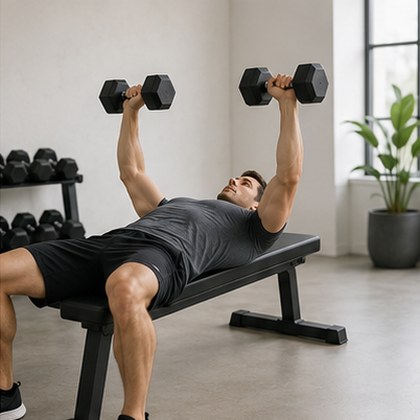
| Chest, weight and strength | dumbbell bench press | in Borges's 2018 study, the chest worked at 67.9% in the press vs. 50.8% in the pullover; the pullover complements a press and can't replace it |
| Lats | straight-arm pullover standing at a cable, lat pulldown to the chest | lats 59.5% in the pulldown vs. 22.7% in the pullover (Borges, 2018); standing at a cable, the lats work harder than in the lying pullover (Muyor, 2022) |
| Long head of the triceps | overhead skull crushers, overhead cable extensions | the long head grows more overhead: +28.5% vs. +19.6% (Maeo, 2023) |
| Home with no bench | floor pullover, floor flyes | the floor limits the range and protects your lower back |
What to pair it with. The classic pairing is the dumbbell bench press, then pullovers or flyes. The press gives your chest weight, the pullover gives it a stretch and works the triceps; pick one of the two isolation exercises, otherwise in your first months your chest and shoulders get too much stretching in one session. On back day, you can slot in the dumbbell pullover as a light "finisher" for the lats, but remember the numbers from section 02: most of the work still goes to your chest. For back, the cable pullover is more useful.
In the Sportygram workout diary, you can ask the virtual coach, Alex, in chat to add dumbbell pullovers to Wednesday's workout. He shows a confirmation card, and once you confirm, the exercise appears in that day's workout with its form photos. You log your weight and reps in the diary, and the weight history shows when it's time for the next dumbbell.
 Dumbbell bench press
Questions and answers
Is the dumbbell pullover a chest or a back exercise?
Chest and triceps first. In Borges's 2018 measurements, the chest worked at 50.8% of max in the pullover, the triceps at 34.3%, and the lats at 22.7%. If your goal is back, do the straight-arm pullover standing at a cable: per Muyor's 2022 study, the lats are more active there than in the lying pullover.
How do you do a pullover across the bench, and how is it different from the lengthwise version?
Across the bench, only your upper back and shoulder blades rest on it, your hips are slightly lower, feet flat on the floor. The range is longer because your torso hinges at the lower back, and that's exactly why your lower back is at risk: keep your hips no lower than bench level and brace your abs. We recommend beginners start lengthwise and try the cross-bench version after six weeks.
Can you do a dumbbell pullover on the floor at home?
Yes. Knees bent, lower back pressed down, lower the dumbbell behind your head until it touches the floor. The floor limits the range, which protects your shoulders and back, so it's a convenient place to start. Without a dumbbell, a 1.5-liter (50 oz) water bottle, two bottles in a bag, or a kettlebell will do.
How much weight should a woman or a man use for pullovers?
4 kg (9 lb) for women, 8 kg (17.5 lb) for men, 3 sets of 10. Following our plan, by week 8 that's 7 and 14 kg (15.5 and 31 lb) for 3 × 12. The ceiling to keep in mind is about 30% of body weight for 8–10 reps in trained people, from the studies by Marchetti in 2011 and Muyor in 2022. Add weight only when all 12 reps come out with no lower-back arch and no shoulder pain.
How many sets and reps should you do, and where does the pullover go in a workout?
3 sets of 10–12 reps twice a week, with 2–3 reps in reserve, as the second or third exercise after a press. 12–15 reps work too: per Schoenfeld's 2017 meta-analysis, muscles grow the same on light and heavy loads if the set is taken close to failure.
Does the dumbbell pullover really expand your rib cage?
There are no studies confirming it. Ribs and cartilage don't grow in adults from training. Your chest looks wider after pullovers because of bigger chest muscles and better posture: stretched pecs stop pulling your shoulders forward.
Why does my shoulder hurt after pullovers, and what should I do?
Most often the depth is greater than your shoulder mobility allows, or your elbows have flared out, or the weight is too heavy. Stop 10–15 cm (4–6 in) higher, bring your elbows in, do the depth test with 2 kg (4.5 lb), and switch to the floor or cable version for a while. If the pain is sharp, with a click, at night, with numb fingers, or doesn't go away in 2–3 days, see a doctor.
What is a good alternative to the dumbbell pullover?
For chest, dumbbell flyes or the dumbbell bench press. For lats, the straight-arm cable pulldown and the lat pulldown to the chest: in Borges's 2018 study, the lats worked at 59.5% in the pulldown vs. 22.7% in the pullover. For triceps, overhead skull crushers.
The bottom line
- A dumbbell pullover is lying shoulder extension: dumbbell above your chest, elbows bent 10–20°, lower it behind your head until your chest stretches while your ribs stay down, bring it back over your chest.
- The main muscle is the chest, second is the long head of the triceps, and the lats come third: 50.8%, 34.3% and 22.7% of max in Borges's 2018 study. For back, the standing cable pullover is stronger (Muyor, 2022).
- Elbow position changes nothing for the chest (Lacio, 2021); bent elbows only let you lift 46% more (Washif, 2024).
- Depth is to the stretch while your ribs stay down; normal shoulder flexion is 161.5° in men and 158.5° in women (Gill, 2020), so not everyone reaches parallel, and that's fine. The stretched position grows muscle better than extra weight (Maeo, 2023; Wolf, 2023).
- Start with 4 kg (9 lb) for women and 8 kg (17.5 lb) for men, 3 × 10 twice a week; reps up to 12 first, then a dumbbell 1–2 kg (2–4 lb) heavier. Volume grows 110% over 8 weeks.
- "Rib cage expansion" has no research behind it: muscles and posture change, an adult's ribs don't.
- Pain at the front of the shoulder: stop higher and bring your elbows in; pain with a click, night pain, arm weakness, or numbness: see a doctor.
Checklist: before a set of dumbbell pullovers
- Back of the head on the bench, eyes on the ceiling; across the bench, chin slightly tucked.
- Both palms under the top plate, thumbs locked.
- Elbows bent 10–20°, pointing up, angle doesn't change.
- Ribs down, abs braced, lower back on the bench; across the bench, hips no lower than the bench.
- Depth from the 2 kg (4.5 lb) test, 5 cm (2 in) higher with your working weight.
- Tempo 2–3 seconds down, 1–2 up, the dumbbell finishes above your chest.
- Steady breathing: inhale down, exhale up.
- The weight leaves 2–3 reps in reserve, and the set is logged in your diary.
Sources
- Borges E., Mezêncio B., Pinho J., Soncin R., Barbosa J., Araujo F., Gianolla F., Amadio C., Serrão J. Resistance training acute session: pectoralis major, latissimus dorsi and triceps brachii electromyographic activity. Journal of Physical Education and Sport, 2018. — 13 men, 10-rep load, four exercises: in the lifting phase of the pullover, the chest worked at 50.8%, the long head of the triceps at 34.3%, the lats at 22.7% of max; in the lowering phase 27.5 / 20.5 / 8.4%; the lats hit 59.5% in the lat pulldown, the chest 67.9% in the bench press, the triceps 67.7% in the lying triceps extension; the authors conclude the pullover is more effective for the chest than for the lats.
- Marchetti P.H., Uchida M.C. Effects of the pullover exercise on the pectoralis major and latissimus dorsi muscles as evaluated by EMG. Journal of Applied Biomechanics, 2011. — 8 men, barbell pullover at 30% of body weight, 10 reps: the chest was more active than the lats in both phases of the movement; activation depends on the moment arm of the external load.
- Lacio M.L., Teixeira J.D., Vieira J.G., Santana D., Amorim G.D., Coelho M.A., Campos Y.A.C., Dias M.R., Panza P., Novaes J., Vianna J.M. Electromyographic Activation of Pectoralis Major and Triceps Brachii during Dumbbell Pullover. Journal of Exercise Physiology Online, 2021. — 13 men, dumbbell pullover at 90% of the 10-rep load, straight vs. bent elbows: clavicular portion of the chest 39.6 / 40.9%, sternal portion 48.4 / 44.0%, triceps 54.2 / 56.1%; the triceps was significantly more active than the clavicular portion, and with straight elbows the sternal portion was significantly more active than the clavicular one; no difference between elbow positions.
- Muyor J.M., López-Miñarro P.A., Alacid F. Comparison of Electromyographic Activity during Barbell Pullover and Straight Arm Pulldown Exercises. Applied Sciences, 2022. — 20 healthy active adults, 8 reps at 30% of body weight: the barbell pullover loads the chest harder (especially the sternal and lower portions), the front deltoid and the abs; the lats and triceps work harder in the straight-arm cable pulldown; the lifting phase is more active than the lowering phase in both.
- Washif J.A., Beaven C.M., Hebert-Losier K. Electromyographic signals during pullover exercise variants, and relationships between strength and throwing performance. The Journal of Sport and Exercise Science, 2024. — 7 javelin throwers, 85% of max, four barbell pullover variations: one-rep max in the regular pullover with slightly bent elbows 30 kg (0.40 of body weight), with straight arms 37 kg, with elbows at about 45° 44 kg (+46% over regular, +18% over straight); lats 29 / 52 / 46% with no statistically significant difference, abs 71–107%.
- Di Fonza D., Di Claudio G., Colantuono G., Persichini L., Cerulo N., Sangregorio B., Buonsenso A., Fiorilli G., Calcagno G., di Cagno A. Electromyographic Analysis of Latissimus Dorsi Activation During Common Resistance Training Exercises: A Narrative Review. Journal of Functional Morphology and Kinesiology, 2026. — A review of 23 studies on lat activity; three pullover papers covering roughly 43 people: the pullover primarily activates the pectoralis major and loads the lats noticeably less; relative activity depends on the shoulder angle; the pullover is a two-muscle exercise, and for the lats the lat pulldown to the chest and other rows are more reliable.
- Gerling M.E., Brown S.H.M. Architectural analysis and predicted functional capability of the human latissimus dorsi muscle. Journal of Anatomy, 2013. — 12 cadaver specimens: the latissimus dorsi adducts, extends and internally rotates the shoulder; cross-sectional area 5.6 cm², fascicle length 26.4 cm, that is, a muscle built for moderate force over a large range; in shoulder flexion it operates on the plateau and descending limb of its length–tension curve.
- Maeo S., Wu Y., Huang M., Sakurai H., Kusagawa Y., Sugiyama T., Kanehisa H., Isaka T. Triceps brachii hypertrophy is substantially greater after elbow extension training performed in the overhead versus neutral arm position. European Journal of Sport Science, 2023. — 21 people, 12 weeks, 70% of max, 5 × 10 twice a week: long head of the triceps +28.5% overhead vs. +19.6% alongside the body, whole triceps +19.9% vs. +13.9%, with loads 34–39% lighter.
- Wolf M., Androulakis-Korakakis P., Fisher J., Schoenfeld B., Steele J. Partial vs full range of motion resistance training: A systematic review and meta-analysis. International Journal of Strength and Conditioning, 2023. — Full vs. partial range of motion: SMD 0.12 (−0.02 to 0.26) in favor of full, trivial; partial range in the stretched position: SMD −0.28 (−0.81 to 0.16) in its favor for muscle growth; strength grows in the range you train.
- Gill T.K., Shanahan E.M., Tucker G.R., Buchbinder R., Hill C.L. Shoulder range of movement in the general population: age and gender stratified normative data using a community-based cohort. BMC Musculoskeletal Disorders, 2020. — 2,404 people aged 20–91 with no shoulder pain: active shoulder flexion averaged 161.5° in men and 158.5° in women, decreasing with age.
- Kolber M.J., Beekhuizen K.S., Cheng M.S., Hellman M.A. Shoulder injuries attributed to resistance training: a brief review. Journal of Strength and Conditioning Research, 2010. — Up to 36% of injuries and complaints in people who strength train involve the shoulder; risk factors are muscular and joint imbalances and form errors; most data are retrospective.
- Hackett D.A., Chow C.M. The Valsalva maneuver: its effect on intra-abdominal pressure and safety issues during resistance exercise. Journal of Strength and Conditioning Research, 2013. — Breath-holding is unavoidable at loads above 80% of max or when training to failure; it raises intra-abdominal and blood pressure, and risks for healthy people are not confirmed.
- American College of Sports Medicine. Progression models in resistance training for healthy adults. Medicine & Science in Sports & Exercise, 2009. — Beginners should train at a load allowing 8–12 reps, adding 2–10% once 1–2 extra reps are achievable; a slow-to-moderate tempo (moderate meaning 1–2 seconds per phase); 1–2 minutes of rest for muscle growth; 2–3 sessions a week.
- Currier B.S., D'Souza A.C., Singh M.A.F. et al. American College of Sports Medicine Position Stand. Resistance Training Prescription for Muscle Function, Hypertrophy, and Physical Performance in Healthy Adults: An Overview of Reviews. Medicine & Science in Sports & Exercise, 2026. — 137 systematic reviews, more than 30,000 participants: 10 or more sets per muscle per week for muscle growth; training to failure isn't necessary; no consistent difference between free weights and machines; resistance training is safe for healthy adults; the authors cite an analysis of more than 38,000 people (over 6,700 in strength training) where exercise didn't raise the risk of serious adverse events.
- Schoenfeld B.J., Grgic J., Ogborn D., Krieger J.W. Strength and Hypertrophy Adaptations Between Low- vs. High-Load Resistance Training: A Systematic Review and Meta-analysis. Journal of Strength and Conditioning Research, 2017. — 21 studies: muscle growth is the same with light (up to 60% of max) and heavy loads when sets are taken to failure; maximal strength grows more with heavy loads.
This article is for informational purposes only and is not a substitute for medical advice.