

in Maeo's 2021 study, each person trained one leg seated and the other lying, and after 12 weeks the hamstrings grew 14% on the seated side versus 9% on the lying side. Foot position makes no difference to growth: in Cadeo's 2023 trial, muscle thickness and strength grew the same over 10 weeks with the toes pulled up or pointed. The difference is that with the toes pulled up the calves help (Gallucci, 2002), so you get more reps but your calves may cramp, while with the toes pointed the calves nearly switch off (Lisboa, 2026).Start at 15 kg (33 lb) for women and 25 kg (55 lb) for men, 3 × 10, then add reps up to 15 before adding 5 kg (11 lb). Over our 8-week plan, work per session grows by 100% for women and 68% for men.
A leg curl is an isolation exercise for the hamstrings: you bend your knees and pull a padded roller toward your glutes while your hips, back and arms stay put. There are three kinds of machine — lying face down, seated, and standing on one leg. If your gym has a seated machine, a beginner should start there: the hamstrings grow noticeably more on it, because they work in a stretched position. A starting weight on the stack is 15 kg (33 lb) for women and 25 kg (55 lb) for men, 3 sets of 10–15 reps twice a week. The biggest mistake on the lying machine is letting your hips rise off the pad: your lower back ends up finishing the rep for you, and the load leaves your hamstrings.
What a leg curl is and what it does for you
A leg curl is a single-joint exercise: the only movement is at the knee, while the hip, back and arms are locked in place. You hook your lower legs under a padded roller, bend your knees to pull the roller toward your glutes, and lower it back slowly. Gyms also call it a hamstring curl, and the machine is labeled "leg curl" or "hamstring curl" depending on the brand.
Why bother with it if you already do Romanian deadlifts and squats? In a deadlift, the hamstrings work as hip extensors: they pull your torso upright out of the hinge. In a leg curl, the same muscle does its second job — bending the knee. These two movements load different parts of the muscle. In Schoenfeld's 2015 study, 10 trained men did lying leg curls and stiff-leg deadlifts with their 8-rep max. The leg curl loaded the lower outer and lower inner portions of the hamstrings harder, while the upper part of the muscle worked the same in both exercises. What this means for you: neither exercise fully covers for the other, so it's worth keeping both in your program. The lower hamstrings, close to the knee, get their work on the machine.
That's why the leg curl usually sits second or third in a leg workout, after squats, leg presses or deadlifts. The authors of Lisboa's 2026 paper call it one of the most commonly prescribed hamstring exercises, and that makes sense: the machine holds your body for you, there's no balance to learn, and the weight adjusts to the exact plate on the stack.
Who gets the most out of it:
- beginners who can't yet hold a flat back in a hinge with weight: here the back doesn't work at all;
- anyone whose lower back tires or aches during deadlifts: on the seated machine it rests against the back pad;
- runners and anyone who plays soccer or tennis: hamstring strains are very common in sports with sprints and sudden bursts (Maeo, 2024), so strengthening the muscle pays off;
- anyone evening out their legs after an injury to one side: you can curl one leg at a time and compare.
Leg curl muscles worked
Three hamstring muscles do the main work — the semitendinosus, the semimembranosus and the biceps femoris — and the gastrocnemius in the calf helps them bend the knee.
| Muscle | What it does in a leg curl | Where you feel it |
|---|---|---|
| Semitendinosus (inner hamstring) | bends the knee; on the machine it works harder than the outer hamstring, together with the semimembranosus | tension and burn down the back of the thigh, toward the inner side |
| Semimembranosus (inner hamstring, deeper than the semitendinosus) | bends the knee alongside the semitendinosus | same place, deeper |
| Biceps femoris, long head (outer hamstring) | bends the knee and extends the hip | back of the thigh, toward the outer side |
| Biceps femoris, short head | only bends the knee; the one hamstring that doesn't extend the hip | just above the back of the knee, outer side |
| Gastrocnemius (back of the calf) | crosses the knee and helps bend it, especially with the toes pulled up | the calves, sometimes to the point of a cramp |
The leg curl loads the inner hamstrings harder than the outer. In Bourne's 2017 study, 24 men did 10 hamstring exercises with electromyography sensors — pads on the skin that pick up the electrical activity of a muscle. Of all ten, the machine leg curl and the bent-knee glute bridge had the lowest ratio of outer-to-inner hamstring activity during the lifting phase: the inner hamstrings, the semitendinosus and semimembranosus, were working noticeably harder than the outer one, the biceps femoris. A 45° hip extension gave the opposite picture, with the long head of the biceps femoris in the lead. That gives you a simple rule: to train the whole hamstring, you need both knee flexion and hip extension — the machine plus a deadlift.
The calf is its own story. The gastrocnemius starts on the thigh above the knee and ends at the heel through the Achilles tendon, so it takes part in bending the knee. Gallucci and Challis tested this in 2002 on 9 men. They curled their legs on an isokinetic dynamometer — a device that holds the movement at a fixed speed and measures force — at three speeds, 30, 75 and 150 degrees per second, with the toes pulled up and with the toes pointed. With the toes pulled up, knee flexion torque was higher at all three speeds. The authors' conclusion: the gastrocnemius helps in a leg curl, and helps more when it's stretched, which is when you pull your toes toward your shins. What that means for your form is in section 07.
Lying, seated or standing: how they differ and which to pick
Seated, the hamstrings grow more than lying, because in the seat your hip is bent to about 90° and the muscle works in a stretched position.
The best comparison of the two machines came from Maeo's group in 2021. For 12 weeks, 20 people trained one leg seated and the other lying, 5 sets of 10 reps at 70% of their max, twice a week. Hamstring volume was measured by MRI. The whole hamstring group grew 14% on the leg trained seated and 9% on the leg trained lying. The two-joint muscles — the ones that cross both the hip and the knee — gained 8 to 24% seated versus 4 to 19% lying. The short head of the biceps femoris, which doesn't cross the hip, grew the same on both sides: 10% versus 9%. Protection against muscle damage from a heavy eccentric load, meaning lowering a weight under control, was the same for both legs. In Maeo's protocol, the hip angle was about 90° seated and about 30° lying, thanks to the bend in the bench, and the knee moved from 0 to 90° on both machines.
Here's why seated wins. A two-joint muscle is stretched from both ends. Seated, the hip is bent, so the muscle is already stretched at the top when you start bending the knee. Lying, the hip is nearly straight, the muscle is shortened at the top, and at the top of the curl it's shortened from both ends. In that position it's weak and gets less of a growth stimulus.
| Lying | Seated | Standing | |
|---|---|---|---|
| Hip angle | about 0–30° (the bench's bend) | about 90° | about 0° |
| Hamstrings at the start of the rep | shortened at the hip | stretched | shortened |
| Volume gain over 12 weeks (Maeo, 2021) | +9% | +14% | not measured |
| Your back | lies flat, but if your hips lift the load goes into your lower back | rests on the back pad, lower back relaxes | standing, hands on the handles |
| Best for | when it's the only machine in the gym; people who find the seated thigh pad uncomfortable | the default for beginners; a tired or sore lower back | evening out a weaker leg; coming back from a one-leg injury; a gym with no lying machine |
Standing is the third option: you brace one thigh against a pad and curl the other leg against the roller. There are no muscle-growth studies on it, so there's no way to rank it against the other two by the numbers. Biomechanically it's closer to the lying version: the hip is straight and the muscle is shortened at the top. Its advantages are elsewhere: you work each leg on its own, you see the difference between sides immediately, and it fills in when there's no lying machine.
If your gym has only one machine. Use the one you have. The hamstrings still grow lying down, 9% instead of 14%, and the lower part of the muscle gets excellent work. If you have both, put seated first and use lying for variety or for single-leg work.
If the seated machine digs into your thighs. On lean people, the thigh pad in the seat can press uncomfortably. Sit deeper and set the pad just above the knees, on the lower third of the thigh. If it still bothers you, switch to lying.
Lying leg curl: step-by-step form
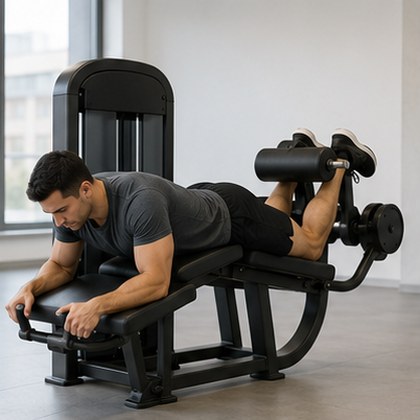
Lie face down so your knees are just past the edge of the bench, set the roller above your heels on the lower part of your calves, and curl without letting your hips leave the pad. Step by step:
- The roller. Adjust it to the length of your lower leg. At the bottom it should rest a couple of centimeters (about an inch) above your Achilles tendon, on the meaty part of the calf. On the heel itself it slides and presses on the Achilles; above mid-calf the lever gets shorter and the weight feels heavier.
- The knees. Position yourself so your kneecaps are just past the edge of the bench, in the air. A knee resting on the bench jams against it and blocks the movement.
- The bend in the bench. Most lying machines have a bench that's angled like a shallow roof. The peak of that angle should be under your hips: that way the hip is slightly bent and the hamstrings are less shortened.
- The hands. Hold the handles under the bench or by your head. They keep your torso in place; you don't pull the weight with your arms.
- The hips. Press your pubic bone into the pad and keep it there for the whole set. This is the key point, and we'll come back to it.
- The curl. Exhale, bend your knees and pull the roller toward your glutes over 1–2 seconds. Go as far as it nearly touches your glutes or the lever stops. You can lightly squeeze your glutes at the top.
- The pause. Half a second at the top. No jerk and no throw.
- The lowering. Lower the roller over 1–2 seconds, under control. At the bottom, don't lock the knee out: leave a small bend so the load stays in the muscle instead of the joint.
- Breathing. Exhale on the curl, inhale on the way down. Keep your neck neutral — rest your forehead on your hands and look at the floor.
A tempo of 1–2 seconds up and the same down is the moderate tempo the American College of Sports Medicine (ACSM) recommends in its 2009 position stand for muscle growth.
Why your hips lift, and why it's a problem. Lying down, the hamstrings are already shortened at the hip because the hip is straight. When you bend the knee all the way, the muscle shortens at the other end too, and at that point it's weak. Your body finds a workaround: it lifts the hips by arching the lower back. The hip bends, the muscle gets a bit of stretch at the top, and it can pull again. From the side it looks like your glutes "bounce" on every rep. The weight goes up, but the lower back and glutes are lifting it, and the hamstrings are resting. The result is a weak stimulus for the thighs and a tired lower back. The fix is simple: less weight, pubic bone into the pad, and a slightly shorter range at the top if the full range isn't happening yet without the hips rising.
for your first two weeks, have someone check your hips from the side. Ask whoever's nearby to rest a palm on your sacrum, the flat bone at the base of your spine: if the palm rises on every rep, your hips are lifting. Training alone? Prop your phone on the floor beside the machine and film a set. If your glutes bounce, drop 5 kg (11 lb) on the stack and repeat the set.
Seated leg curl: step-by-step form
Set the back pad so the machine's pivot lines up with the middle of your knee, lock your thighs under the top pad, and pull your heels under the seat.
- The pivot. Every seated machine has a point the lever rotates around, usually marked with a circle or a colored dot on the side. Sit down and slide the back pad until that point lines up with the middle of your knee. If your knee is in front of the pivot, the roller rides up your calf; if it's behind, the knee gets pulled on.
- The lower roller. Same as lying: on the lower part of the calf, just above the Achilles.
- The thigh pad. Lower it onto your thighs just above the knees and tighten it so it holds firmly without pressing to the point of pain. This pad does the machine's main job: it stops your hips and thighs from rising, which replaces the "pubic bone into the pad" cue from the lying version.
- Your torso. Back against the pad, hands on the handles beside the seat, as if you're pulling yourself down into the chair.
- The curl. Exhale, bend your knees and pull your heels under the seat over 1–2 seconds. On most seated machines the range is bigger than lying: the knee bends to 90° and beyond.
- The lowering. Return the roller over 1–2 seconds to nearly straight legs, without locking the knees out.
- Breathing is the same: exhale on the effort, inhale on the return.
Leaning forward. If you lean your torso slightly forward during the set, the hip bends even more and the hamstrings stretch even further. The lean itself hasn't been studied, but the idea behind it, a more deeply bent hip, has. In Maeo's 2024 study, 42 men were split into three groups of 14. For 12 weeks, one group did Nordic hamstring curls, the second did curls on an ordinary seated leg curl machine whose back pad had been modified so the hip was bent more than usual, to about 120°, and the third didn't train. In the second group, the weight was lifted with both legs and lowered with one, slowly, over about 4 seconds. The deep-hip-bend version produced +18% hamstring volume versus +11% for Nordic curls. Different muscles grew in each: the muscles that extend the hip grew 2.2 times more from the seated curl, and the muscles that don't extend the hip grew 1.9 times more from Nordic curls. For you this means a slight forward lean in the seat is likely useful, as long as the back pad allows it and your back doesn't round.
Back pad mistakes. Too far from the roller, and your knee sits in front of the pivot, the roller slides, and you feel a pull behind the knee. Too close, and your knee sits behind the pivot, your thighs rise, and the thigh pad digs in. One rule fixes both: middle of the knee on the pivot, and everything else falls into place.
Standing leg curl and single-leg work
Standing, you curl one leg against the roller while standing on the other, and this version earns its place when your legs differ in strength, after an injury to one of them, or when the gym has no lying machine.
Standing form. Step up to the machine, brace your thigh against the support pad, with the knee of the working leg level with the pivot. The roller goes behind the lower part of your calf. Hold the handles. Exhale and bend the knee, bringing your heel toward your glute; inhale and return. Keep your hips level, without leaning toward the standing leg, and don't arch your back. Keep the standing knee soft, not locked.
Single-leg on the lying and seated machines. On ordinary machines you can work one leg at a time: the other just rests on top of the roller or on the floor. Use a little less than half the two-leg weight. Reps and sets stay the same.
When to work one leg at a time:
- one leg is noticeably weaker: with both legs, the strong side pulls the roller and the weak side just goes along for the ride;
- after a hamstring injury, once your doctor has cleared you to load it: start with the injured leg and match the healthy leg's volume to it;
- when you've run out of stack and the two-leg weight feels light.
Toes pointed or flexed during leg curls
For hamstring growth, foot position doesn't matter. The only difference is whether your calves work or rest.
Every gym argues about this, and it's a rare case where three studies answer the question piece by piece.
The first one is about strength. Gallucci and Challis showed in 2002, on 9 men, that knee flexion torque with the toes pulled up was higher than with the toes pointed at all three speeds they tested. The gastrocnemius is stretched and helps. So with the toes pulled up, the roller moves more easily and you get more reps.
The second is about growth. Cadeo and colleagues checked in 2023 whether that changes the result. Hamstring electrical activity during lying leg curls didn't depend on foot position in beginners or in trained lifters. Then the trained participants worked for 10 weeks with one leg toes-up and the other toes-pointed. The thickness of the long head of the biceps femoris and strength grew the same on both sides. The toes-up leg did more total work, meaning more reps, but in the end that changed nothing.
The third is about what actually swells. Lisboa and colleagues in 2026 put 17 women aged 18 to 37 on a seated machine for 3 sets to failure with 2 minutes of rest, measuring muscle thickness by ultrasound before and after. With a neutral foot, both the hamstrings and the outer gastrocnemius swelled. With the toes pointed, only the hamstrings swelled. The difference in outer-calf thickness between the two foot positions was 0.07 cm (0.03 in) — small, but statistically significant — while hamstring thickness itself didn't depend on foot position.
Put the three together and you get this table:
| Foot position | Calves | Hamstrings | How many reps you'll get | When to choose it |
|---|---|---|---|---|
| Toes pulled up (flexed) | working (Gallucci, 2002) | grow the same (Cadeo, 2023) | more, so more volume | the default, if your calves don't cramp |
| Toes pointed | nearly switched off (Lisboa, 2026) | grow the same (Cadeo, 2023; Lisboa, 2026) | fewer | if your calves cramp, or you want to load the hamstrings "clean" |
| Neutral | working (Lisboa, 2026) | grow the same | in between | how the foot sits on most seated machines |
What this means for you: if your calves don't cramp, pull your toes up and stop thinking about it. You'll get more reps and a more honest set. If your calves cramp every set, point your toes: the hamstrings get the same stimulus and the calves get a rest. Another reason to point the toes is a separate calf workout on the same day.
Toes in or out. Gym lore says toes turned in shift the load to the inner hamstrings and toes turned out to the outer. We couldn't find any reliable measurements on this, so don't take it as a rule. Rotating your feet on the machine changes the position of the knee and can give you an unpleasant feeling in the joint. Keep your feet straight.
How much weight and how many reps: an 8-week plan for women and men
Women start at 15 kg (33 lb) on the stack and men at 25 kg (55 lb), 3 sets of 10 reps, adding reps up to 15 first and then 5 kg (11 lb).
Why reps first. The 2009 ACSM position stand recommends that beginners use a weight that allows 8–12 reps and add 2–10% once they can do 1–2 reps more than that. Machine stacks usually move in 5 kg (11 lb) steps — or 10–15 lb steps on US machines. For a woman at 15 kg (33 lb), the next plate is a 33% jump; for a man at 25 kg (55 lb), it's 20%. Both are several times ACSM's upper limit. The way around it is to grow the reps: from 10 to 12, then to 15, and only then move the pin to the next plate and drop back to 10. If the stack has a 2.5 kg (5 lb) add-on weight, the steps are smaller and you can add weight more often.
Why 10–15 reps. The leg curl is an isolation exercise, and heavy weights aren't needed on it. Schoenfeld's 2017 meta-analysis of 21 studies showed that muscles grow equally with light weights, up to 60% of max, and heavy weights, as long as the set gets close to failure. Heavy weights build more strength, but almost no one needs maximal strength on a leg curl: people do this exercise for the muscle. So 10–15 reps with 2–3 reps left in reserve is the working range here.
Eight weeks of leg curls, in numbers. Two sessions a week, 3 working sets each. Volume is the work done per session: sets × reps × weight on the stack. For example, 3 × 10 × 15 kg = 450 kg (990 lb).
| Week | Women | Volume | Men | Volume | What changed |
|---|---|---|---|---|---|
| 1 | 15 kg (33 lb), 3 × 10 | 450 kg (990 lb) | 25 kg (55 lb), 3 × 10 | 750 kg (1,655 lb) | starting point |
| 2 | 15 kg, 3 × 12 | 540 kg (1,190 lb) | 25 kg, 3 × 12 | 900 kg (1,985 lb) | +2 reps per set |
| 3 | 15 kg, 3 × 15 | 675 kg (1,490 lb) | 25 kg, 3 × 15 | 1,125 kg (2,480 lb) | +3 reps |
| 4 | 20 kg (44 lb), 3 × 10 | 600 kg (1,325 lb) | 30 kg (66 lb), 3 × 10 | 900 kg (1,985 lb) | weight up: +33% women, +20% men; reps drop back |
| 5 | 20 kg, 3 × 12 | 720 kg (1,585 lb) | 30 kg, 3 × 12 | 1,080 kg (2,380 lb) | +2 reps |
| 6 | 20 kg, 3 × 15 | 900 kg (1,985 lb) | 30 kg, 3 × 15 | 1,350 kg (2,975 lb) | +3 reps |
| 7 | 25 kg (55 lb), 3 × 10 | 750 kg (1,655 lb) | 35 kg (77 lb), 3 × 10 | 1,050 kg (2,315 lb) | weight up: +25% and +17% |
| 8 | 25 kg, 3 × 12 | 900 kg (1,985 lb) | 35 kg, 3 × 12 | 1,260 kg (2,780 lb) | +2 reps |
Over 8 weeks, work per session grows 100% for women, from 450 to 900 kg (990 to 1,985 lb), and 68% for men, from 750 to 1,260 kg (1,655 to 2,780 lb). In the weeks where the weight goes up, volume dips: that's by design, and it climbs again on reps afterward. If 15 clean reps — no hips lifting, no jerking — aren't happening in some week, stay on it for another week or two. Add weight only when all three sets are done with 2–3 reps in reserve.
Three notes about the stack:
- The kilograms or pounds on the stack mean different effort on different machines. Every model has its own lever, pulleys and cable, and 25 kg (55 lb) in one gym can feel like 35 kg (77 lb) in another. Compare weights only on the same machine.
- Lying and seated have different maxes. Run the plan on one version. If you switch from lying to seated, start over at 15 or 25 kg (33 or 55 lb) and find your 10 reps again.
- The starting 15 and 25 kg are a reference, not a requirement. If 15 kg (33 lb) for 10 reps is a struggle, start at 10 kg (22 lb). If 25 kg (55 lb) is easy and you have more than 5 reps in reserve, take 30 kg (66 lb).
How often, and how many sets in total. Twice a week, with 1–2 minutes of rest between sets, as ACSM recommended in 2009 for muscle growth. The 2026 ACSM position stand, which pools 137 systematic reviews and more than 30,000 participants, puts the number for muscle growth at 10 or more sets per week. Six sets of leg curls is a little over half of that. Make up the rest with Romanian deadlifts: they load the upper hamstrings, the curl loads the lower, and together they cover the whole muscle. The same position stand says training to failure isn't necessary and that the type of equipment, machine or free weight, has no consistent effect on muscle growth, so you can choose between them by convenience.
After the eight weeks. Once the plan is done, the general rule applies: reps first, then weight, and change one thing at a time. How to structure that for months ahead is in our guide to progressive overload.
In the Sportygram app (go.sportygram.com; the interface and the coach are in Russian for now), the lying and seated leg curl are both in the exercise catalog, each with its own technique photos. You log weights and sets in the workout diary, and the history shows when your reps have reached 15 and it's time to move the pin.
 Lying leg curl
 Single-leg Romanian deadlift
Mistakes: where you feel it → what to fix
A correct leg curl feels like a burn down the back of your thighs by the end of the set; if instead you feel it in your lower back, your calves cramp, or the back of your knee hurts, the form has drifted.
| Where you feel it | What's wrong | The fix |
|---|---|---|
| Lower back, on every rep | your hips are lifting off the lying pad, and your back is finishing the rep | pubic bone into the pad, 5 kg (11 lb) off the stack, slightly shorter range at the top, have someone check from the side |
| Lower back, in the seat | your torso is coming off the back pad and you're pulling the roller with your whole body | back against the pad, hands pulling you down, thigh pad tighter |
| Calf cramps | toes pulled up with sensitive calves, or the roller is sitting on the heel | point your toes, move the roller up onto the calf |
| Pulling or clicking behind the knee | the knee isn't on the pivot; the knee locks out at the bottom; the roller is on the heel | middle of the knee on the pivot, leave a small bend at the bottom, roller on the calf |
| Thighs burn only at the very start, then nothing | the roller is moving with a jerk, the weight is too heavy | take 5–10 kg (11–22 lb) off, 1–2 seconds each way |
| Barely tired, but you don't feel the muscle either | short range: the roller is moving in the middle of its path | pull to the glutes or until the lever stops, lower to nearly straight legs |
| The thigh pad digs in, thighs go numb | the pad is too low on the knees or tightened to the limit | raise it to the lower third of the thigh, loosen it one notch |
| One leg pulls, the other coasts | a difference between sides | a week or two of single-leg work, starting with the weaker leg |
The most common mistake is hips lifting on the lying machine. Why it happens is covered in section 04. The heavier the weight, the harder your glutes "bounce." It's fixed by weight, range, and the habit of keeping the pubic bone pressed down.
The second most common is jerking. When the weight is too heavy, the roller goes up on a throw and falls back on its own. This is a real shame, because the lowering is where the hamstrings get their main stimulus: the 2026 ACSM position stand specifically notes that eccentric loading, meaning lowering under control, enhances muscle growth. Lower the roller more slowly than you lift it, and pick a weight where the last two reps are hard but smooth.
Leg curl alternatives at home and in the gym
The closest substitutes by movement are the band leg curl, the stability ball leg curl and the slider leg curl; by muscle, the Romanian deadlift and the Nordic hamstring curl.
Substitutes fall into two groups. The first repeats the movement itself, bending the knee against resistance: that's what you need when there's no machine but you still want to work the lower hamstrings. The second loads the same muscle through a different movement, hip extension, and works when you just need to get your weekly hamstring sets in.
| Substitute | What you need | Which part of the muscle it loads | What the research shows |
|---|---|---|---|
| Band leg curl | a resistance band and something to anchor it to | the same movement, lower hamstrings | no direct studies; the movement copies the machine |
| Stability ball leg curl | a stability ball, a mat | knee flexion plus holding the hips up | no direct studies |
| Slider leg curl | a towel or socks on a smooth floor | knee flexion, especially on the lowering | no direct studies |
| Nordic hamstring curl | a partner or a bar to anchor your heels | the inner hamstring: semitendinosus +24.3% in 9 weeks (Morin, 2025) | half as many hamstring injuries across 8,459 athletes (van Dyk, 2019) |
| Romanian deadlift | a barbell or dumbbells | the upper and inner hamstrings: semimembranosus +11.2% in the stiff-leg deadlift (Morin, 2025) | upper hamstrings same as the curl, lower hamstrings less (Schoenfeld, 2015) |
| Standing cable leg curl | a low pulley and an ankle cuff | the same movement as the standing machine, lower hamstrings | no direct studies; the movement copies the standing machine |
With a band. Anchor the band around a sofa leg or a heavy cabinet, lie face down with your head away from the anchor, and loop the band around your lower calf above the heel. Scoot back until the band is already taut with your leg straight. Bend your knee, pulling your heel toward your glute, over 1–2 seconds, and return the same way. Hips pressed into the floor, as on the machine. A band's resistance builds toward the top of the movement, so it loads the part of the path where you're strongest — fine for a home version. A full program built around bands is in our resistance band workout.
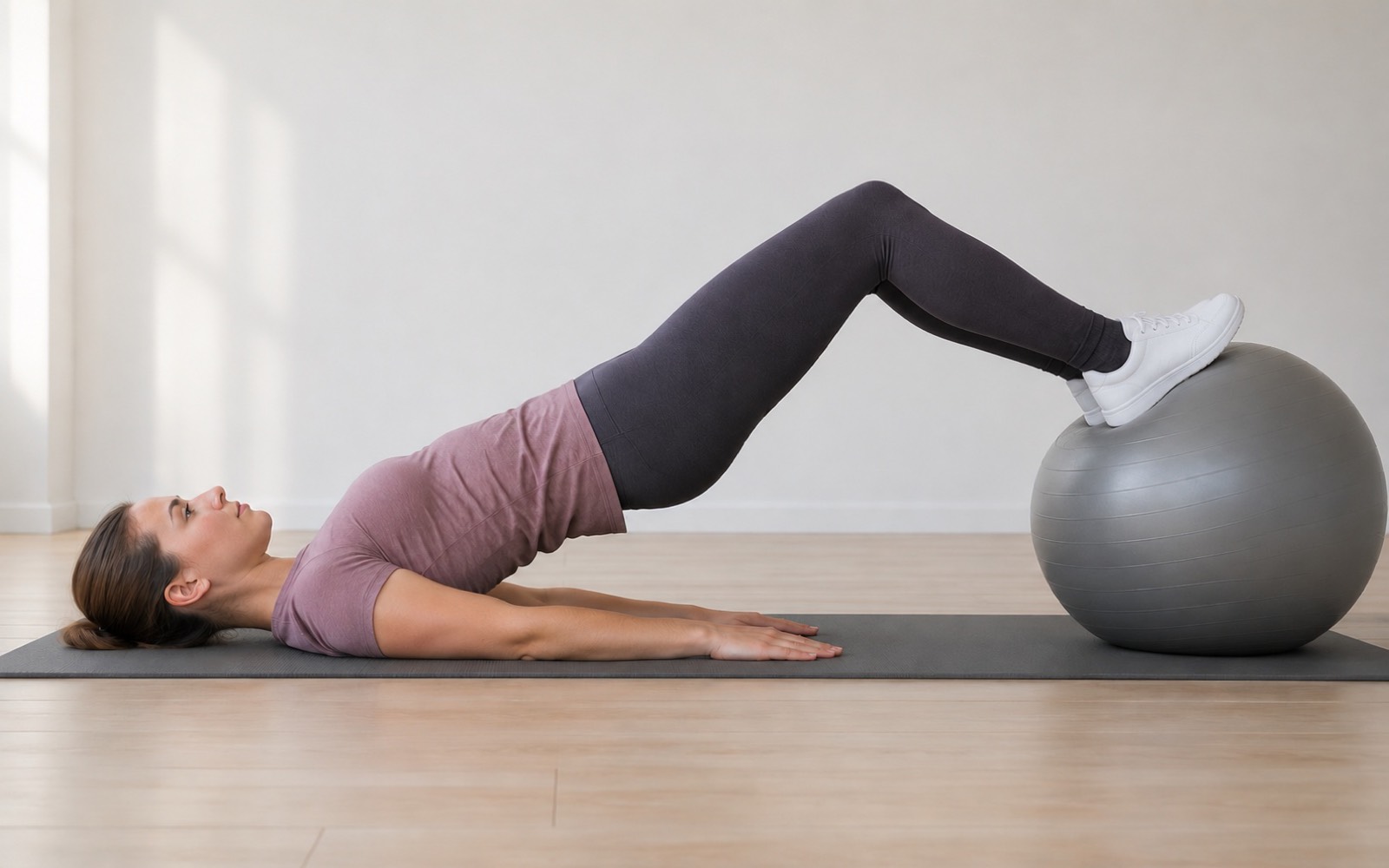
On a stability ball. Lie on your back with your heels on the ball and lift your hips until your body is a straight line from shoulders to heels. Bend your knees, rolling the ball toward your glutes, and roll it back out without dropping your hips. Harder than it looks: start with 3 sets of 8–10. When it gets easy, do it one leg at a time.
With sliders. Same thing on a smooth floor: heels on a towel, or socks on laminate, hips up. Pull your heels in and push them back out slowly over 3–4 seconds. The lowering is the most useful part, and here it's harder than the pull.
Nordic hamstring curl. Kneel down, anchor your heels under a bar or have someone hold them. Slowly lower your torso forward, resisting with your hamstrings for as long as you can, then catch yourself with your hands and push back up. In Morin's 2025 blinded randomized trial, 36 beginners were randomly split into three groups: for 9 weeks, 3 times a week, one did Nordic curls, the second did stiff-leg deadlifts, and the third didn't train. Nordic curls produced +24.3% semitendinosus volume, the deadlift +11.2% in the semimembranosus; total hamstring growth was similar in both groups, and the authors recommend keeping both exercises in one program. Van Dyk's 2019 meta-analysis of 15 studies and 8,459 athletes showed that programs including Nordic curls cut hamstring injury rates by up to 51%: the injury risk was 0.49 of normal. For a runner or a soccer player, that's a stronger argument than any machine. Start with 2 sets of 3–5 slow lowerings: the first few days afterward, the muscles will be very sore.
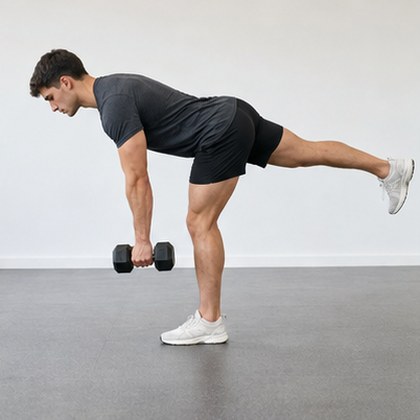
Romanian deadlift. For racking up hamstring sets, it's the first choice in the gym and at home with dumbbells. Just remember section 01: the deadlift loads the upper hamstrings, and the lower part near the knee gets less than it does from a curl (Schoenfeld, 2015). Ideally your program has both.
Leg curls and leg extensions on the same day. This is the standard thigh pair: extensions for the quads, curls for the hamstrings. Doing them on the same day is fine and convenient, since the machines usually sit side by side. The order is after your compound exercise, a leg press or a barbell squat, because ACSM's 2009 position stand recommends single-joint exercises after multi-joint ones. You can alternate sets of curls and extensions with the usual 1–2 minutes of rest.
Safety: knees, pain behind the knee, lower back, who should be careful and when to see a doctor
Leg curls don't hurt healthy knees. Pain behind the knee, a click, or swelling is a reason to stop the set and figure out what's going on.
The knee. In a leg curl, the joint works through a simple movement, with no axial load like a squat and no twisting. That's why the exercise is given to people who can't squat yet. Two things protect it: the middle of the knee on the machine's pivot, and a small bend at the bottom instead of locking out. Locking out until the knee clicks shifts the weight from the muscle onto ligaments and tendons, and repeated 15 times a set, that's what gives you the "pulling behind the knee."
Pain behind the knee. The most common cause is the tendons that run through the back of the knee: the semitendinosus and semimembranosus on the inner side, the biceps femoris on the outer side, the gastrocnemius at the back. They get overloaded when the roller sits on the heel, when the knee isn't on the pivot, and when the weight is too heavy and the roller jerks. Fix the setup, drop the weight, and it usually clears in a week or two. If a firm swelling appears behind the knee that stops you bending the leg all the way, it could be a Baker's cyst — a pocket of fluid in the back of the knee. That's a doctor's visit, and the exercise waits until you've been seen.
Pain at the sit bone. If it pulls and aches deep in the glute, right at the bone you sit on, and gets worse with long sitting, the hamstring tendon at its attachment may be the problem. This kind of pain takes a long time to settle and likes to come back, so a program around it is best built with a doctor or physical therapist.
The lower back. On its own, it doesn't work in a leg curl. It only gets loaded by a mistake: hips lifting on the lying machine or the torso coming off the back pad in the seat. If your back already hurts, pick the seated version: it rests against the pad there.
Who should be careful:
- After a hamstring strain. Come back with your doctor's clearance, seated, light, and one leg at a time, starting with the injured one. The Nordic curls from section 10 are a separate conversation with your doctor; they're harsher than the machine.
- Pregnancy. Lying face down isn't an option after the first trimester; discuss the seated version with the doctor managing your pregnancy.
- Varicose veins or a history of blood clots. Lying, the roller compresses the calf, and you need a doctor's advice here. The seated version is gentler, but still worth discussing.
- Knee surgery or injury. After arthroscopy (keyhole surgery on the joint), ligament reconstruction, or with osteoarthritis, leg curls are often part of rehab, but the weight and range come from your physical therapist.
- After 40 and after 60. Strength training is safe for healthy adults of any age. Per the 2026 ACSM position stand, in an analysis of more than 38,000 people, exercise didn't increase the risk of serious adverse events. Start seated, at 10–15 kg (22–33 lb), and add weight following the plan in section 08.
See a doctor if:
- swelling appears behind the knee or in the calf, or the leg gets hot or red;
- the pain came on suddenly, with a click, mid-set;
- the pain doesn't ease after 2–3 days of rest or comes back every session with the machine set up correctly;
- your lower leg or foot goes numb or weak.
Questions and answers
Which is better: seated or lying leg curl?
Seated. In Maeo's 2021 study, over 12 weeks the hamstrings grew 14% on the leg trained seated and 9% on the leg trained lying. The reason is the bent hip: the muscle is stretched at the top and works in a more favorable position. Do the lying version if your gym has no seated machine or the thigh pad digs in: the lower hamstrings get just as much work there.
What muscles do leg curls work?
Three hamstring muscles — the semitendinosus, the semimembranosus and the biceps femoris — plus the gastrocnemius in the calf. The inner hamstrings, the semitendinosus and semimembranosus, work hardest (Bourne, 2017), along with the lower part of the muscle near the knee (Schoenfeld, 2015). The calves join in when you pull your toes up.
Should your toes be pointed or flexed?
It doesn't matter for the hamstrings: in Cadeo's 2023 study, muscle thickness and strength grew the same over 10 weeks with either foot position. With the toes pulled up, the calves help and you get more reps. With the toes pointed, the calves are nearly switched off, which is the choice if they cramp.
What weight should a woman start with on the leg curl?
Start at 15 kg (33 lb) on the stack, 3 sets of 10 reps, with 2–3 reps left in reserve. Grow the reps to 15 first, then move to the next plate. On our plan, by week 7 that's 25 kg (55 lb) for 3 × 10. Men start at 25 kg (55 lb) and reach 35 kg (77 lb) by week 7. If the machine is heavy and 15 kg for 10 reps isn't happening, start at 10 kg (22 lb): the numbers on the stack mean different effort on different models.
How many sets, and how often per week?
3 sets of 10–15 reps twice a week, with 1–2 minutes of rest between sets. That's 6 sets for the hamstrings, and for muscle growth ACSM in 2026 calls for 10 or more a week. Make up the other 4 sets with Romanian deadlifts or Nordic curls.
Why do my calves cramp and the back of my knee hurt during leg curls?
Your calves cramp because the gastrocnemius helps bend the knee, especially with the toes pulled up (Gallucci, 2002), and even more so when the roller sits right on the heel. Point your toes and move the roller up onto the calf. The back of the knee pulls when the knee isn't on the machine's pivot or when you lock the leg out at the bottom: leave a small bend. If there's swelling behind the knee, a click, or pain that doesn't ease in 2–3 days, see a doctor.
What can you do instead of leg curls at home?
By movement: a band leg curl lying face down, or a stability ball or slider leg curl on your back with your hips up. By muscle: Romanian deadlifts with dumbbells, and Nordic curls with your heels anchored — in Morin's 2025 study, Nordic curls produced +24.3% semitendinosus volume in 9 weeks. Start them carefully, 2 sets of 3–5 slow lowerings.
Can you do leg curls and leg extensions on the same day?
Yes, it's the standard thigh pair: extensions load the quads, curls load the hamstrings. Put them after your compound exercise, a leg press or a squat: ACSM's 2009 position stand recommends single-joint exercises after multi-joint ones. You can alternate the sets: a set of extensions, a minute of rest, a set of curls.
The bottom line
- The leg curl is a single-joint hamstring exercise; it loads the lower part of the muscle harder than a deadlift does, which is why the two complement each other (Schoenfeld, 2015).
- Seated beats lying: +14% versus +9% volume in 12 weeks, because the hip is bent and the muscle is stretched (Maeo, 2021). There are no studies on the standing version; it's there for single-leg work.
- Toes pointed or flexed makes no difference to hamstring growth (Cadeo, 2023); flexed brings in the calves and gives you more reps, pointed is for when the calves cramp.
- Start at 15 kg (33 lb) for women and 25 kg (55 lb) for men, 3 × 10, twice a week. Reps up to 15 first, then 5 kg (11 lb) more. Over 8 weeks, volume grows 100% and 68%.
- The biggest lying-machine mistake is hips lifting: the lower back finishes the rep. Pubic bone into the pad, less weight, a check from the side.
- At home, a band, a stability ball and sliders replace the machine; by muscle, Romanian deadlifts and Nordic curls, which also halve hamstring injuries (van Dyk, 2019).
- Swelling behind the knee, a click, pain lasting more than 2–3 days, or numbness in the lower leg: see a doctor.
Checklist: before a set of leg curls
- Roller on the lower calf, above the Achilles tendon, not on the heel.
- Middle of the knee on the machine's pivot; lying, knees just past the edge of the bench.
- Lying: pubic bone pressed into the pad; seated: back against the pad, thigh pad tightened.
- Foot position chosen: toes up if your calves don't cramp, toes pointed if they do.
- Tempo of 1–2 seconds up and 1–2 seconds down, no locking out at the bottom.
- A weight that leaves 2–3 reps in reserve.
- Sets and weight logged in your workout diary.
Sources
- Maeo S., Huang M., Wu Y., Sakurai H., Kusagawa Y., Sugiyama T., Kanehisa H., Isaka T. Greater Hamstrings Muscle Hypertrophy but Similar Damage Protection after Training at Long versus Short Muscle Lengths. Medicine & Science in Sports & Exercise, 2021. — 20 people, one leg seated and the other lying, 70% of max, 5 × 10, twice a week, 12 weeks: hamstring volume +14% seated versus +9% lying; two-joint muscles +8–24% versus +4–19%; biceps femoris short head +10% versus +9%; damage protection the same.
- Cadeo G.M., Fujita R.A., Villalba M.M., Silva N.R.S., Júnior C.I., Pearcey G.E.P., Gomes M.M. Myoelectric activity and improvements in strength and hypertrophy are unaffected by the ankle position during prone leg curl exercise — a within person randomized trial. European Journal of Sport Science, 2023. — Hamstring activity doesn't depend on foot position in beginners or trained lifters; in trained lifters, over 10 weeks the thickness of the biceps femoris long head and strength grew the same with the toes pulled up or pointed; the toes-up leg did more total work.
- Lisboa F., Gomes F., Kunevaliki G., Manske I., Santos-Melo V., Prado A., Miguel A., Tricoli I., Costa B., Kassiano W., Stavinski N., Francsuel J., Cyrino E.S. Ankle Position-Dependent Muscle Swelling During Seated Leg Curl: Ultrasonographic Insights Into the Hamstrings and Medial and Lateral Gastrocnemius. Journal of Strength and Conditioning Research, 2026. — 17 women aged 18–37, seated leg curl, 3 sets to failure with 2 minutes of rest: with a neutral foot, both the hamstrings and the lateral gastrocnemius swell (calf difference versus toes pointed 0.07 cm); with the toes pointed, only the hamstrings; hamstring swelling itself doesn't depend on foot position.
- Gallucci J.G., Challis J.H. Examining the Role of the Gastrocnemius during the Leg Curl Exercise. Journal of Applied Biomechanics, 2002. — 9 men, 3 maximal reps on an isokinetic dynamometer at 30, 75 and 150°/s: knee flexion torque with the toes pulled up was higher than with the toes pointed at all three speeds; a stretched gastrocnemius contributes more to knee flexion.
- Schoenfeld B.J., Contreras B., Tiryaki-Sonmez G., Wilson J.M., Kolber M.J., Peterson M.D. Regional differences in muscle activation during hamstrings exercise. Journal of Strength and Conditioning Research, 2015. — 10 trained men, 8-rep max to failure: the lying leg curl loads the lower outer and lower inner hamstrings harder than the stiff-leg deadlift; the upper hamstrings work the same.
- Bourne M.N., Williams M.D., Opar D.A., Al Najjar A., Kerr G.K., Shield A.J. Impact of exercise selection on hamstring muscle activation. British Journal of Sports Medicine, 2017. — 24 men, 10 exercises: the machine leg curl and the bent-knee glute bridge had the lowest outer-to-inner activity ratio during the lifting phase, meaning they mainly load the inner hamstrings, the semitendinosus and semimembranosus; the 45° hip extension loads the biceps femoris long head harder.
- Maeo S., Balshaw T.G., Nin D.Z., Mc Dermott E.J., Osborne T., Cooper N.B., Massey G.J., Kong P.W., Pain M.T.G., Folland J.P. Hamstrings Hypertrophy Is Specific to the Training Exercise: Nordic Hamstring versus Lengthened State Eccentric Training. Medicine & Science in Sports & Exercise, 2024. — 42 men in three groups of 14 (two training, one control), 12 weeks, 34 sessions: eccentric curls on a seated machine with a modified back pad (hip bent to about 120°, weight lowered with one leg) produced +18% hamstring volume versus +11% for Nordic curls; hip extensors grew 2.2 times more in the first version, non-hip-extending muscles 1.9 times more in the second.
- Morin T., Doguet V., Nordez A., Caillet A., Lacourpaille L. Minimal Role of Hamstring Hypertrophy in Strength Transfer Between Nordic Hamstring and Stiff-Leg Deadlift: A Blinded Randomized Controlled Trial. Journal of Strength and Conditioning Research, 2025. — 36 beginners in three groups (Nordic curls, stiff-leg deadlift, control), 9 weeks, 3 sessions a week: Nordic curls +24.3% semitendinosus volume, stiff-leg deadlift +11.2% semimembranosus; total hamstring growth similar (11.4% and 7.0%); the authors recommend keeping both exercises in a program.
- van Dyk N., Behan F.P., Whiteley R. Including the Nordic hamstring exercise in injury prevention programmes halves the rate of hamstring injuries: a systematic review and meta-analysis of 8459 athletes. British Journal of Sports Medicine, 2019. — 15 studies, 8,459 athletes: programs with Nordic curls cut hamstring injury rates by up to 51%, relative risk 0.49.
- Schoenfeld B.J., Grgic J., Ogborn D., Krieger J.W. Strength and Hypertrophy Adaptations Between Low- vs. High-Load Resistance Training: A Systematic Review and Meta-analysis. Journal of Strength and Conditioning Research, 2017. — 21 studies: muscle growth is the same with light (up to 60% of max) and heavy loads when sets are taken close to failure; strength grows more with heavy loads.
- American College of Sports Medicine. Progression models in resistance training for healthy adults. Medicine & Science in Sports & Exercise, 2009. — Beginners: a load allowing 8–12 reps, 2–3 sessions a week, a 2–10% increase once 1–2 extra reps are achievable; a moderate tempo of 1–2 seconds up and down; 1–2 minutes of rest for muscle growth; single-joint exercises after multi-joint ones.
- Currier B.S., D'Souza A.C., Singh M.A.F. et al. American College of Sports Medicine Position Stand. Resistance Training Prescription for Muscle Function, Hypertrophy, and Physical Performance in Healthy Adults: An Overview of Reviews. Medicine & Science in Sports & Exercise, 2026. — 137 systematic reviews, more than 30,000 participants: 10 or more sets per muscle per week and eccentric overload for muscle growth; 2 or more sessions a week and full range of motion for strength; failure isn't necessary; equipment type (machine or free weight) has no consistent effect; in an analysis of more than 38,000 people, exercise didn't increase the risk of serious adverse events.
This article is for informational purposes only and is not a substitute for medical advice.