

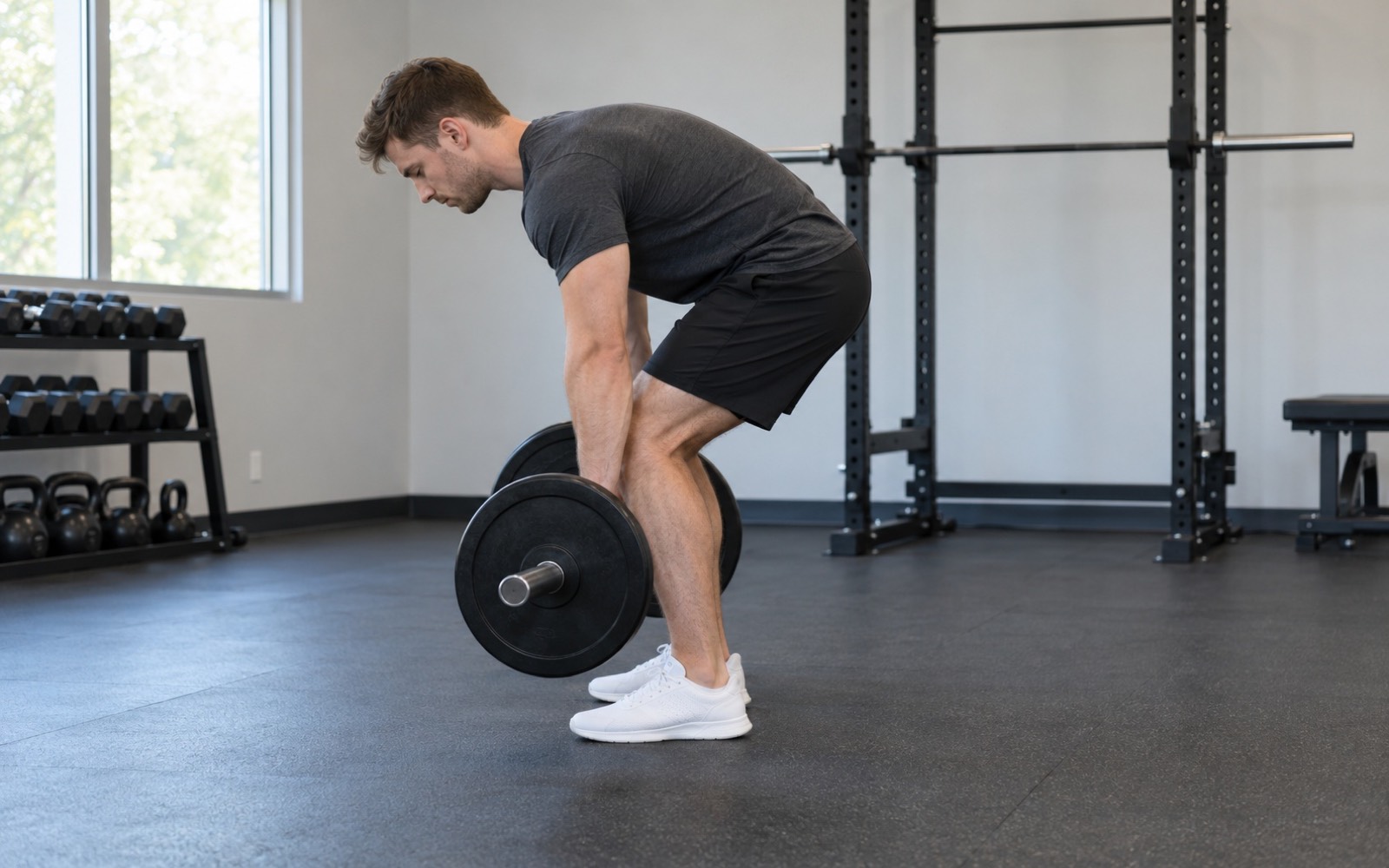
knees stay bent at roughly 15° and barely change angle through the set, the bar rides against your legs, and depth is wherever your back stays flat — usually mid-shin. In McAllister's 2014 comparison, the hamstrings worked hardest in the Romanian deadlift and the glute-ham raise. What separates it from a conventional deadlift is the top-down start and the nearly locked knee angle: in Lee's 2018 study, the quads worked more than twice as hard in a conventional deadlift, 58.6% versus 25.3%.Starting point: 5 kg (11 lb) dumbbells for women, 8 kg (17.5 lb) for men, 3 sets of 10 with 2–3 reps left in the tank, twice a week. Over our 8-week plan, training volume per session grows by 72–80%.
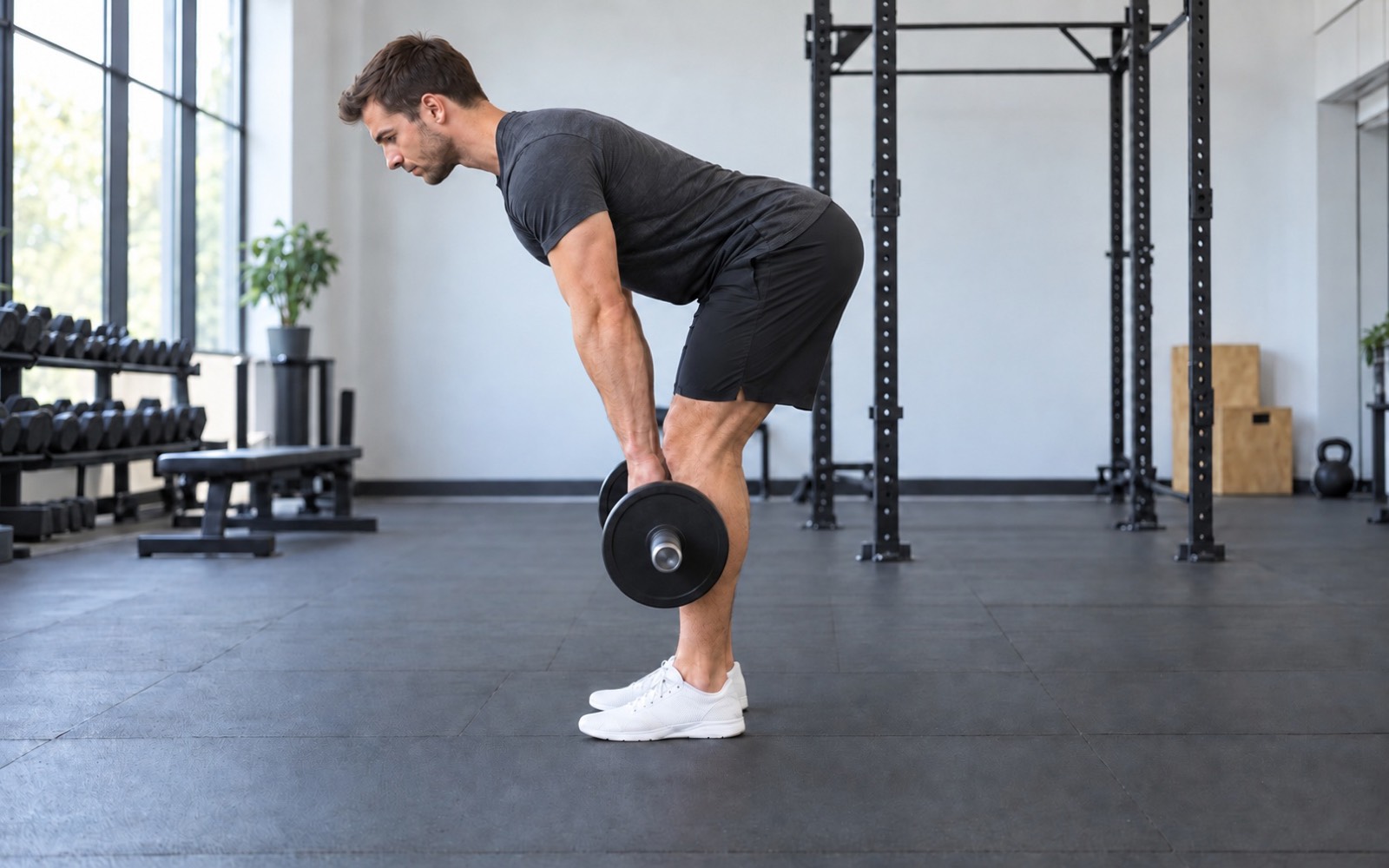
A Romanian deadlift is a forward hip hinge with weight. The movement comes from your hip joint: you push your hips back, your knees stay slightly bent and barely change angle, and the bar or dumbbells slide down the front of your legs to about mid-shin. You lower until your back stays flat, then stand back up by driving your hips forward. Your hamstrings do most of the work, and your glutes help you finish the lift. A beginner is fine with 3 sets of 10–12 reps twice a week. Start with dumbbells — 5 kg (11 lb) each for women, 8 kg (17.5 lb) each for men — and move to a barbell after about six weeks.
What a Romanian deadlift is and where the name comes from
A Romanian deadlift is a loaded forward bend where your torso drops because your hips travel back, not because your spine rounds. Coaches call this pattern a hip hinge. Picture your hands full of grocery bags and closing a car door with your hip: your torso tips forward on its own because your hips just moved back.
You take the bar off pins set around mid-thigh height, or you pull it off the floor on the first rep the way you would in a conventional deadlift, and after that it never touches the floor again until the set is done. That keeps constant tension on your hamstrings, which work hardest at the bottom, where they're most stretched. After your first few sessions you'll feel a Romanian deadlift as tightness down the back of your thighs, sometimes all the way to the back of your knee. Its short name is RDL.
Where "Romanian" comes from. The name was coined in 1990 in San Francisco. Romanian weightlifters had traveled to the US for the Goodwill Games, held that year in Seattle and Spokane, and Olympic weightlifting champion Nicu Vlad and his coach Dragomir Cioroslan ran a seminar at the Sports Palace gym while they were in the country. According to Jim Schmitz, who owned the gym and was president of USA Weightlifting at the time, Vlad did the exercise after a 220–230 kg (485–505 lb) clean and jerk and worked up to 250 kg (550 lb) for 3 reps. The lift didn't have a name yet, so Schmitz suggested calling it the Romanian deadlift. In his description of the technique, the bar comes down to within about 5 cm (2 in) of the platform — a depth that takes an Olympic weightlifter's hip mobility, well beyond what a beginner will have starting out.
Muscles worked in the Romanian deadlift
The Romanian deadlift is primarily a hamstring exercise: your glutes help you stand back up, and your spinal erectors hold your back flat for the whole set.
| Muscle | What it does in the lift | Where you feel it |
|---|---|---|
| Semitendinosus and semimembranosus (inner hamstrings) | extend the hip, bringing your torso back up; most stretched at the bottom | tightness down the back of the thigh, toward the inner side |
| Biceps femoris (outer hamstring) | bends the knee and extends the hip; in the RDL it works on hip extension, slightly less than the semitendinosus | tightness down the back of the thigh, toward the outer side |
| Gluteus maximus | drives the hips forward in the second half of the rep | tension in the glutes at the top when you squeeze them |
| Gluteus medius | keeps the pelvis level, especially on one leg | side of the glute, most noticeable in the single-leg version |
| Spinal erectors (long muscles along the spine) | keep your back flat for the whole rep | mild fatigue along the lower back |
| Lats and traps | keep the bar against your legs and stop your shoulders from rounding forward | under the armpits and between the shoulder blades |
| Forearm muscles | grip the bar or dumbbells | hands and forearms as the weight climbs |
The hamstrings. In 2014, McAllister and colleagues compared four exercises in 12 trained men, each done for one rep at 85% of their max: lying leg curls, barbell good mornings, glute-ham raises, and the Romanian deadlift. The hamstrings worked hardest in the Romanian deadlift and the glute-ham raise, and the semitendinosus was noticeably more active than the biceps femoris across all four lifts. The authors' takeaway: anyone training the hamstrings hard should lean on these two exercises.
Martín-Fuentes's 2020 systematic review of 19 hinge studies, each with 8 to 34 participants, backs this up. The hamstrings are more active in variations where the knees stay locked and nearly straight — the Romanian deadlift and the stiff-leg deadlift. That said, the Romanian deadlift specifically was studied on its own in only two of the nineteen papers.
Does it actually build muscle. In a 2025 blinded randomized trial, Morin and colleagues split 36 untrained people into three groups — control, Nordic hamstring curls, and stiff-leg deadlifts, the closest relative of the Romanian deadlift — and trained them 3 times a week for 9 weeks. In the stiff-leg deadlift group, total hamstring volume grew by 7.0%, and the semimembranosus specifically grew by 11.2%. In the Nordic curl group, where you lower your torso forward with your heels anchored, total hamstring volume grew by 11.4% and the semitendinosus by 24.3%. The authors call the overall gains comparable between groups, but different parts of the muscle grew in each. They recommend keeping both exercises in the same program. You can't apply these numbers directly to the Romanian deadlift, but the direction is clear: a loaded hinge grows the hamstrings, especially the inner portion.
The back. Per Martín-Fuentes's review, the spinal erectors work less hard than the hamstrings in a Romanian deadlift. That's why mild lower-back fatigue after a set is normal, and why the lift strengthens your back as a side effect rather than a main goal.
Glutes or hamstrings. Mostly hamstrings, glutes too. In Lee's 2018 study, the gluteus maximus worked slightly less in the Romanian deadlift than in a conventional deadlift: 46.9% versus 51.5%. If your goal is specifically glutes, pair the Romanian deadlift with the hip thrust, which loads the glutes hardest at the very top of the movement.
Romanian deadlift vs. conventional deadlift vs. stiff-leg deadlift
A conventional deadlift starts from the floor and bends the knees like a squat; a Romanian deadlift starts from the top and barely changes knee angle; a stiff-leg deadlift keeps the knees locked straight and usually starts from the floor too.
A stiff-leg deadlift is a different lift, even though people mix the names up online — it's done with the knees fully straight. We covered the classic pulled-from-the-floor version in our conventional deadlift guide; here's just the comparison.
| Conventional deadlift | Romanian deadlift | Stiff-leg deadlift | Single-leg (RDL) | |
|---|---|---|---|---|
| Knees | bend at the bottom like a squat, straighten on the way up | bent 15–33°, barely change angle | stay locked straight the whole set | standing leg slightly bent, other leg swings back |
| Starting point | the floor, every rep | from the top: pins or after the first pull off the floor | usually the floor | standing, weight at your thighs |
| How low the weight goes | to the floor | wherever your back stays flat, usually mid-shin | wherever your back stays flat, often below the knee | to about mid-shin of the standing leg |
| What works hardest | rectus femoris (front of thigh): 58.6% vs. 25.3% in the RDL (Lee, 2018) | semitendinosus — more active than in the stiff-leg version (Coratella, 2022) | gluteus maximus — more active than in the RDL (Coratella, 2022) | gluteus maximus and medius — 59% of max each (Distefano, 2009) |
| Best for | whole-body strength, powerlifting | hamstrings and glutes, a staple in any program | experienced lifters with good hamstring flexibility | glutes and balance, light weight at home |
In Lee's 2018 study, 21 men with at least 3 years of training experience did both lifts with the same load — 70% of their Romanian deadlift max — and lowered the bar to the floor in both. In the RDL, they were asked to keep their knees bent at roughly 15°; not everyone had the hip flexibility for that, and knee bend at the bottom averaged 33.9°, so the authors call 15–33° the working range. The rectus femoris, one of the quad muscles, worked more than twice as hard in the conventional deadlift, the glutes worked slightly harder too, and the biceps femoris showed no meaningful difference between the two lifts. Knee and ankle loading were also higher in the conventional deadlift. What this means for you: if your quads are on fire during a Romanian deadlift, your knees are bending too much and the lift has turned into a conventional deadlift.
Coratella and colleagues, in 2022, compared three loaded hinges at 80% of max in 10 competitive bodybuilders averaging 10.6 years of training: the Romanian deadlift, a Romanian deadlift performed from a 15 cm (6 in) platform, and the stiff-leg deadlift. Pulling from the raised platform produced more activity in the gluteus maximus, the semitendinosus, and the longissimus, a spinal muscle — the authors attribute this to the greater range of motion and the deeper muscle stretch.
Beginners find the Romanian deadlift the easier place to start. With the knees slightly bent, the hamstrings stretch less, which makes it possible to go deeper with a flat back.
How to do a barbell Romanian deadlift: step by step
Take the bar off pins set around mid-thigh height, bend your knees slightly, push your hips back while the bar slides down your legs to mid-shin, then stand up by driving your hips forward. Step by step:
- Setup. Set the safety pins in a power rack to mid-thigh height, unrack the bar and step back. No rack? Pull the bar off the floor on the first rep like a conventional deadlift, then work from the top for the rest of the set.
- Feet. Hip-width apart, toes forward or turned out slightly. Flat, firm-soled shoes — soft running shoes make it harder to balance.
- Grip. Overhand, just outside your hips, arms straight. The bar rests against your thighs.
- Knees. Bend them slightly, about 15°. Don't try to measure the angle — just unlock the knee without dropping into a squat. That angle barely changes for the rest of the set.
- Torso. Breathe into your belly and brace your abs. Pull your shoulder blades back and down, like tucking them into your back pockets. Look at the floor 1–2 meters (3–6 ft) ahead of you.
- Lowering. Push your hips back, like closing a car door with them. The bar slides down your thighs, knees and shins, staying against your legs or close to it. Take about 2 seconds on the way down.
- The bottom. Stop where your back is still flat and you feel strong tension down the back of your thighs. For most beginners that's around knee height or mid-shin.
- Standing up. Drive your hips forward, as if trying to press them into the bar, and squeeze your glutes. The bar travels back up along the same path against your legs. Take 1–2 seconds on the way up.
- The top. Finish in a normal standing position. Don't lean back and don't push your hips further forward than a neutral stance.
The 2009 American College of Sports Medicine (ACSM) position stand recommends a slow-to-moderate tempo for beginners — moderate meaning 1–2 seconds up and 1–2 seconds down.
A depth test. Your ideal depth depends on your leg length, flexibility and proportions, so it's personal. Stand sideways to a mirror or film yourself on your phone from the side. Bend forward with empty hands and lower yourself until your lower back starts to round. Stop 3–5 cm (1–2 in) above that point — that's your depth for now. It tends to improve with training.
Breathing. Breathe in before you bend, hold that breath through the descent, and exhale past the halfway point of standing up. With light dumbbells, breathing normally is fine — just don't let your stomach go slack at the bottom.
Straps and a belt. Use straps once your grip gives out before your hamstrings do. A mixed grip isn't necessary in a Romanian deadlift. A belt isn't needed for a beginner with light weight; if your lower back is tiring, that's a technique or load issue, and a belt will just hide it.
for your first two weeks, do 5 hinges with a dowel before each set. Hold a broomstick or a PVC pipe against your back — one hand behind your neck, the other at your lower back. The dowel should touch your head, your upper back and your tailbone. Hinge by pushing your hips back. If it lifts off any of those three points, your back has lost position. The depth where all three contacts hold is your working depth with weight.
Romanian deadlift with dumbbells, a kettlebell, in a Smith machine, or at home
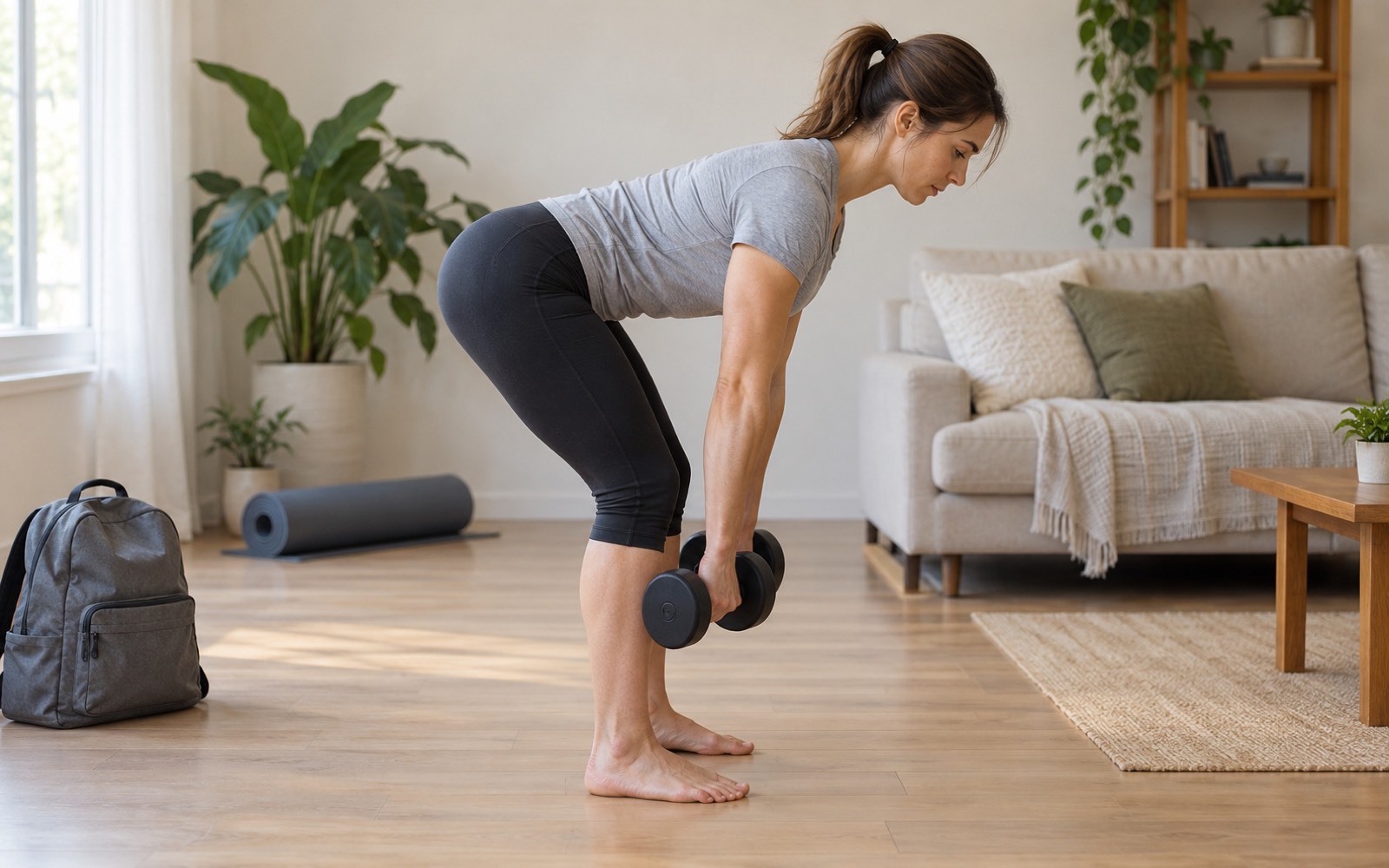
With dumbbells the form is identical — two dumbbells travel down the front of your thighs and end up around mid-shin at the bottom.
With dumbbells. Hold them at your thighs, palms facing you or facing each other, whichever feels more stable. This is the best starting point for beginners: no rack needed, you can start at home, and 5 kg (11 lb) and 8 kg (17.5 lb) pairs are in every gym. You can also hold one dumbbell with both hands in front of your thighs.
With a kettlebell. Hold it with both hands by the handle in front of your thighs, or between your legs. By weight it's close to a pair of dumbbells from section 08: 8–12 kg (18–26 lb) works for women, 16–24 kg (35–53 lb) for men.
In a Smith machine. On most machines the bar travels in a straight vertical line, while in a Romanian deadlift it moves along a slight arc close to your legs — so set your feet a little in front of the bar. The upside of a Smith machine is that the bar can't fall and can be hooked at any height; the downside is that the path is fixed for you instead of following your own hip hinge.
From a platform. Stand on a step platform or a weight plate about 15 cm (6 in) high so the bar can drop below foot level. Per Coratella's 2022 study from section 03, this loads the muscles harder than pulling from the floor. Move to it once your back stays flat through a full range of motion on the floor.
With a resistance band. Stand in the middle of a loop band and hold the ends. Resistance increases as you stand up — a good substitute for dumbbells when you're traveling.
On a cable machine. Stand facing away from a low pulley, run the rope or handle between your legs, hold it with both hands and hinge forward toward the machine. The cable pulls backward through the whole rep, so tension doesn't drop off at the top.
Wide stance. Feet wider than shoulder-width, toes turned out, a dumbbell or kettlebell held between your legs. This is a sumo-style Romanian deadlift; the form is the same — hips travel back, knees barely change angle. People choose it when it's easier to balance, or when holding one weight with both hands.
At home without dumbbells. Fill a backpack with books or water bottles — a 1.5-liter (50 oz) bottle weighs about 1.5 kg (3.3 lb), so four bottles give you 6 kg (13 lb). Hold the backpack by its straps in front of your thighs and hinge the same way you would with a dumbbell. With no weight at all, do the single-leg version instead: your full bodyweight loads one leg, which is plenty for your first few weeks. A full home routine built around the Romanian deadlift is in our dumbbell workout at home.
Single-leg Romanian deadlift
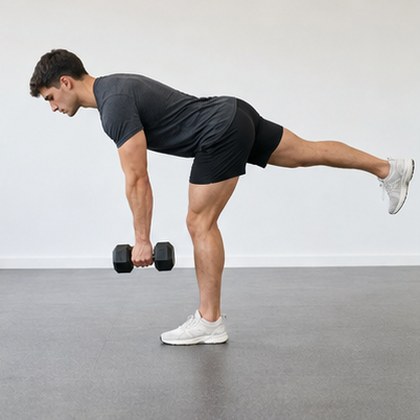
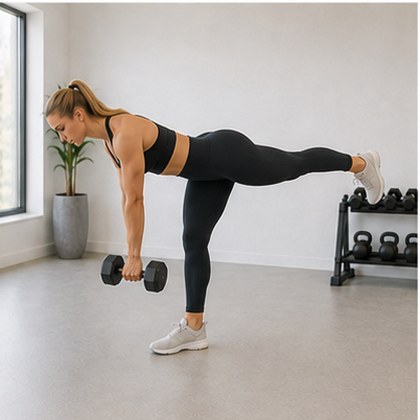
On one leg you do the same hinge, except your standing leg stays slightly bent and your other leg swings back in line with your torso, until your body forms a rough letter T.
The single-leg version loads the glutes and trains balance at the same time. In a 2009 study, Distefano and colleagues had 21 healthy, active people perform 12 popular glute exercises. In the single-leg deadlift, the gluteus maximus worked at 59% of maximal voluntary contraction — the same as in a single-leg squat. Band side steps produced 27%, and the "clamshell," lying on your side and opening your top knee, produced 34%. The gluteus medius, which keeps the pelvis level, also worked at 59% in the single-leg deadlift.
How to do it:
- Stance. Stand on your right leg, knee soft, and hold a dumbbell in your left hand. Holding the weight in the opposite hand makes it easier to stay balanced. You can also hold a dumbbell in each hand.
- The hinge. Push your hips back and lift your left leg back at the same time. Your torso and back leg move together like one board.
- The hips. Keep the toes of your back foot pointed at the floor. If that foot turns outward, your hips have opened up and the glute stops doing the work.
- Depth. Lower until your torso and back leg are close to parallel with the floor, or until your back stays flat. The dumbbell reaches about mid-shin.
- Standing up. Push through your standing leg and drive your hips forward.
- Support. For the first few weeks, hold a wall or a chair back with your free hand until your balance catches up with your muscles.
Start with no weight: 3 sets of 8–12 reps per leg, the same rep range ACSM recommends for beginners. Once every rep is clean and you don't need support, add a dumbbell — 6–12 kg (13–26 lb) for men, 4–8 kg (9–18 lb) for women.
 Single-leg, men’s set
 Single-leg, women’s set
Mistakes: where you feel it → what to fix
A correct Romanian deadlift feels like strong tension down the back of your thighs. If you feel it in your lower back, the front of your thighs, or behind your knee, the form has drifted:
| Where you feel it | What's wrong | The fix |
|---|---|---|
| Lower back, at the bottom | your back is rounding — you're going deeper than your flexibility allows, or the bar has drifted away from your legs | stop 3–5 cm (1–2 in) higher, keep the bar against your legs, drop some weight |
| Lower back, at the top | you're leaning back and arching your spine to finish | finish in a neutral standing position, squeeze your glutes, keep your ribs down |
| Front of the thighs | your knees keep bending more and more, and the lift has turned into a deadlift | lock in the knee angle from the first rep to the last |
| A sharp feeling right below the knee | your knees are locked straight | soften them, roughly 15° of bend |
| Nothing in the hamstrings | your spine is bending while your hips stay put | push your hips back harder — remember the car door — and drop the weight |
| Neck | your head is tilted back and you're staring at yourself in the mirror | look at the floor 1–2 meters (3–6 ft) ahead |
| Your hands give out before your legs | your grip is weaker than your hamstrings | use straps, or chalk |
Why it's your lower back and not your hamstrings. Mild fatigue along your spine is normal, as covered in section 02. If your lower back is tighter than your hamstrings, it's almost always one of three mistakes:
- the hinge is coming from your spine while your hips stay put;
- you're going deeper than your hamstring flexibility allows;
- the bar has drifted forward, away from your legs, increasing the leverage on your lower back.
The fix is the same for all three: less weight, hips further back, less depth, bar against your legs. If your back rounds slightly on the last rep, don't panic — it's usually a sign the weight or the depth is a bit too much right now. Finish the set, then make the next one lighter or shallower.
Sharp pain, pain that shoots down your leg, or one-sided pain is a reason to stop the set right away. Section 10 covers when that means seeing a doctor.
What weight to start with: an 8-week plan for women and men
Women should start with 5 kg (11 lb) dumbbells, men with 8 kg (17.5 lb), 3 sets of 10 with 2–3 reps in reserve, and add reps first, then weight.
The progression rule comes from that same 2009 ACSM position stand. A beginner needs a weight that allows 8–12 reps. Once you can do 1–2 reps more than that, increase the weight by 2–10%. A newer ACSM position stand came out in 2026, but this particular rule is unchanged from the older one.
There's a catch with light dumbbells. The jump between neighboring pairs is usually 1–2 kg (2–4 lb), so moving from a 5 kg (11 lb) pair to 6 kg (13 lb) is a 20% jump — double ACSM's upper limit. That's why in the plan below, reps drop back to 10 after every dumbbell increase and climb back to 12. A barbell has smaller jumps: two 1.25 kg (2.75 lb) plates add 2.5 kg (5.5 lb) total. On a 25–50 kg (55–110 lb) bar that's a 5–10% jump, small enough to add most weeks. On an empty 15 kg (33 lb) women's bar, the same 2.5 kg (5.5 lb) is already a 17% jump.
Eight weeks of Romanian deadlifts, in numbers. Two sessions a week, 3 working sets each. Volume is sets × reps × total weight lifted per session — for example, 3 sets × 10 reps × (2 × 5 kg) = 300 kg (660 lb).
| Week | Women | Volume | Men | Volume | What changed |
|---|---|---|---|---|---|
| 1 | 2 × 5 kg (11 lb) dumbbells, 3 × 10 | 300 kg (660 lb) | 2 × 8 kg (17.5 lb) dumbbells, 3 × 10 | 480 kg (1,060 lb) | starting point |
| 2 | 2 × 5 kg, 3 × 12 | 360 kg (795 lb) | 2 × 8 kg, 3 × 12 | 576 kg (1,270 lb) | +2 reps per set |
| 3 | 2 × 6 kg (13 lb), 3 × 10 | 360 kg (795 lb) | 2 × 10 kg (22 lb), 3 × 10 | 600 kg (1,325 lb) | weight up: +20% women, +25% men |
| 4 | 2 × 6 kg, 3 × 12 | 432 kg (950 lb) | 2 × 10 kg, 3 × 12 | 720 kg (1,585 lb) | +2 reps |
| 5 | 2 × 7 kg (15.5 lb), 3 × 10 | 420 kg (925 lb) | 2 × 12 kg (26 lb), 3 × 10 | 720 kg (1,585 lb) | weight up: +17% and +20% |
| 6 | 2 × 7 kg, 3 × 12 | 504 kg (1,110 lb) | 2 × 12 kg, 3 × 12 | 864 kg (1,905 lb) | +2 reps |
| 7 | 15 kg (33 lb) bar, 3 × 10 | 450 kg (990 lb) | 25 kg (55 lb) bar (20 kg bar + 2 × 2.5 kg), 3 × 10 | 750 kg (1,655 lb) | switch to a barbell: +7% and +4% over the dumbbells |
| 8 | 15 kg bar, 3 × 12 | 540 kg (1,190 lb) | 27.5 kg (60 lb) bar, 3 × 10 | 825 kg (1,820 lb) | women +2 reps, men +10% weight |
Over the 8 weeks, training volume per session grows 80% for women (300 to 540 kg / 660 to 1,190 lb) and 72% for men (480 to 825 kg / 1,060 to 1,820 lb). In the weeks where the weight goes up, volume barely grows or even dips slightly, because reps drop back down — that's intentional, since volume climbs again from added reps in the following week.
This is a typical path, not a fixed standard — some people move through it in 6 weeks, others need 10. Only add weight once every set is done with a flat back and 2–3 reps left in the tank. If 12 clean reps aren't happening at some point, stay at that week for another week or two.
If you're training at home with no barbell, weeks 7 and 8 work fine with 2 × 8 kg (17.5 lb) dumbbells for women (volume 480 and 576 kg / 1,060 and 1,270 lb) and 2 × 14 kg (31 lb) for men.
Is the Romanian deadlift alone enough? 3 sets twice a week is 6 sets for the hamstrings, and for muscle growth, ACSM's 2026 position stand recommends 10 or more sets a week. Make up the remaining 4 sets with leg curls, back extensions, or hip thrusts. For how to keep progressing once these eight weeks are done, see our guide to progressive overload.
How many sets and reps, and how often per week
A beginner is fine with 3 sets of 8–12 reps twice a week, stopping each set 2–3 reps short of failure.
The 2026 ACSM position stand updated the strength training guidelines that had been in place since 2009, drawing on 137 systematic reviews and more than 30,000 participants. Four of its conclusions apply directly to the Romanian deadlift:
- Volume. Muscles grow more with 10 or more sets per muscle per week.
- Frequency. Strength improves more with two or more sessions a week.
- Range of motion. A full range of motion produces more strength gain, so it's worth extending your depth as long as your back stays flat.
- Proximity to failure. Training to failure isn't necessary — 2–3 reps in reserve is enough.
Rest between sets — 1–2 minutes, per the 2009 ACSM recommendation for muscle growth.
Where to place it in your workout. Put the Romanian deadlift first or second in your session, while you're still fresh. Pairing it with squats on the same day is fine — that's a common leg-day combination. Heavy conventional deadlifts and Romanian deadlifts on the same day are a worse idea: both load the hamstrings and lower back, and the second lift will fight an already fatigued back.
What comes next. Once you've finished the plan in section 08, add variety: a 15 cm (6 in) platform, a 1–2 second pause at the bottom, or the single-leg version with a dumbbell. Change one thing at a time.
In the Sportygram app (go.sportygram.com; the interface and the coach are in Russian for now), the Romanian deadlift is available in three variations — barbell, dumbbell, and single-leg — each with its own technique photos. You can ask the virtual coach, Alex, in chat to add dumbbell Romanian deadlifts to Thursday's workout; he shows a confirmation card, and once you confirm, the exercise appears in that day's plan. Log your sets and weight in the workout diary, and the weight history shows when it's time to add more.
Who should be careful with the Romanian deadlift, and when to see a doctor
A healthy person can do Romanian deadlifts at any age, but with back pain, a recent hamstring strain, or during pregnancy, weight and range of motion should be discussed with a doctor.
- Chronic lower back pain, lasting longer than 12 weeks and not currently flared up. Here, exercise tends to help rather than hurt. In a 2021 Cochrane review, Hayden and colleagues pooled 249 studies and found that exercise reduced pain by an average of 15.2 points on a 0–100 scale compared with no treatment, usual care, or a placebo. Side effects were mostly minor, like soreness. A doctor or physical therapist should decide which exercises and how much weight, and the Romanian deadlift may not make that list.
- A disc herniation or protrusion. Hold off on Romanian deadlifts while it's flaring up. Once the pain settles, return under a doctor's guidance — the one who's seen your scans — starting with a dowel and shallow depth, then light dumbbells.
- A hamstring strain. Return only after your doctor clears you, starting shallow and light.
- Pregnancy. Talk to the doctor managing your pregnancy about the exercise. Typically the weight comes down, the depth shortens, and rest periods get longer.
- After 40 and after 60. Strength training is safe for healthy adults of any age. Per the 2026 ACSM position stand, an analysis of more than 38,000 people found no increase in the risk of serious adverse events from resistance training. With high blood pressure, heart disease, or joint issues, coordinate your program with a doctor and start with dumbbells and the supported single-leg version.
See a doctor if pain shoots down your leg, your foot goes numb or weak, the pain came on suddenly with a click mid-set, or it doesn't ease up after 2–3 days of rest. Which exercises help with lower back pain, and which to hold off on, is covered in our guide to lower back pain exercises.
Questions and answers
How is a Romanian deadlift different from a conventional deadlift?
A conventional deadlift starts from the floor, and the knees bend like a squat; a Romanian deadlift starts from the top, and the knees barely move. That's why the quads work more than twice as hard in a conventional deadlift: 58.6% versus 25.3% in Lee's 2018 study.
Are a Romanian deadlift and a stiff-leg deadlift the same thing?
No. A stiff-leg deadlift keeps the knees fully locked straight the whole set, and the weight usually starts from the floor. In Coratella's 2022 study, the Romanian deadlift loaded the semitendinosus harder, while the stiff-leg version loaded the gluteus maximus harder. They're related lifts, but not the same movement.
Which is better: Romanian deadlift with dumbbells or a barbell?
Pick whichever fits your setup. There's no direct study comparing the two, and even the 2026 ACSM position stand found no consistent difference in strength or muscle gain between free weights and machines in general. Dumbbells are more convenient at home and in your first weeks — no rack needed, and it's easy to start light. A barbell becomes useful once your dumbbells run out of weight, and it's easier to add small increments on it.
Why does my lower back hurt after Romanian deadlifts?
Usually one of three mistakes: the hinge is coming from your spine, you're going deeper than your flexibility allows, or the bar has drifted away from your legs. Mild next-day muscle fatigue along the spine can happen even with good form — that's soreness, and it goes away on its own in a few days. Sharp pain, pain shooting down your leg, or numbness means stop and see a doctor.
What weight should a woman start with for Romanian deadlifts?
Start with 5 kg (11 lb) dumbbells in each hand, 3 sets of 10. Following our plan, you can switch to a 15 kg (33 lb) barbell by week 7, or 8 kg (17.5 lb) dumbbells if you're training at home. Only add weight once every set of 12 reps happens with a flat back and 2–3 reps left in reserve.
How often should you do Romanian deadlifts per week?
Twice a week, 3 sets of 8–12 reps. For muscle growth, the 2026 ACSM position stand calls for 10 or more sets per muscle per week, so add 4 sets of leg curls, hyperextensions, or hip thrusts alongside your 6 sets of Romanian deadlifts. There's no benefit to doing it every day — hamstrings need recovery time.
Can you do Romanian deadlifts at home without dumbbells?
Yes. A backpack full of books or water bottles works (a 1.5-liter/50 oz bottle weighs about 1.5 kg/3.3 lb), or a resistance band under your feet, or the single-leg version with no weight at all. Once those get easy, it's time for a pair of adjustable dumbbells.
What's a good substitute for the Romanian deadlift?
For the hamstrings, a glute-ham raise works well if your gym has the machine — in McAllister's 2014 study, it loaded the hamstrings as hard as the Romanian deadlift. Other options are hyperextensions, machine leg curls, and the single-leg deadlift. If your goal is glutes specifically, add a hip thrust or a glute bridge.
The bottom line
- A Romanian deadlift is a hip hinge with your hips pushed back: knees bent at roughly 15° and barely changing angle, the bar sliding down your legs to about mid-shin or wherever your back stays flat.
- The hamstrings do most of the work, glutes assist, and the back holds position (McAllister, 2014; Martín-Fuentes, 2020).
- Compared with a conventional deadlift, the top-down start and nearly locked knees mean the quads work less than half as hard: 25.3% versus 58.6% (Lee, 2018).
- Start with 5 kg (11 lb) dumbbells for women and 8 kg (17.5 lb) for men, 3 × 10. Reps climb to 12 first, then weight goes up. By week 7 you can move to a barbell.
- Train it twice a week with 2–3 reps in reserve, and hit 10 sets a week for the hamstrings overall, combining it with other exercises (ACSM, 2026).
- Feeling it in your lower back? Less weight, hips further back, less depth, bar against your legs.
- Pain shooting down your leg, a numb foot, or sudden pain with a click: see a doctor.
Checklist: before a set of Romanian deadlifts
- In your dowel hinge, all three contact points hold: head, upper back, tailbone.
- Feet hip-width apart, soles flat and firm.
- Knees soft, angle barely changes through the set.
- The bar or dumbbells stay against your legs.
- Depth stops wherever your back is still flat.
- At the top: hips forward, glutes squeezed, no backward lean.
- The weight leaves 2–3 reps in reserve.
- Sets and weight logged in your workout diary.
Sources
- Lee S., Schultz J., Timgren J., Staelgraeve K., Miller M., Liu Y. An electromyographic and kinetic comparison of conventional and Romanian deadlifts. Journal of Exercise Science & Fitness, 2018. — 21 experienced men, matched load at 70% of Romanian deadlift max, bar to the floor; knees cued at roughly 15° of bend but averaging 33.9° at the bottom; rectus femoris 58.6% in the conventional lift versus 25.3% in the Romanian, gluteus maximus 51.5% versus 46.9%, no significant difference in the biceps femoris.
- Coratella G., Tornatore G., Longo S., Esposito F., Cè E. An Electromyographic Analysis of Romanian, Step-Romanian, and Stiff-Leg Deadlift: Implication for Resistance Training. International Journal of Environmental Research and Public Health, 2022. — 10 bodybuilders, 80% of max: the Romanian deadlift loaded the semitendinosus harder, the stiff-leg deadlift loaded the gluteus maximus harder; pulling from a 15 cm platform increased activity in the gluteus maximus, semitendinosus and longissimus.
- McAllister M.J., Hammond K.G., Schilling B.K., Ferreria L.C., Reed J.P., Weiss L.W. Muscle activation during various hamstring exercises. Journal of Strength and Conditioning Research, 2014. — 12 trained men, 85% of max: hamstrings worked hardest in the Romanian deadlift and the glute-ham raise, with the semitendinosus more active than the biceps femoris.
- Martín-Fuentes I., Oliva-Lozano J.M., Muyor J.M. Electromyographic activity in deadlift exercise and its variants. A systematic review. PLoS One, 2020. — 19 studies: in the Romanian deadlift, spinal erectors work less than the hamstrings, and the hamstrings are more active in variants with nearly straight knees.
- Morin T., Doguet V., Nordez A., Caillet A., Lacourpaille L. Minimal Role of Hamstring Hypertrophy in Strength Transfer Between Nordic Hamstring and Stiff-Leg Deadlift: A Blinded Randomized Controlled Trial. Journal of Strength and Conditioning Research, 2025. — 36 untrained people in three groups, 9 weeks, 3 sessions a week: stiff-leg deadlifts produced +7.0% hamstring volume and +11.2% semimembranosus growth; Nordic curls produced +11.4% and +24.3% in the semitendinosus; overall gains were comparable, and the authors recommend combining both exercises.
- Distefano L.J., Blackburn J.T., Marshall S.W., Padua D.A. Gluteal muscle activation during common therapeutic exercises. Journal of Orthopaedic & Sports Physical Therapy, 2009. — 21 people, 12 exercises: the single-leg deadlift produced 59% of maximal gluteus maximus and gluteus medius activation, band side steps produced 27% in the gluteus maximus, and clamshells produced 34%.
- Currier B.S., D'Souza A.C., Singh M.A.F. et al. American College of Sports Medicine Position Stand. Resistance Training Prescription for Muscle Function, Hypertrophy, and Physical Performance in Healthy Adults: An Overview of Reviews. Medicine & Science in Sports & Exercise, 2026. — 137 systematic reviews, more than 30,000 participants: 10 or more sets per muscle per week for hypertrophy, 2 or more sessions a week and full range of motion for strength; no consistent difference between free weights and machines or between training to failure and stopping short; resistance training was safe for healthy adults of any age, with no increase in serious adverse events across more than 38,000 people.
- American College of Sports Medicine. Progression models in resistance training for healthy adults. Medicine & Science in Sports & Exercise, 2009. — Beginners should train at a load allowing 8–12 reps, adding 2–10% once 1–2 extra reps are achievable; a slow-to-moderate tempo (1–2 seconds up and down) for beginners; 1–2 minutes of rest for hypertrophy.
- Hayden J.A., Ellis J., Ogilvie R., Malmivaara A., van Tulder M.W. Exercise therapy for chronic low back pain. Cochrane Database of Systematic Reviews, 2021. — 249 studies: for chronic low back pain lasting more than 12 weeks, exercise reduced pain by an average of 15.2 points out of 100 compared with no treatment, usual care, or placebo; adverse effects were mostly minor, such as soreness.
- Schmitz J. RDL: Where It Came From, How to Do It. IronMind. — The Sports Palace gym owner's and then USA Weightlifting president's account of how the exercise got its name from Nicu Vlad in San Francisco in 1990; 250 kg for 3 reps after a 220–230 kg clean and jerk; in his technique description the bar comes down to roughly 5 cm off the platform.
This article is for informational purposes only and is not a substitute for medical advice.