

the transverse abdominis does almost all the work in a stomach vacuum, while the rectus abdominis — the muscle behind your six-pack — barely engages at all (Urquhart, 2005; Chanthapetch, 2009). A beginner is fine with 10 seconds × 10 reps, breathing normally: that's close to what the NHS, the UK's public health service, gives women after childbirth. Six weeks of three one-hour sessions a week grew the muscle's cross-sectional area (Koh, 2014), while two weeks changed nothing about its thickness at rest (Lee, 2018). It doesn't touch belly fat: 5 minutes at 70 kg (154 lb) burns roughly 17 kcal. In postpartum diastasis recti, the gap between the abdominal muscles actually gets 2–4 mm wider while you hold the vacuum (Theodorsen, 2019), and the breath-hold version raises blood pressure (de Lucena, 2021) — skip that version if you're pregnant or have high blood pressure.
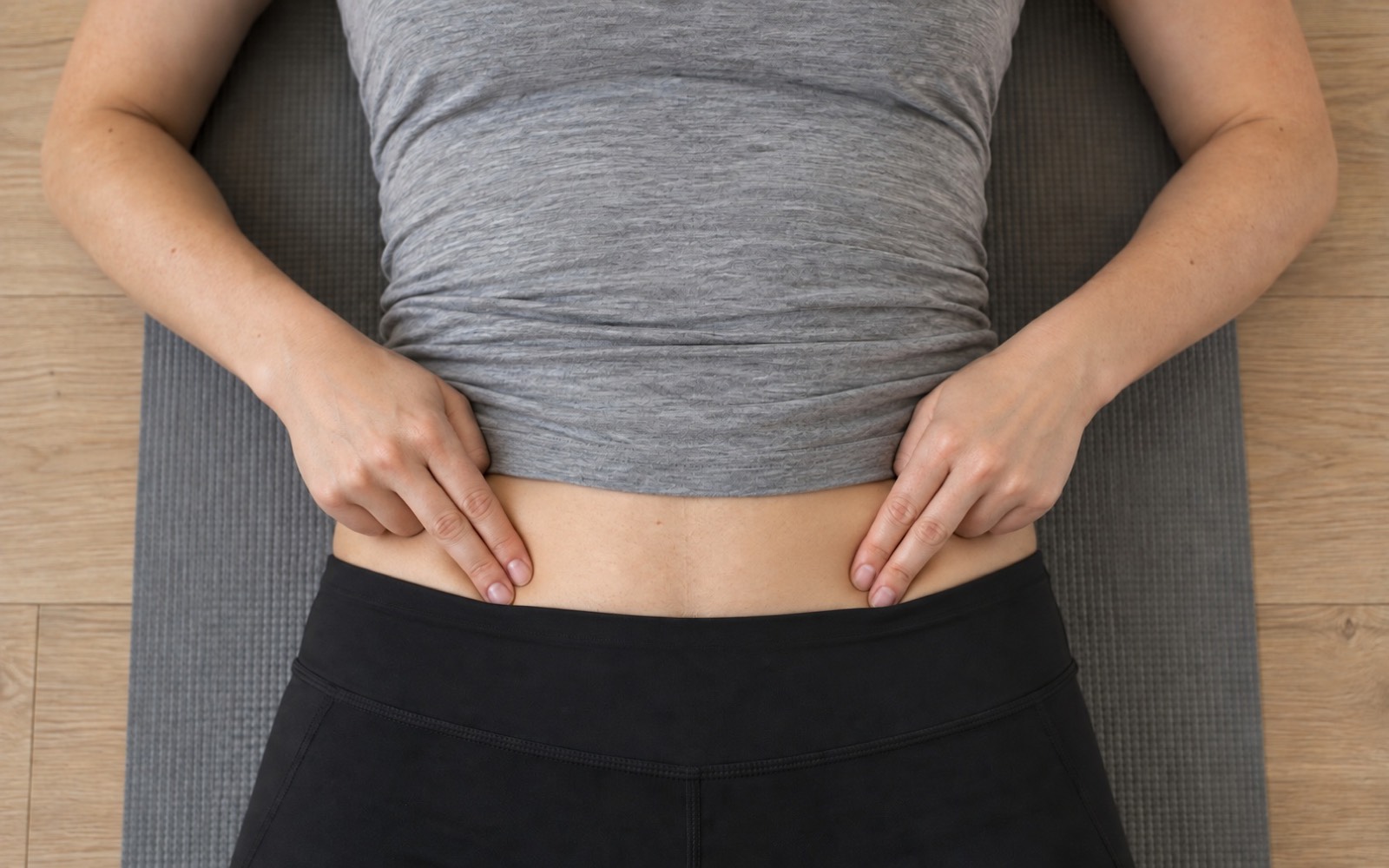
The stomach vacuum is an exercise where you pull your lower belly in toward your spine and hold it there for a few seconds. The main muscle doing the work is the transverse abdominis, the deepest layer of your abs: it wraps around your waist like a belt. You do it lying on your back with your knees bent: exhale, gently draw the lower belly in, and hold for 10 seconds while you keep breathing. The vacuum trains you to hold your stomach in, but it doesn't burn the fat sitting on top of it.
What is a stomach vacuum and which muscles does it work
A stomach vacuum is holding your lower belly drawn in toward your spine, and the transverse abdominis does most of the work. Its fibers run sideways around your torso, from your spine, around your waist, to the linea alba — the strip of connective tissue down the front of your abdomen — so when it contracts, it cinches your waist like a corset. The internal and external obliques sit above it, and the rectus abdominis, your six-pack muscle, sits in front of all of them.
In 2005, a team led by Donna Urquhart recorded electromyography — the electrical activity of muscle contractions — across different layers of the abdominal wall. Drawing the lower belly in while lying down activated the transverse abdominis more than the obliques or rectus, while bracing the whole core mainly fired the external oblique instead. In 2009, Chanthapetch and colleagues had 32 healthy people around 21 years old draw their bellies in from four different starting positions, and in every position the transverse abdominis and internal oblique worked hardest, with the rectus abdominis working least.
| Muscle | Where it sits | What it does during a vacuum | Source |
|---|---|---|---|
| Transverse abdominis | deepest layer, wraps the waist | the main mover: pulls the belly inward | Urquhart, 2005; Chanthapetch, 2009 |
| Internal oblique | above the transverse, on the sides | works alongside the transverse abdominis; the two were recorded together | Chanthapetch, 2009 |
| External oblique | surface layer, on the sides | works lightly; becomes the main mover when you brace the whole core | Urquhart, 2005; Chanthapetch, 2009 |
| Rectus abdominis (the "six-pack") | front, from the ribs to the pubic bone | barely involved, weakest of the four in every position | Chanthapetch, 2009 |
| Pelvic floor muscles | base of the pelvis | lift less than during a direct squeeze, and drop in some women | Bø, 2003 |
| Inhalation muscles | rib cage | only in the breath-hold version: they widen the ribs on a "false inhale" | described this way by Soto-González, 2024 |
Two different exercises share one name. What's often called "the stomach vacuum" is actually two moves, and your choice between them decides both the benefit and the risk.
- The normal-breathing vacuum. You gently draw the lower belly in on an exhale and hold it while continuing to breathe. In physical therapy this is called abdominal hollowing or the abdominal drawing-in maneuver (ADIM), and it's the version the NHS gives postpartum. We didn't find evidence of harm for this version — the caveats are limited to diastasis recti, the separation of the abdominal muscles after pregnancy, and a weak pelvic floor (sections 07 and 08).
- The breath-hold vacuum. You exhale fully and take a "false inhale": you widen your rib cage without letting air in, and your stomach pulls up under your ribs. This version comes from yoga (uddiyana bandha), from classic bodybuilding, where the vacuum was a stage pose, and from hypopressive training. It raises your blood pressure and isn't right for everyone (section 08).
Nauli is a separate yoga technique where you isolate the rectus abdominis and roll it in a wave — a beginner doesn't need it, and we're not covering it here. The muscle and the technique are the same for men and women.
How to do a stomach vacuum: step-by-step technique
Lie on your back, bend your knees, inhale calmly, and on the exhale gently pull your lower belly in toward your spine, like you're cinching a corset, then hold for 10 seconds while continuing to breathe.
- Position. Lie on a mat, knees bent, feet hip-width apart, and don't press your lower back flat into the floor. After childbirth, lying on your side is more comfortable, as the NHS describes.
- Finger check. Place two fingertips just inside and below the bony points of your hips.
- Inhale. Breathe in calmly through your nose; your belly rises gently.
- Exhale and draw in. On a slow exhale, pull your lower belly, below your navel, in and slightly up. You'll feel a soft tension under your fingers. If your belly pushes out instead, you're straining rather than drawing in.
- Effort. Aim for roughly 30–50% of your maximum — that's a practical guideline, not a number from research. Pull in with everything you've got and your obliques take over while your breathing falls apart.
- Ribs and shoulders. Keep your ribs still, shoulders and neck relaxed.
- Breathing. Breathe normally through your chest and sides while your lower belly stays drawn in. If you can say a short sentence out loud, you're not holding your breath.
- Hold and rest. Hold for 10 seconds, release completely, rest for 10 seconds. Do 10 reps total.
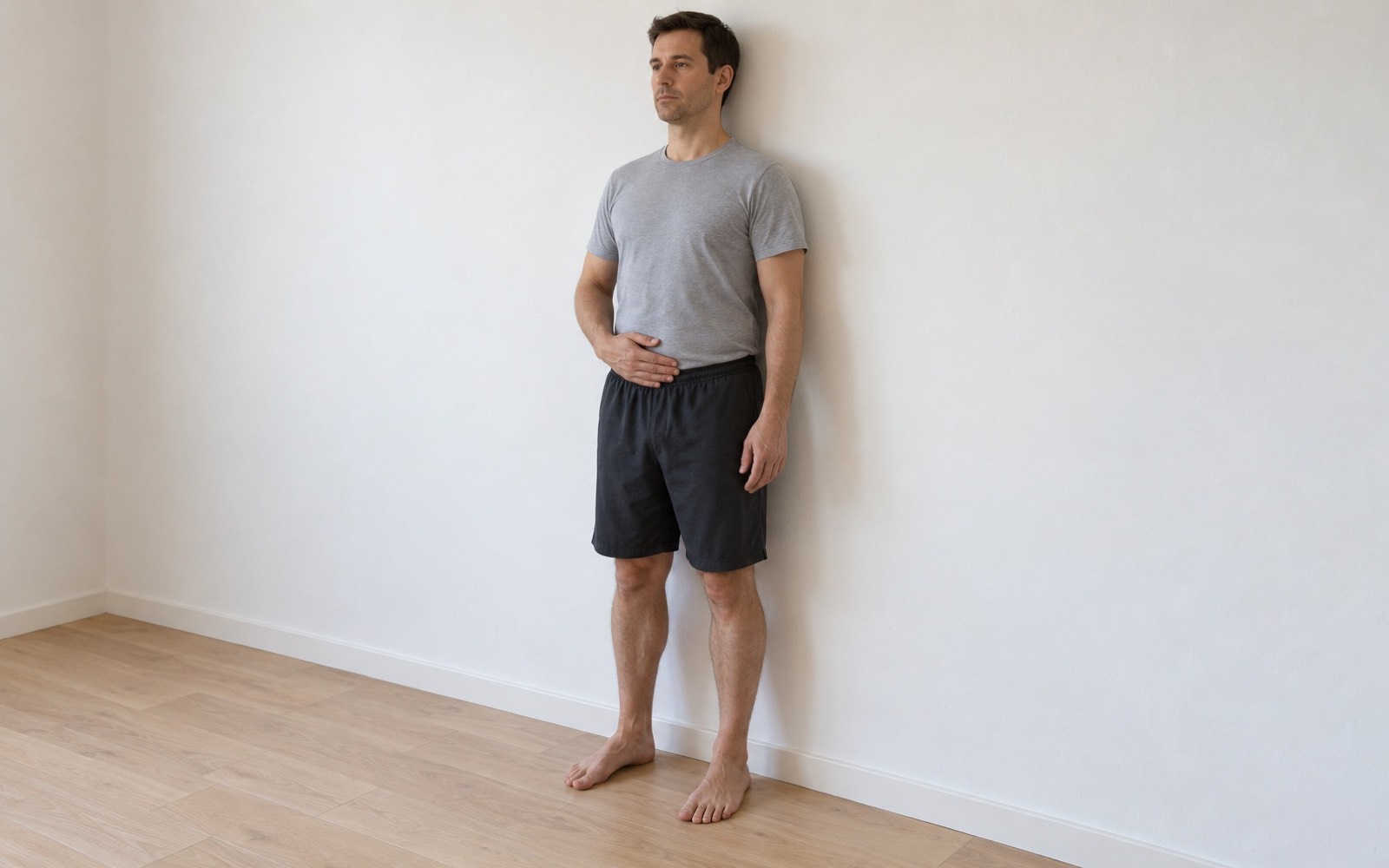
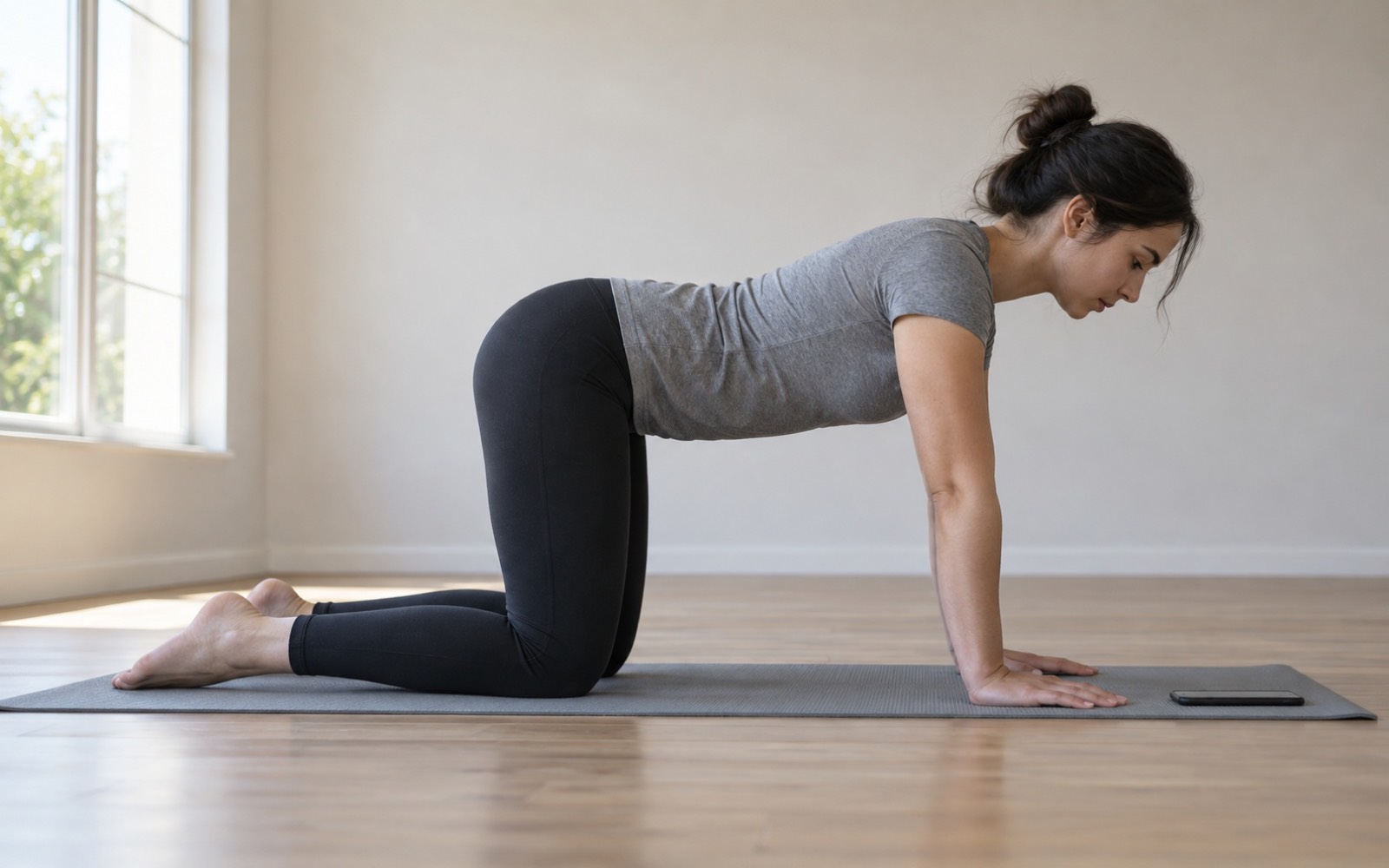
Pick whichever position works for you. In Chanthapetch's study, all four positions — on your back, on your stomach, on hands and knees, and standing against a wall — activated the transverse abdominis. From there, it's practice. Lying on your back makes the muscle easiest to feel, so start there. On hands and knees is harder, since your belly sags under its own weight; put a towel under your knees. Sitting works well at a desk during the day. Standing against a wall makes it easier not to arch your back, and from there it's a short step to doing the vacuum while walking.
The breath-hold vacuum is worth learning once the basic version works well standing up. Stand with your knees slightly bent, hands braced on your thighs. Take three calm breaths in and out, exhale fully, and don't inhale. Without opening your throat, widen your ribs as if you were inhaling, and your stomach will pull up under your ribs. Hold for 5–10 seconds, release, and inhale; take 3–4 calm breaths between reps. In a 2024 trial by Soto-González, women held the breath-hold for at least 10 seconds, did 3 reps, and were coached by two physical therapists.
Variations and substitutes.
- At home, a mat, a wall and a chair are all you need.
- With dumbbells, you don't hold weight during the vacuum itself — there's no reason to. A dumbbell is more useful for a dead bug or for carrying a heavy dumbbell in one hand on a walk, where a braced belly keeps your torso stable.
- At the gym, the vacuum works as a warm-up before ab work, 2–3 sets of 10 seconds. During heavy squats and deadlifts, you brace your whole core instead (section 06).
- If the vacuum doesn't work for you, swap in a dead bug, a plank, or a bird-dog, where you extend opposite arm and leg on hands and knees.
for your first few sessions, stand sideways to a mirror, or lay a bathrobe belt across your lower belly. Done right, your lower belly pulls in and your ribs stay put. If you feel the urge to hold your breath, you're pulling in too hard — cut the effort in half.
How long to hold it and how many reps
Start with 10 seconds × 10 reps, breathing normally, once a day, 5–6 days a week. After 2–3 weeks, move to 15–20 seconds; the practical ceiling for the normal-breathing version is around 30 seconds. That's under 4 minutes a day including rest. This starting scheme comes from the NHS, which has people hold to a count of 10 and repeat up to 10 times while breathing normally. The breath-hold version is held for 5–10 seconds, for 3–5 reps.
Popular articles online throw around everything from "no more than 20 seconds" to "up to 60 seconds." The longer numbers usually describe the breath-hold version or the stage pose. On a long hold, it's easy to start holding your breath or letting the rectus abdominis help out. There's no research on the ideal hold time, so 10 and 30 seconds are practical guardrails, not hard limits from a study.
When to expect results. In Lee's 2018 study, 20 healthy people trained abdominal hollowing for two weeks, and their abdominal muscle thickness at rest didn't change. But the people who watched their own muscle on an ultrasound screen got better at firing the transverse abdominis separately from the obliques. The first two weeks are for learning to switch the muscle on. In Koh's 2014 study, 30 middle-aged women trained either hollowing or full-core bracing for six weeks, three one-hour sessions a week. After hollowing, the transverse abdominis grew on both sides; after bracing, the obliques grew, and for engaging the abdominal muscles as a whole the authors judged bracing the more effective approach. With short daily sets, growth may take longer than six weeks to show up.
Morning, evening, on an empty stomach. There's no research comparing times of day, so do it whenever suits you. The one thing to avoid is right after a meal — drawing in on a full stomach is uncomfortable. Before breakfast or two hours after eating works well. The basic version is fine to do every day.
Mistakes: why it's not working and why your stomach hurts after
Usually what gets in the way is holding your breath, drawing in the upper belly instead of the lower belly, or pulling in too hard. Check your own sensations against this table.
| What you feel | What's wrong | How to fix it |
|---|---|---|
| Can't breathe, face turning red | Holding your breath in the basic version | Cut the effort in half and count out loud |
| Ribs and shoulders lift, neck is tense | Drawing in the upper belly and chest | Work the lower belly below the navel, shoulders down |
| Belly bulges under your fingers | Straining instead of drawing in | Exhale, release, and start again more gently |
| Downward pressure toward the pelvic floor | The pelvic floor may be dropping: it happened in 6 of 20 women in Bø, 2003 | Lift the pelvic floor along with the belly — that dropped it to 2 of 20; see a doctor if urine leaks |
| Pulling in the lower back, spine arching | Your pelvis is tilting forward | Lying down, your lower back should touch the floor lightly; standing, do it against a wall |
| Feeling dizzy | Holding your breath or fast, deep breathing | Sit down, breathe calmly, go back to the basic version |
| Stinging or pulling in your stomach afterward | Training right after a meal, or holding too long | Wait 2 hours after eating and shorten your holds |
Why your stomach hurts after a stomach vacuum. Mild muscle fatigue the next day, after your first sessions, is normal. A stinging pain right after a session usually comes from a full stomach or from pulling in too hard or too long. See a doctor if the pain is sharp, doesn't ease off by the next day, or if you notice a bulge at your navel or in your groin when you strain — that can be a sign of a hernia.
What the stomach vacuum does — and doesn't do — for your waist, abs and belly fat
The vacuum strengthens the transverse abdominis and teaches you to keep your belly tucked, but it doesn't burn belly fat and it doesn't carve a six-pack.
| The claim | What the research showed | What it means for you |
|---|---|---|
| A flatter stomach, a smaller waist | Martins Rodrigues, 2024: in a review of 5 studies, waist circumference shrank, but the methods were weak and the authors didn't recommend the practice | Your stomach may look tighter if the deep muscle was weak, but the fat stays |
| Burns belly fat | Vispute, 2011: 6 weeks of ab exercises didn't change belly fat or waist size | The vacuum doesn't burn fat |
| Strengthens the muscle | Koh, 2014: the transverse abdominis grew over 6 weeks; Lee, 2018: no change at 2 weeks | The muscle does get stronger — noticeably, by around 6 weeks |
| Reveals a six-pack | Chanthapetch, 2009: the rectus abdominis works weakest of all during drawing-in | The vacuum barely touches six-pack development |
| Treats back pain | Saragiotto, 2016 (Cochrane): it helps, on par with other exercise | Fine to use if you enjoy it |
| Closes diastasis recti | Mota, 2015; Theodorsen, 2019: the gap widens during the hold; Moreira, 2026: unchanged after 12 weeks; Soto-González, 2024: narrowed about as much as regular training | Useful as a skill, but movement-based exercises are what close the gap |
| Strengthens the pelvic floor, "lifts your organs" | Bø, 2003: the pelvic floor lifts 2.6 times less than during a direct squeeze | Train the pelvic floor separately |
| Improves digestion, helps with constipation | We didn't find solid trials on this | We won't promise it |
Waist size. Martins Rodrigues's 2024 review gathered studies on hypopressive training — the breath-hold vacuum — in healthy women. Out of 410 papers, 5 met the criteria, and the main outcome, waist circumference, went down in them. But because of serious methodological problems, the authors stopped short of recommending the practice. If your transverse abdominis was weak to begin with, your belly may stick out less, but that isn't fat loss.
Fat. In Vispute's 2011 trial, 24 sedentary people did seven ab exercises, two sets of 10, five days a week for six weeks, without a calorie deficit. Body weight, body fat percentage and waist circumference didn't change in any meaningful way. The only thing that improved was ab endurance: 47 sit-ups versus 32 for the people who didn't train.
Calories. The 2024 Compendium of Physical Activities has no dedicated code for the stomach vacuum. Its MET values show how many times more energy an activity burns compared with resting. Treating the vacuum as light calisthenics like a plank (2.8 MET) and running the Compendium's formula — MET × 3.5 × weight in kg ÷ 200 — gives about 17 kcal for 5 minutes at 70 kg (154 lb), 15 kcal at 60 kg (132 lb), and 22 kcal at 90 kg (198 lb). A month of daily practice at 70 kg adds up to roughly 515 kcal, but you'd burn about a third of that just lying on the couch (1 MET). Above resting, that's about 330 kcal — the energy in about 37 g (1.3 oz) of pure fat.
A six-pack comes from a well-developed rectus abdominis and a low body fat percentage over it, and the rectus abdominis is the weakest-working muscle during a vacuum. For how to train your abs for every job they actually do, see abs are built by training.
If your goal is a smaller belly, you need a calorie deficit. For activity, the WHO's 2020 guidelines call for 150–300 minutes a week of moderate activity, like walking, plus strength training for all the major muscle groups on 2 or more days a week. For a plan and a realistic timeline, see how to lose belly fat. The easiest way to track a deficit is the food diary in the Sportygram app: calories, protein, fat, carbs and water, with search across a database of roughly 101,000 foods and a barcode scanner, while your profile calculates your calorie target; note that the app is currently in Russian.
Does it help with back pain, and do you need it at the gym
For chronic low back pain, the vacuum helps as part of motor control exercise for the deep core muscles, roughly as much as other exercise does. Before a heavy set at the gym, you brace your whole core, from every side, instead.
A 2016 Cochrane review by Saragiotto pooled 29 trials and 2,431 people with chronic low back pain. Motor control exercise starts by engaging the deep core muscles, including the transverse abdominis, and builds up to more complex movement. Compared with minimal treatment, it lowered pain in the long run by roughly 13 points out of 100, with low-to-moderate confidence in that number. Compared with other exercise, and with manual therapy, there was no clinically meaningful difference — so the authors advise picking exercise based on preference, cost and safety. The vacuum is a fine choice if you like it, and other exercise you enjoy will help about as well.
In 2007, Stephen Grenier and Stuart McGill recorded muscle activity in 8 healthy men holding a load and calculated spinal stability using a model of the spine. In their calculated ideal case, bracing the whole core gave 32% more stability than hollowing, at the cost of 15% more compression on the spine. The transverse abdominis on its own contributed just 0.14% of that stability.
The vacuum is worth doing to feel the deep layer of your abs and to hold your stomach in day to day. In a squat, a deadlift, or an overhead press, the job is different: before a heavy rep, breathe into your belly and brace the muscles around your whole waist, as if you were braced for a light punch. Gyms call this bracing. For how to combine it with your breathing, and why holding your breath is risky with high blood pressure, see how to breathe during exercise. With acute back pain, pain radiating down a leg, or numbness, see a doctor first.
Stomach vacuum after childbirth and with diastasis recti: what the measurements show
The gentle, normal-breathing vacuum is what the NHS gives women after childbirth as an exercise for the deep abdominal muscles. It doesn't close a diastasis recti gap on its own — while you hold it, the gap actually gets 2–4 mm wider. Movement-based ab exercises are what narrow it. Diastasis recti is a separation of the rectus abdominis muscles along the linea alba, most often appearing during pregnancy. The table below shows ultrasound and blood pressure measurements taken during a vacuum; the percentages are our own calculations from the raw numbers.
| What was measured | In whom | At rest | During the vacuum | Difference (our calculation) | Source |
|---|---|---|---|---|---|
| Gap between the rectus muscles, 2 cm above the navel | 38 postpartum women with a gap at least two fingers wide | 25.7 mm | 28.4 mm | +2.8 mm, about +11% | Theodorsen, 2019 |
| Same gap, 2 cm below the navel | same women | 21.0 mm | 23.3 mm | +2.3 mm, about +11% | Theodorsen, 2019 |
| Gap above the navel, vacuum plus a pelvic floor squeeze | same women | 25.7 mm | 29.6 mm | +3.9 mm, about +15% | Theodorsen, 2019 |
| Gap below the navel, at 6–8, 12–14 and 24–26 weeks postpartum | 84 first-time mothers | — | — | +3.0 / +1.8 / +2.5 mm | Mota, 2015 |
| Same gap at 35–41 weeks of pregnancy | same women | — | — | −3.8 mm, a narrowing | Mota, 2015 |
| Pelvic floor lift | 20 women physical therapists | — | 4.3 mm vs. 11.2 mm with a direct squeeze | about 38%; dropped in 6 of 20 (30%) | Bø, 2003 |
| Pelvic floor lift, vacuum plus a pelvic floor squeeze | same women | — | 8.5 mm vs. 11.2 mm | about 76%; dropped in 2 of 20 (10%) | Bø, 2003 |
| Blood pressure during a breath-hold after exhaling | 10 women with normal blood pressure | baseline | systolic and mean pressure rose | back to baseline by the 5-minute rest mark | de Lucena, 2021 |
The math: 2.8 / 25.7 = 10.9%; 2.3 / 21.0 = 11.0%; 3.9 / 25.7 = 15.2%; 4.3 / 11.2 = 38.4%, meaning 2.6 times weaker; 8.5 / 11.2 = 75.9%; 6 of 20 = 30%; 2 of 20 = 10%. When the pelvic floor was squeezed along with the belly, the number of women whose pelvic floor dropped fell from 6 to 2. That's why the postpartum version pairs breathing with a pelvic floor squeeze, and the breath-hold version is left to healthy people. For comparison, the crunch in Mota's study did narrow the gap.
What the NHS recommends. Lie on your side, and on an exhale draw your lower belly in like a corset while squeezing your pelvic floor at the same time; hold to a count of 10, breathing normally, for up to 10 reps. Early on, skip sit-ups, planks, jumping, straining and heavy lifting. If the gap is still visible 8 weeks after giving birth, see a doctor.
So why do the vacuum after birth at all? In a 2016 study by Diane Lee and Paul Hodges, 26 women with diastasis did a regular crunch that narrowed the gap but distorted the linea alba. When they engaged the transverse abdominis before the crunch, the gap narrowed less, but the distortion was smaller too. The authors think this may help the belly transfer force better from one side to the other. So the postpartum vacuum is a skill you later fold into movement-based exercise.
What full programs deliver. In Moreira's 2026 trial, 44 women 1.5–6 months postpartum with a gap of 20 mm or more trained hypopressive exercise for 12 weeks, twice a week for 30 minutes. Compared with women who didn't train, the gap didn't change. But they held a forearm plank 34 seconds longer, and pelvic floor complaints dropped by 4 points. In Soto-González's 2024 trial, 28 women at least 8 weeks past a vaginal birth trained for 6 weeks, 12 one-hour sessions. The gap narrowed by about 3 mm, equally in the hypopressive group and the regular-exercise group. A 2025 review by de Oliveira, covering 34 trials, found that only movement-based ab exercises meaningfully narrow the gap, though confidence in that finding is very low.
After a C-section, there's no data on timing. The WHO advises returning to activity gradually and with a doctor's input, and Soto-González's trial excluded women who'd had a C-section or a hernia altogether. A gentle vacuum starts once a doctor clears the incision as healed. For a full program and how to check your own gap at home, see diastasis recti exercises.
Who should skip the stomach vacuum: blood pressure, pregnancy, pelvic floor, hernias
We didn't find evidence of harm from the normal-breathing vacuum. Skip the breath-hold version if you have high blood pressure or heart disease, are pregnant, have a hernia, are in your first weeks postpartum, or have had abdominal surgery.
Blood pressure and heart disease — there's data. Hypopressive training is generally advised against for people with cardiovascular disease, because holding your breath after exhaling is thought to raise blood pressure. In de Lucena's 2021 study, 10 women with normal blood pressure and experience with this type of training did 3 sets of 8 breath-hold cycles. Systolic and mean arterial pressure rose significantly, and were back to baseline by the 5-minute rest mark. Two of the paper's authors teach this method themselves, which is worth keeping in mind. In Nataesh's 2025 study, 30 healthy students saw their diastolic blood pressure rise right after uddiyana bandha and return to normal within 10 minutes. With high blood pressure or heart disease, stick to the normal-breathing version, and talk to a doctor first.
Pregnancy — there's WHO guidance. In 2020, the WHO advised pregnant people, after the first trimester, to avoid exercise lying flat on their back. Pelvic floor training, per the WHO, is fine every day and lowers the risk of urinary incontinence. We didn't find studies on the breath-hold vacuum during pregnancy; since it raises blood pressure, skip it while pregnant. Talk to the doctor managing your pregnancy about a gentle, lying-on-your-side or seated version.
Pelvic floor — there's data. In Bø's 2003 study, the pelvic floor dropped during belly drawing-in in 6 of 20 women physical therapists, despite the fact that they teach this exercise themselves. If you leak urine when you cough or jump, or feel heaviness in your pelvis, start with pelvic floor exercises and see a gynecologist. In that case, only do the vacuum together with a pelvic floor squeeze, the way the NHS version does it.
Hernias, abdominal surgery, flare-ups of stomach or gut conditions — caution, without dedicated research. We didn't find specific studies here. The breath-hold version is built around changing the pressure inside your abdomen — that's where "hypopressive" comes from — so skip it in these cases. Start the basic version only once your surgeon or gastroenterologist clears you.
Periods, an IUD, fibroids — bans from yoga tradition, no research behind them. We didn't find solid evidence of harm from the vacuum in these cases. If your lower belly hurts or your flow is heavy, skip the session. With fibroids or an IUD, and any doubt, ask your gynecologist.
See a doctor if you notice a bulge at your navel or in your groin, belly pain that doesn't ease off, urine leaking, a postpartum gap that's still visible after 8 weeks, or your vision darkening during a vacuum.
A 4-week stomach vacuum program
Four weeks, 5–6 days a week: from 10 seconds lying down to 20–30 seconds standing and moving, and you move to the next week only once the current one works with normal breathing. The 10×10 starting point comes from the NHS, the position changes from Chanthapetch's 2009 study, and the rest is practical guidance.
| Week | Position | Hold × reps, rest | Times a day × days a week | The "gate": when to move on |
|---|---|---|---|---|
| 1 | On your back, knees bent (on your side, postpartum) | 10 sec × 10, 10 sec rest | 1 × 5–6 | You can hold 10 sec and still say a sentence |
| 2 | On hands and knees, plus one set lying down | 10–15 sec × 8–10, 10–15 sec rest | 1–2 × 5–6 | Your belly doesn't sag on hands and knees |
| 3 | Seated in a chair, and standing against a wall | 15–20 sec × 6–8, 15 sec rest | 1–2 × 5–6 | You can hold 20 sec standing without holding your breath |
| 4 | Standing and moving: 1–2 minutes of vacuum while walking, dead bug 2 × 8 per side | 20–30 sec × 5–6 | 1–2 × 5–6 | Your belly stays tucked while moving, breathing stays even |
| Healthy people only | Breath-hold vacuum, standing or on hands and knees | 5–10 sec × 3–5, 3–4 breaths between reps | no more than once a day | Skip with high blood pressure, heart disease, pregnancy, hernia, and in the early weeks postpartum or after surgery |
Time under tension per set runs from about 100 seconds in week one to 100–180 seconds by week four: one set with rest takes 3–5 minutes, not counting the walking version. If you don't clear a "gate," stay on that week for another 7 days. After the program, keep the vacuum as a 2–3-times-a-week warm-up and hand the main work over to movement-based exercise: dead bugs, planks, lying leg raises.
The stomach vacuum is one of the 142 exercises with photos in the workout diary on Sportygram. You can add it to your day plan, and Alex, the virtual coach in the chat, will add it to a workout through a confirmation card, move a session to another day, or mark one as done. The app and Alex are currently in Russian.
Questions and answers
Does the stomach vacuum help you lose belly fat?
No, it doesn't burn belly fat. In Vispute's 2011 study, even 6 weeks of ab exercises, 5 days a week, changed neither belly fat nor waist circumference. Five minutes of vacuuming at 70 kg (154 lb) burns about 17 kcal. Your stomach can look tighter if the deep muscle was weak, but the inches only come off with a calorie deficit.
How long should you hold a stomach vacuum, and how many reps?
As a beginner: 10 seconds × 10 reps with normal breathing, the NHS scheme. After 2–3 weeks, move to 15–20 seconds, with a practical ceiling around 30 seconds, 5–6 days a week. The breath-hold version is held for 5–10 seconds.
Can you do stomach vacuums every day?
The basic version, yes. There's no research on the best frequency, but pelvic floor exercises, which the NHS pairs with the postpartum vacuum, are recommended at least 3 times a day. For muscle growth, Koh's 2014 study found 3 one-hour sessions a week enough. Do the breath-hold version no more than once a day, and only if you're healthy.
When will you see results from stomach vacuums?
Muscle thickness doesn't change in the first two weeks — that's when you're learning to fire the muscle on its own, separately from the obliques (Lee, 2018). Cross-sectional area of the transverse abdominis grew after six weeks of three one-hour sessions a week (Koh, 2014).
Can you do stomach vacuums after giving birth and with diastasis recti?
Yes, as a skill: gently, on an exhale, lying on your side and paired with a pelvic floor squeeze, the way the NHS recommends. During the hold itself, the gap is 2–4 mm wider (Theodorsen, 2019). Over 12 weeks of hypopressive training it didn't change at all (Moreira, 2026); in another trial, six weeks narrowed it by 3 mm, the same as regular exercise (Soto-González, 2024). Movement-based exercise closes the gap most reliably — see the program in our diastasis recti exercises guide. If the gap is still visible after 8 weeks, see a doctor.
Is it safe to do a stomach vacuum during pregnancy?
Not the breath-hold version. There's no safety data on it in pregnant people, and it raises blood pressure. The WHO's 2020 guidance tells pregnant people to avoid exercise lying flat on their back after the first trimester, while pelvic floor training is fine daily. Discuss a gentle, side-lying or seated drawing-in with the doctor managing your pregnancy.
Can you do a stomach vacuum on your period?
We didn't find research showing harm from the vacuum during your period — that restriction comes from yoga tradition. If your lower belly hurts or your flow is heavy, skip the session, and ask your gynecologist if you have fibroids or an IUD.
Why does your stomach hurt after doing stomach vacuums?
Usually from pulling in too hard, holding your breath, or training right after a meal — ease off, keep breathing, and train about 2 hours after eating. Sharp pain, pain that's still there the next day, or a bulge at your navel or in your groin are reasons to see a doctor.
The bottom line
- A stomach vacuum is holding your lower belly drawn in. The transverse abdominis does the work; the rectus abdominis barely engages (Urquhart, 2005; Chanthapetch, 2009).
- Technique: lie down, knees bent, exhale and gently draw your lower belly in, hold while continuing to breathe.
- Start with 10 seconds × 10 reps (NHS). The muscle doesn't change in the first two weeks (Lee, 2018); cross-sectional area grows after six weeks of three one-hour sessions (Koh, 2014).
- It doesn't touch belly fat: 5 minutes at 70 kg (154 lb) burns roughly 17 kcal.
- After childbirth, the vacuum is a skill: the diastasis gap gets 2–4 mm wider during the hold, and movement-based exercise is what closes it. Squeeze your pelvic floor along with your belly.
- The breath-hold version raises blood pressure (de Lucena, 2021): skip it with high blood pressure, heart disease, pregnancy, or a hernia.
- The 4-week program moves you from 10 seconds lying down to 20–30 seconds standing and walking.
Checklist: stomach vacuum without the risk
- Start on your back, knees bent.
- Draw your lower belly, below the navel, in on an exhale.
- Keep your ribs and shoulders still, neck relaxed.
- Breathe, and check you can still say a short sentence.
- 10 seconds × 10 reps, 5–6 days a week, and move up only through the "gates."
- Don't train right after a meal.
- After childbirth: lie on your side and pair it with a pelvic floor squeeze.
- Brace your whole core before a heavy lift.
- No breath-holding with high blood pressure, heart disease, pregnancy, or a hernia.
- A bulge, pain that doesn't ease off, or leaking urine: see a doctor.
Sources
- Urquhart D. M. et al. Abdominal muscle recruitment during a range of voluntary exercises. Manual Therapy, 2005. — Drawing the lower belly in while lying down activated the transverse abdominis more than the obliques or rectus; bracing the whole core mainly activated the external oblique.
- NHS. Your post-pregnancy body. NHS (UK), 2026. — An exercise for the deep abdominal muscles after childbirth, hold to a count of 10 for up to 10 reps; see a doctor if the gap is still visible after 8 weeks.
- Koh H. W., Cho S. H., Kim C. Y. Comparison of the Effects of Hollowing and Bracing Exercises on Cross-sectional Areas of Abdominal Muscles in Middle-aged Women. Journal of Physical Therapy Science, 2014. — 30 women, 6 weeks of three one-hour sessions: hollowing grew the transverse abdominis's cross-sectional area, bracing grew the obliques'.
- Lee D. H. et al. Is abdominal hollowing exercise using real-time ultrasound imaging feedback helpful for selective strengthening of the transversus abdominis muscle?. Medicine (Baltimore), 2018. — 20 people, 2 weeks: resting abdominal muscle thickness didn't change, but ultrasound feedback improved selective activation of the transverse abdominis.
- Chanthapetch P. et al. Abdominal muscle activity during abdominal hollowing in four starting positions. Manual Therapy, 2009. — 32 people, four positions: in every one, the transverse abdominis and internal oblique worked hardest and the rectus abdominis worked weakest.
- Martins Rodrigues I. et al. Current evidence for hypopressive exercises in healthy women: A systematic review. Journal of Bodywork and Movement Therapies, 2024. — Out of 410 papers, 5 were included; the main outcome, waist circumference, decreased, but the authors didn't recommend the practice due to weak methodology.
- Vispute S. S. et al. The effect of abdominal exercise on abdominal fat. Journal of Strength and Conditioning Research, 2011. — 24 people, 6 weeks of ab exercises: belly fat and waist circumference didn't change, ab endurance improved.
- Herrmann S. D. et al. 2024 Adult Compendium of Physical Activities — Conditioning Exercise. Adult Compendium of Physical Activities, 2024. — Light calisthenics (crunches, plank) sit at 2.8 MET, lying at rest at 1 MET; the MET × 3.5 × weight ÷ 200 formula is on the same site's unit conversion page.
- Bull F. C. et al. World Health Organization 2020 guidelines on physical activity and sedentary behaviour. British Journal of Sports Medicine, 2020. — Adults: 150–300 minutes of moderate activity plus strength training on 2 or more days a week; pregnant people: avoid exercise lying on your back after the first trimester; after a C-section: return gradually and with a doctor.
- Saragiotto B. T. et al. Motor control exercise for chronic non-specific low-back pain. Cochrane Database of Systematic Reviews, 2016. — 29 trials, 2,431 people: pain dropped by about 13 points out of 100 versus minimal treatment, with no difference versus other exercise.
- Grenier S. G., McGill S. M. Quantification of lumbar stability by using 2 different abdominal activation strategies. Archives of Physical Medicine and Rehabilitation, 2007. — 8 men, a spine model: full-core bracing gave 32% more stability than hollowing at the cost of 15% more spinal compression; the transverse abdominis alone contributed 0.14%.
- Theodorsen N. M., Strand L. I., Bø K. Effect of pelvic floor and transversus abdominis muscle contraction on inter-rectus distance in postpartum women: a cross-sectional experimental study. Physiotherapy, 2019. — During a vacuum, the diastasis gap widened by 2.3–3.9 mm.
- Mota P. et al. The Immediate Effects on Inter-rectus Distance of Abdominal Crunch and Drawing-in Exercises During Pregnancy and the Postpartum Period. Journal of Orthopaedic & Sports Physical Therapy, 2015. — Postpartum, drawing-in widened the gap by 1.8–3.0 mm.
- Lee D., Hodges P. W. Behavior of the Linea Alba During a Curl-up Task in Diastasis Rectus Abdominis: An Observational Study. Journal of Orthopaedic & Sports Physical Therapy, 2016. — With the transverse abdominis engaged first, the linea alba distorted less during a curl-up.
- Moreira S. E. et al. Hypopressive exercises for diastasis recti and pelvic floor symptoms in postpartum women: A randomized trial. Brazilian Journal of Physical Therapy, 2026. — 44 women, 12 weeks: the gap didn't change, plank hold time rose by 34 seconds, pelvic floor complaints dropped.
- Soto-González M. et al. Effect of hypopressive and conventional abdominal exercises on postpartum diastasis recti: A randomized controlled trial. PLoS One, 2024. — 28 women, 6 weeks: the gap narrowed by about 3 mm, equally after hypopressive and conventional training; breath-holds were held for at least 10 seconds.
- de Oliveira L. C. et al. Effects of conservative approaches for treating diastasis recti abdominis in postpartum women: A systematic review and meta-analysis. Medicine (Baltimore), 2025. — 34 trials: only movement-based ab exercises meaningfully narrowed the gap, with very low confidence.
- Bø K., Sherburn M., Allen T. Transabdominal ultrasound measurement of pelvic floor muscle activity when activated directly or via a transversus abdominis muscle contraction. Neurourology and Urodynamics, 2003. — 20 women: drawing-in lifted the pelvic floor 4.3 mm versus 11.2 mm with a direct squeeze, and dropped it in 6 of 20; paired with a pelvic floor squeeze, 8.5 mm, dropped in 2.
- de Lucena E. G. P. et al. Hypopressive exercise in normotensive young women: A case series. Journal of Bodywork and Movement Therapies, 2021. — 10 women with normal blood pressure: a post-exhale breath-hold raised systolic and mean pressure, back to baseline during rest.
- Nataesh S. R. et al. Immediate effects of Uddiyana bandha on blood pressure and heart rate variability in healthy individuals — a randomized crossover study. Journal of Bodywork and Movement Therapies, 2025. — 30 students: diastolic blood pressure rose right after uddiyana bandha and returned to normal within 10 minutes.
This article is for informational purposes only and is not a substitute for medical advice.