

elbows at 45–60° from your torso, dumbbells down to chest level, 2–3 cm (about an inch) between them at the top and no clank. In Saeterbakken's 2011 study, the one-rep max with dumbbells was 17% lower than with a barbell, while the chest worked just as hard. For the upper chest, set the incline bench to 30°: in Lauver's 2016 study, the upper chest in the second quarter of the press hit 122.5% of maximal isometric effort at 30° versus 98.2% flat, and at 45° the lower chest over the whole press dropped to 71.9% versus 100.1%. Over 8 weeks, incline pressing added 0.62 cm (0.24 in) more thickness to the upper chest than flat pressing (Chaves, 2020). Start with 2 × 5 kg (11 lb) for women and 2 × 10 kg (22 lb) for men, 3 sets of 10 twice a week. Over our 8-week plan, volume per session grows by 68%.
A dumbbell bench press is a chest exercise where you lie on a bench, hold a dumbbell in each hand and press them from chest level up over your shoulders. The pectoralis major does most of the work, with the front of the shoulder and the triceps helping out. Unlike a barbell, the two dumbbells aren't connected, so each arm guides its own weight along its own path: the chest stretches more at the bottom, and your weaker arm can't hide behind the stronger one. The form is simple: elbows at 45–60° from your torso, dumbbells lowered to chest level over 2 seconds, stopped over your shoulders at the top without clanking together. A beginner is fine with 3 sets of 10 reps twice a week. Women can start with a pair of 5 kg (11 lb) dumbbells, men with a pair of 10 kg (22 lb).
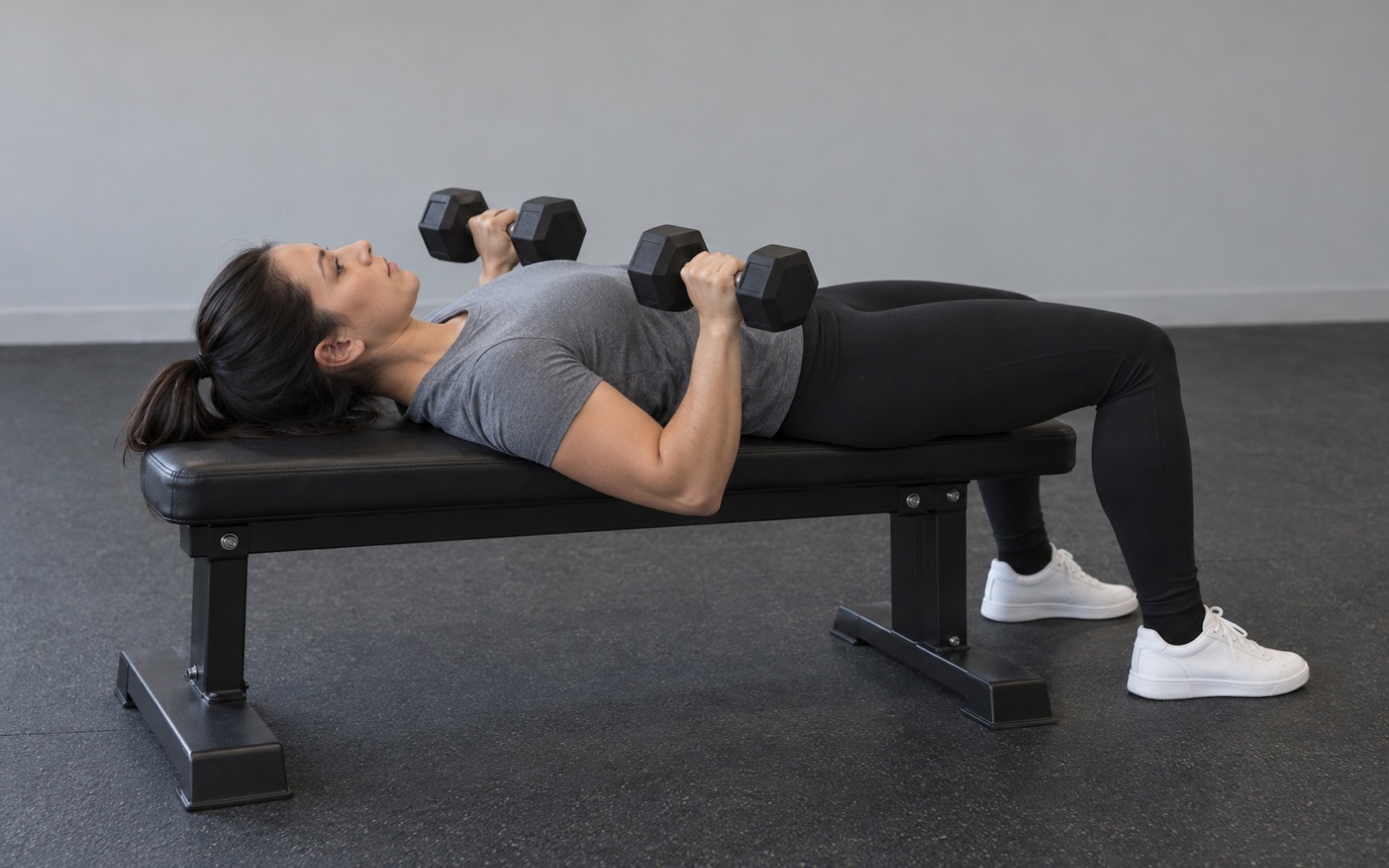
What a dumbbell bench press is and how it differs from a barbell bench press
A dumbbell bench press is a press of two independent weights from a lying position: shoulder blades pulled together and pinned to the bench, feet on the floor, dumbbells traveling from chest level up over your shoulders and back down. With a barbell, your hands are linked by one bar and help each other. With dumbbells, each arm holds its own path, and the stabilizing muscles of the shoulder have to work harder.
Two things follow from that. First: you'll lift less with dumbbells than with a barbell. In Saeterbakken's 2011 study, 12 trained men averaging 22.7 years of age and 78.6 kg (173 lb) of bodyweight pressed in a Smith machine, with a barbell and with dumbbells. The one-rep max with dumbbells came out 17% lower than with a barbell and 14% lower than in the Smith machine. Second: the chest doesn't suffer from this. Activity in the pectoralis major and anterior deltoid didn't differ across the three versions, while the biceps worked harder the less stable the weight was, and the triceps worked less with dumbbells than with a barbell.
What this means for you: if you bench 40 kg (88 lb) on a barbell for 10 reps, the pair of dumbbells for the same 10 reps will weigh about 33 kg (73 lb) in total, or 16–17 kg (35–37 lb) in each hand. The conversion table is in section 03. Barbell form — racks, five points of contact, grip width — is covered in our bench press guide; here the barbell appears only for comparison.
Some gyms and apps call this exercise the dumbbell chest press. It's the same movement. It's a chest exercise, and the shoulders and triceps are only helpers.
Dumbbell bench press muscles worked
In the dumbbell bench press, the pectoralis major does the main work, the anterior deltoid and triceps assist, and the biceps and rotator cuff keep the dumbbells on track.
| Muscle | What it does in the press | Where you feel it |
|---|---|---|
| Pectoralis major, sternocostal head (middle and lower chest) | brings the upper arms toward the center and pushes the dumbbells up; works hardest on a flat bench | the middle of the chest, especially the lower part, when the dumbbells are at chest level |
| Pectoralis major, clavicular head (upper chest) | helps raise the upper arm forward and up; works hardest on an incline bench | just under the collarbones |
| Anterior deltoid | brings the upper arm forward; the steeper the bench, the more it works | the front of the shoulder |
| Triceps brachii | straightens the elbow, most of all in the top half of the movement | the back of the arm, toward the end of the press |
| Serratus anterior | keeps the shoulder blade pinned to the ribs | the side of the ribcage under the armpit, on heavy sets |
| Rotator cuff | holds the head of the humerus in the socket while the dumbbell finds its path | deep inside the shoulder, as mild fatigue after a set |
| Biceps brachii | stabilizes the elbow and forearm; works harder with dumbbells than with a barbell (Saeterbakken, 2011) | the front of the arm, faintly |
| Forearm muscles | keep the dumbbell straight in your hand | hands and wrists as the weight climbs |
The chest works as hard as it does with a barbell. In Welsch's 2005 study, 12 college-age men and women with varying experience did 3 reps at a 6-rep weight in three exercises: the barbell bench press, the dumbbell bench press and the dumbbell fly. Activity in the pectoralis major and anterior deltoid during the press didn't differ across all three lifts, but in the fly both muscles were active for a smaller part of the rep than in the presses. The authors wrote outright that the barbell press and the dumbbell press can be swapped for each other in a program. In Farias's 2017 study, the chest worked even harder with dumbbells than with a barbell. So the answer to "is the dumbbell bench press a chest exercise?" is simple: yes, and it loads the chest no worse than a barbell does.
It's the same for women. Luczak and colleagues in 2013 measured muscle activity in 24 college-age women: 12 of them trained with weights regularly, 12 were beginners. All did the flat dumbbell press, the incline press and the seated press. There was no difference between the experienced and the beginners. The sternocostal head of the chest worked harder in the flat and incline presses than in the seated press, and the clavicular head during the lowering phase was more active on the incline than flat or seated. The upper trapezius and anterior deltoid peaked in the seated press. That's why the seated version counts as a shoulder exercise, and its form has its own guide: the seated dumbbell shoulder press. The takeaway for women: the chest switches on in the dumbbell press from the very first session, and there's no "experience" you need to wait for.
Which part of the chest works in which position. Rodríguez-Ridao and co-authors in 2020 compared pressing at 60% of max in 30 trained people with at least a year of experience, at bench inclines of 0, 15, 30, 45 and 60°. The upper, clavicular head of the chest was most active at 30°, the middle and lower parts at 0°, meaning on a flat bench. The anterior deltoid rose noticeably from 45° and peaked at 60°. The triceps worked about the same at every angle. More on the incline angle in section 07.
Dumbbell press vs. barbell bench press vs. dumbbell fly vs. machine press
The dumbbell press gives you more range of motion and more work for the stabilizers, the barbell press gives you more weight and an easier way to add it, the fly nearly removes the triceps, and the machine guides the handles for you.
| Dumbbell press | Barbell bench press | Dumbbell fly | Machine or Smith machine press | |
|---|---|---|---|---|
| Weight relative to a barbell | ~83% (Saeterbakken, 2011) | 100% | roughly half the barbell press weight for the same reps (numbers in our fly article) | dumbbells are 14% lighter than the Smith machine; the Smith machine is 3% lighter than a barbell (Saeterbakken, 2011) |
| Range of motion | full, dumbbells go to chest level and slightly below | until the bar touches the chest | a wide arc with nearly straight elbows | set by the handles or the rails |
| Triceps | works less than with a barbell | works harder | almost switched off | same as with a barbell |
| Biceps and stabilizers | work harder than in any other version | less | the biceps holds the elbow angle | minimal |
| Reps over 4 sets at a 10-rep weight | 31.2 | 27.8 (Farias, 2017) | — | — |
| Spotter | not needed, dumbbells can be dropped to the thighs | needed at heavy weights | not needed | not needed |
| Best for | everyone, especially beginners and home training | anyone who needs heavy weight and competition technique | the second exercise after a press | when there's no spotter and your shoulder wants stability |
For chest growth, the implement doesn't matter. The 2026 American College of Sports Medicine (ACSM) position stand pooled 137 systematic reviews and more than 30,000 participants. Free weights and machines produced similar gains in strength and muscle, with no consistent difference between them. So pick your implement by convenience and by what your gym has.
Dumbbells make it easier to rack up reps. Farias and colleagues in 2017 gave 19 trained men 4 sets of presses at a 10-rep weight. With dumbbells they totaled 31.2 ± 3.2 reps, with a barbell 27.8 ± 4.8, with 2 minutes of rest between sets. The chest worked harder with dumbbells than with the barbell, and the triceps worked less. The explanation is simple: the load per arm is lower, and fatigue builds more slowly across sets. That's why dumbbells are convenient for 10–15 rep work, when you want volume.
The fly is a different exercise. In it the elbows are nearly straight, the dumbbells travel in a wide arc, and the triceps barely participates. It belongs after the press, as the second chest exercise: the muscle activity numbers and an 8-week plan for the fly are in our dumbbell fly guide.
Converting weight between a barbell and dumbbells. Per Saeterbakken's 2011 numbers, a pair of dumbbells for the same reps weighs about 83% of the barbell. The figures below are rounded to dumbbells you'll actually find in a gym:
| Barbell for 10 reps | Pair of dumbbells ≈ 83% | Each dumbbell |
|---|---|---|
| 20 kg / 44 lb (empty bar) | 16–17 kg (35–37 lb) | 8 kg (17.5 lb) |
| 30 kg (66 lb) | 25 kg (55 lb) | 12 kg (26.5 lb) |
| 40 kg (88 lb) | 33 kg (73 lb) | 16 kg (35 lb) |
| 50 kg (110 lb) | 41–42 kg (90–93 lb) | 20 kg (44 lb) |
| 60 kg (132 lb) | 50 kg (110 lb) | 25 kg (55 lb) |
One more rule, this time for the incline bench: your flat weight × 0.8 ≈ your weight at a 30° incline. This is our practical rule of thumb from the gym floor; there's no such figure in the research.
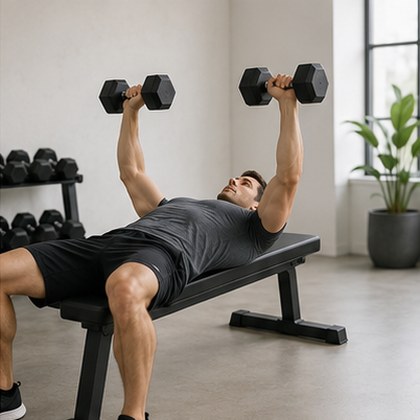 Dumbbell bench press
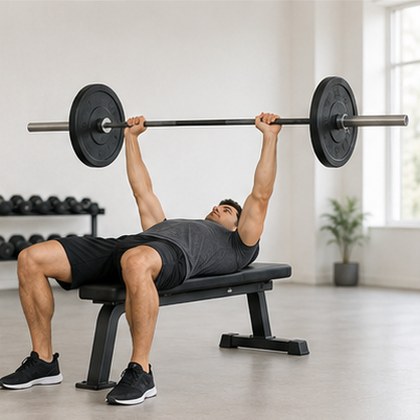 Barbell bench press
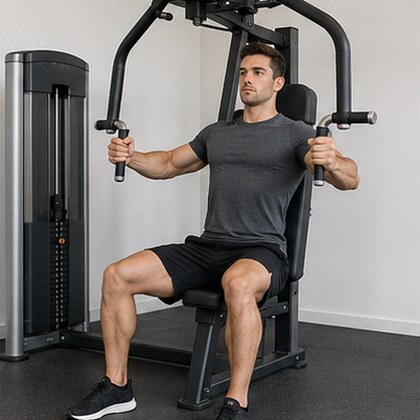 Seated machine chest press
How to do a flat dumbbell bench press: step by step
Lie on the bench, pull your shoulder blades together, bring the dumbbells over your shoulders, lower them over 2 seconds to chest level with your elbows at 45–60° from your torso, and press up until your arms are nearly straight. Step by step it looks like this:
- Dumbbells on your thighs. Sit on the end of the bench and stand the dumbbells upright on your thighs, close to your knees. How to kick them up into the starting position is covered in detail in section 06.
- Five points of contact. The back of your head, your shoulder blades and your hips are on the bench, and both feet are flat on the floor, roughly under your knees. Feet too far forward and your hips will lift; feet tucked under the bench and your heels will come up.
- Shoulder blades. Pull them together and down, as if tucking them into your back pockets; your chest rises as a result. Hold this position for the whole set, including at the top: the shoulder blades don't "chase" the dumbbells.
- Start. Dumbbells over your shoulders, arms nearly straight, wrists over your elbows. Dumbbells at shoulder width or slightly wider, 2–3 cm (about an inch) apart.
- Lowering. Guide the dumbbells down and slightly out over 2 seconds. Your elbows move away from your torso at 45–60°, and your forearms stay vertical the whole time: viewed from behind your head, each elbow sits directly under its dumbbell.
- The bottom. Dumbbells at chest level, elbows just below bench level. No need to go deeper with a working weight: the shoulder is at its most open at the bottom.
- The press. Press the dumbbells up and slightly inward over 1–2 seconds, as if trying to bring your elbows together under your chest. The dumbbells converge toward a point above your shoulders.
- The top. Arms nearly straight, elbows not locked out hard. The dumbbells don't clank: the same 2–3 cm (about an inch) stays between them, and the chest stays tense.
- Breathing. Breathe in on the way down, breathe out on the way up past the hardest point. With light dumbbells, breathe evenly; with heavy ones, don't hold your breath for several reps in a row.
The tempo comes from the 2009 ACSM position stand: beginners are advised a slow or moderate tempo, and moderate there means 1–2 seconds up and the same on the way down.
Where to lower to. At the bottom, the dumbbells end up roughly at nipple level or slightly lower, at the very edge of the chest. Your wrists face up, and your thumb doesn't drift toward your head. If the dumbbells travel toward your neck, you're pressing with your shoulders; if they travel toward your stomach, your elbows are pinned to your sides and the triceps is doing the work.
Leg drive. Pressing your feet into the floor helps keep your hips and shoulder blades in place and makes the press more stable. Your hips don't leave the bench while you do it: lifting your hips turns a flat press into a decline press and loads the lower back.
do an "elbow test." Ask someone to film one set on your phone from behind your head. At the bottom, each elbow should sit directly under its dumbbell with the forearm vertical. If your elbows have spread wider than your wrists, the angle to your torso is over 60° and the shoulder is taking a hit. If your elbows are tucked against your ribs, the angle is under 45°, and the chest is handing the work to the triceps. Film your first two sessions and then once a month: as the weight climbs, the elbows usually drift outward without you noticing.
Grip: neutral, pronated or close — which to choose
A beginner does well with a pronated grip and the wrists turned slightly inward; with shoulder pain, go neutral; and a close neutral grip shifts the work to the triceps and upper chest.
Pronated grip — palms face forward, toward your feet, and the dumbbells sit in line like a barbell. This is the most familiar version: the chest stretches most at the bottom, and the movement is closest to the barbell bench press. Turn your wrists slightly inward, 10–20°, so your elbows settle at 45–60° on their own.
Neutral grip — palms face each other, and the dumbbells run parallel to your body. With this grip the elbows travel closer to your torso and the shoulder opens less at the bottom, so it's gentler on the joint. The load shifts slightly toward the triceps and the clavicular head of the chest. If the front of your shoulder aches during a regular press, start with a neutral grip and lower the dumbbells to chest level, without dipping below it.
Close grip, or the close-grip dumbbell press — the dumbbells are pressed together over your chest, palms facing each other, elbows traveling along your torso. It's essentially a triceps press with some upper chest involvement. Roy and colleagues in 2021 compared 12 variations of the barbell bench press at a 12-rep weight in 13 men with more than a year of training: inclines of −15, 0 and 30°, grip at shoulder width and twice shoulder width, pronated and reverse. The clavicular head of the chest was most active with a close grip, at both 30° and flat; the sternocostal head with a wide pronated grip at 0°; and the triceps with a close pronated grip at 0° and −15°. The authors concluded that a wide pronated grip on a flat bench loads all three parts of the chest at once. The study was done with a barbell, but the logic is the same with dumbbells: close means more triceps and upper chest, wide means more mid-chest.
A wide grip with dumbbells doesn't exist as such: the distance between your hands depends on your elbow angle, and the wrists have nothing to do with it. If you want to load the mid-chest harder, flare your elbows to 60° and lower the dumbbells in line with your chest, but no wider.
How to hold a dumbbell. The handle rests on the base of your palm, close to the wrist, your wrist is straight, and your thumb wraps around the handle. When the dumbbell drifts toward your fingers, the wrist bends back, and the wrist is the first thing that will hurt. A thumbless grip with dumbbells is doubly dangerous: the dumbbell can slip out onto your face.
How to get the dumbbells into position and back down, and what to do if you fail a rep
You bring the dumbbells into the starting position one at a time off your knees, and you return them to your thighs the same way: by rocking forward and lifting your knees up to meet the dumbbells.
How to get the dumbbells up.
- Sit on the end of the bench, feet hip-width apart. Lift the dumbbells from the floor with your back, as in a deadlift, and stand them upright on your thighs close to your knees.
- Press the dumbbells into your thighs and roll back onto your back in one motion, while pushing the dumbbells up with your knees. The kick goes one at a time: your right knee throws the right dumbbell up to your shoulder, your left knee the left one. With light dumbbells you can kick both up at once.
- The moment your back touches the bench, the dumbbells are already over your chest on bent arms. Pull your shoulder blades together, plant your feet into the floor and press the dumbbells up into the starting position.
- If the dumbbells weigh more than 20 kg (44 lb) each, ask for a hand-off: a partner passes them to you one at a time once you're already lying down. Everyone in the gym does this, and it's completely normal.
How to put the dumbbells down.
- Finish the set at the top, bend your arms and lower the dumbbells to your chest.
- Lift your knees up to meet the dumbbells and press the dumbbells into your thighs.
- Sit up by rocking forward: the dumbbells pull you up through their weight on your thighs, and your abs and legs help.
- Set the dumbbells on the floor one at a time, with a straight back, as in a deadlift.
Dropping dumbbells from shoulder height onto the floor is out, even in gyms with rubber flooring. First, when you drop them, the arm unloads abruptly and the pectoralis major takes a jolt in a stretched position. ElMaraghy and Devereaux in 2012 collected 365 cases of pectoralis major tears from 1822 to 2010: 83% happened without a direct blow, and 48% happened during weight training. Second, a dumbbell can bounce and hit the leg of whoever is standing nearby.
If you fail a rep. Lower the dumbbells to your chest, pin your elbows to your sides, and from there you have two options. The first, the usual one: lift your knees, press the dumbbells into your thighs and sit up by rocking forward, exactly as after a set. The second, when you don't have the strength for the rock: lower the dumbbells to the floor one at a time with bent arms, turning your torso toward the dumbbell you're setting down. The one rule that matters: the dumbbells go down at the sides of the bench, away from your stomach and face.
Incline dumbbell press: 30 or 45 degrees
Set the backrest to 30°: at that angle the upper chest works noticeably harder than flat, the lower part hasn't dropped out yet, and the anterior deltoid doesn't take over the work.
The numbers on angle come from three studies. Lauver and colleagues in 2016 measured muscle activity in 14 trained men doing the barbell bench press at 65% of max at −15, 0, 30 and 45°. Activity was expressed as a percentage of maximal isometric effort, meaning what a muscle produces when you push as hard as you can against something that doesn't move. Over the whole press, the upper chest worked the same at every angle, and the difference showed up in the second quarter of the press, from 26 to 50% of the way up: at 30° the upper chest produced 122.5%, at 45° 124%, and at 0° and −15° 98.2% and 96.1%. The lower chest over the whole press dropped to 71.9% at 45° versus 100.1% at 0°, 100.4% at −15° and 86.6% at 30°. The gain for the upper chest at 30° and at 45° is the same, while the loss for the lower chest at 45° is already large. The study was done with a barbell, so with dumbbells the numbers may differ a bit, but the direction is clear.
Rodríguez-Ridao in 2020, as covered in section 02, found the peak of the clavicular head at 30°, while the anterior deltoid rose noticeably from 45° and peaked at 60°. Above 45°, you're increasingly pressing with your shoulders.
Does the upper chest actually grow from incline pressing. Chaves and colleagues in 2020 took 47 untrained men and trained them once a week for 8 weeks in three groups: flat press only, incline press only, and both. Strength rose equally in everyone: by about 10 kg (22 lb) on the flat press test and about 11 kg (24 lb) on the incline test, with no difference between groups. Chest thickness was measured at three points. At the second intercostal space, meaning the very top of the chest, the incline group gained 0.62 cm (0.24 in) more than the flat group and 0.50 cm (0.2 in) more than the mixed group. At the two lower points there was no difference between groups. That means the incline press grows specifically the upper chest, and you lose nothing in strength.
In women, per Luczak's 2013 data from section 02, the clavicular head of the chest was also more active on the incline bench than flat or seated during the lowering phase.
Form on the incline. Everything is the same as on the flat bench, with four adjustments:
- backrest at 30°, which is usually the second notch up from flat; if your bench only offers 45°, put a weight plate under the seat end to reduce the angle;
- the dumbbells come down to the upper chest, to the line of your collarbones, and don't drift toward your neck;
- elbows at the same 45–60°, forearms vertical, and at the top the dumbbells end up over your shoulders, meaning slightly behind eye level;
- hips sit in the corner of the bench, lower back pressed in, feet firmly on the floor.
You'll need less weight on the incline: about 80% of your flat weight. If you press a pair of 10 kg (22 lb) dumbbells for 12 reps flat, start with a pair of 8 kg (17.5 lb) on the incline.
Do you need both the flat and the incline press in one workout? Not as a beginner: one press for 3 sets is enough, and it's better to alternate them from session to session. When you want to add a second chest exercise after two or three months, put the incline press first and the flat press or the fly second.
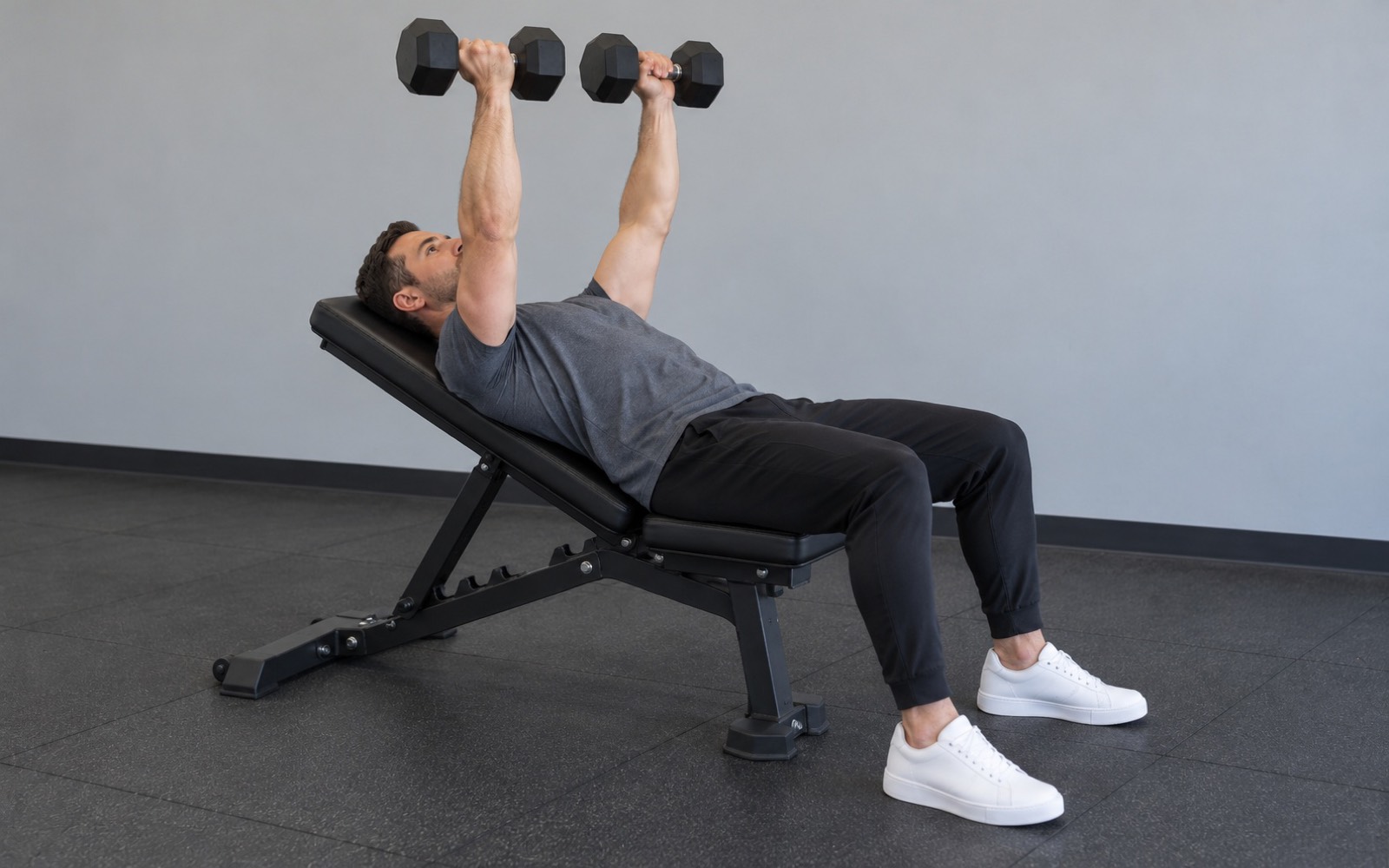
Dumbbell floor press at home: form and what changes
A floor press is the same dumbbell press, only with the floor under your back instead of a bench, and your elbows touching the floor gently at the bottom, so the range of motion is about a third shorter.
At home this version saves the day when there's no bench: you have dumbbells, you have a floor, so you can train your chest. The shorter range changes how the work is shared. There's no separate study of the dumbbell floor press, so we lean on Fischer's 2025 paper: 19 men pressed a barbell at a 10-rep weight through a full range of motion and through two partial ranges. In the top half of the movement, the triceps worked hardest, and the average activity of the chest and anterior deltoid in both partial ranges was even higher than in the full range. The floor cuts off the bottom third of the movement, meaning the chest's most stretched position. For you that means: the triceps and the top half of the movement, the lockout, get more, while the chest works but is underloaded in its most stretched position.
Floor press form.
- Lie on a mat, bend your knees and put your feet on the floor. Straight legs are fine too, but with bent knees it's easier to keep your lower back pressed down.
- Bring the dumbbells to straight arms the same way as on a bench. If they're light, pick them up off the floor while sitting and lie back. If they're heavy, set them next to your thighs, lie down, take them one at a time and bring them to your chest by rolling through your side.
- Pull your shoulder blades together, back of the head on the floor, eyes on the ceiling.
- Lower the dumbbells over 2 seconds until your elbows touch the floor. The touch is soft; the elbows don't "drop" onto the floor.
- Pause 1 second with your elbows on the floor, no bounce. That kills the momentum and forces the chest and triceps to fire from a dead stop.
- Press up and slightly inward, with the same 2–3 cm (about an inch) between the dumbbells at the top.
You can use the same weight on the floor as on a bench, or slightly more, 100–110%: the path is shorter, and the hardest bottom position is gone. Don't carry that weight over to a flat bench, where it will turn out heavy.
What to use instead of a bench at home. Two chairs or a sofa won't work for pressing: they wobble, they sink, they put your back on an edge, and the dumbbells pull you sideways. The best home option without a bench is the floor. If you want some range back, lie on a dense rolled-up mat along your spine: your back rises 5–7 cm (2–3 in), and your elbows can drop lower. A full home session, where the floor press is paired with a row and a squat, is laid out in our dumbbell workout at home.
When there are no dumbbells at home. Do push-ups. Calatayud and colleagues in 2015 trained 30 students with lifting experience for 5 weeks, split into three groups: one did the bench press at a 6-rep weight, the second did push-ups with a resistance band across the back matched for muscle activity, and the third didn't train. In both training groups, strength rose equally, by 13.65–22.21%, while the control group stayed put. How to get from knee push-ups to full ones is covered in our push-ups for beginners guide.
Single-arm, alternating and stability-ball presses: are they worth it
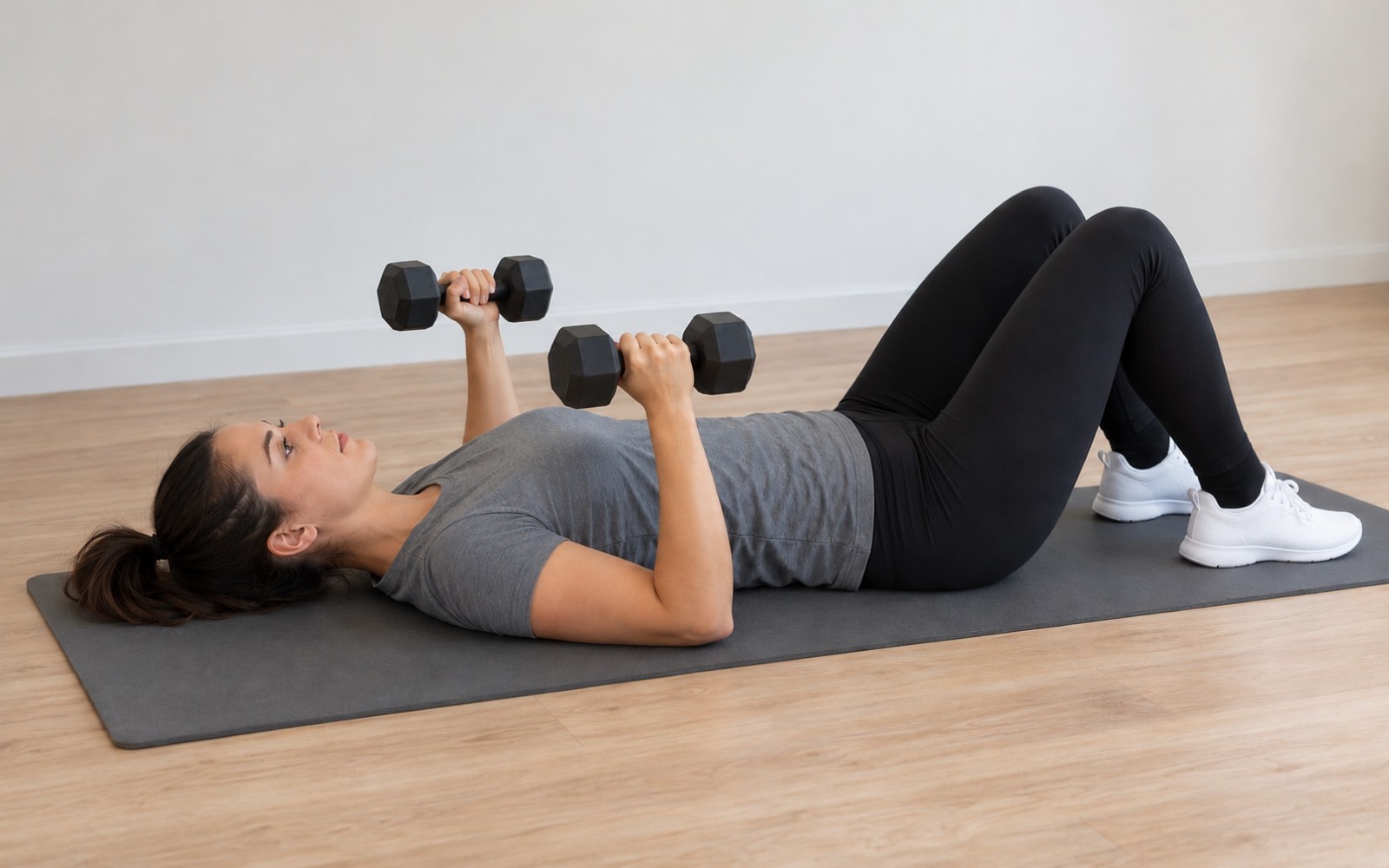
The single-arm press is useful when one arm is clearly lagging, the alternating press is mostly for variety, and a stability ball in place of a bench takes work away from the chest.
Patterson and colleagues in 2015 tested the single-arm press in 20 people: on a regular bench and on a rocking COR bench, with one dumbbell and with two. Activity in the chest, trapezius and obliques, and range of motion, on the rocking bench didn't differ from the regular one. With one dumbbell, range of motion was greater than when the other hand also held a weight. The single-arm press gives you a bit more movement and makes your torso resist twisting, while an unstable surface by itself adds nothing.
Single-arm. Lie on the bench, take a dumbbell in one hand, and rest the other on your stomach or stretch it out to the side for balance. Press along the same path as with two hands, and don't let your hips and shoulders twist toward the dumbbell. Use 10–20% less weight per arm than in the regular press. Two sets of 10–12 on the weaker side at the end of a workout usually even the arms out in 4–6 weeks.
Alternating. Both dumbbells at the top; one goes down and up, then the other. The other arm holds its dumbbell at full extension in the meantime, and the shoulder tires from the hold. For the chest this adds nothing, but it stretches the set out in time. Use it if you want variety, but not in place of your main press.
On a stability ball. Pressing on a ball loads the abs but takes away from the chest. Saeterbakken and Fimland in 2013 compared the barbell bench press in 16 trained men on a bench, on a balance cushion and on a stability ball. The 6-rep weight on the ball was 92% of the bench, chest activity dropped to 81%, triceps to 69%, and the rectus abdominis worked harder than on the bench. The anterior deltoid and biceps worked the same on all three surfaces. If there's no free bench in the gym, a floor press is the better choice: it takes nothing away from the chest.
How much weight and how many reps: an 8-week plan for women and men
Women should start with a pair of 5 kg (11 lb) dumbbells, men with a pair of 10 kg (22 lb), 3 sets of 10 reps twice a week with 2–3 reps in reserve, adding reps first and weight second.
The progression rule comes from the 2009 ACSM position stand: beginners need a weight that allows 8–12 reps, 2–3 sessions a week, and once you can do 1–2 reps more than the target, you add 2–10% weight. There's a catch with dumbbells: the step between neighboring pairs in a gym is 1–2 kg (2–4 lb), and moving from 5 kg (11 lb) to 6 kg (13 lb) is a 20% jump at once. That's why in the plan below, reps climb to 15 first, and only then does the dumbbell change to the next size while reps drop back to 10.
A 10–15 rep range suits a beginner. The 2026 ACSM position stand, which pooled 137 reviews, recommends 10 or more sets per muscle per week for muscle growth, and training to failure gave no consistent extra gain. So 2–3 reps in reserve is our working target for a beginner. On rest between sets, there's Schoenfeld's 2016 study: 21 trained men rested either 3 minutes or 1 minute between sets for 8 weeks, and with 3 minutes, strength in the bench press and squat and the thickness of the front thigh muscles grew more, with the same trend in the triceps. A beginner with light dumbbells is fine with 2 minutes; on heavy sets, rest 2–3.
Eight weeks of dumbbell pressing, in numbers. Two sessions a week, each with 3 working sets on a flat bench or the floor. Volume is the work done per session: sets × reps × the weight of the pair. For example, 3 × 10 × (2 × 5 kg) = 300 kg (660 lb).
| Week | Women | Volume | Men | Volume | What changed |
|---|---|---|---|---|---|
| 1 | 2 × 5 kg (11 lb), 3 × 10 | 300 kg (660 lb) | 2 × 10 kg (22 lb), 3 × 10 | 600 kg (1,325 lb) | starting point |
| 2 | 2 × 5 kg, 3 × 12 | 360 kg (795 lb) | 2 × 10 kg, 3 × 12 | 720 kg (1,585 lb) | +2 reps per set |
| 3 | 2 × 5 kg, 3 × 15 | 450 kg (990 lb) | 2 × 10 kg, 3 × 15 | 900 kg (1,985 lb) | +3 reps |
| 4 | 2 × 6 kg (13 lb), 3 × 10 | 360 kg (795 lb) | 2 × 12 kg (26.5 lb), 3 × 10 | 720 kg (1,585 lb) | dumbbell +1 kg (2 lb) for women and +2 kg (4.5 lb) for men, reps back to 10 |
| 5 | 2 × 6 kg, 3 × 12 | 432 kg (950 lb) | 2 × 12 kg, 3 × 12 | 864 kg (1,905 lb) | +2 reps |
| 6 | 2 × 6 kg, 3 × 15 | 540 kg (1,190 lb) | 2 × 12 kg, 3 × 15 | 1,080 kg (2,380 lb) | +3 reps |
| 7 | 2 × 7 kg (15.5 lb), 3 × 10 | 420 kg (925 lb) | 2 × 14 kg (31 lb), 3 × 10 | 840 kg (1,850 lb) | dumbbell +1 kg and +2 kg, reps back to 10 |
| 8 | 2 × 7 kg, 3 × 12 | 504 kg (1,110 lb) | 2 × 14 kg, 3 × 12 | 1,008 kg (2,220 lb) | +2 reps |
Over 8 weeks, volume per session grows by 68%: for women from 300 to 504 kg (660 to 1,110 lb), for men from 600 to 1,008 kg (1,325 to 2,220 lb). The dumbbell went up by 2 kg (4.5 lb) for women and 4 kg (9 lb) for men, which is +40% on the starting weight. In the weeks where the dumbbell changes, volume dips because there are fewer reps. That's by design: volume climbs back through added reps. If your gym has no 7 kg (15.5 lb) dumbbells, stay at 6 kg (13 lb) for another week and add a fourth set.
This is a typical path, and there's no mandatory standard in it. The weight goes up only when every set is done with your elbows under the dumbbells and 2–3 reps in reserve. If 15 clean reps aren't happening, stay on that week for another one or two.
How to check yourself against other people's numbers. There's the Strength Level database, where people log their own results: it holds 4.73 million dumbbell bench press entries, 1.26 million of which passed its filters. It's a user-submitted database with no scientific vetting, and the people who log there already go to the gym. The average one-rep dumbbell there is 38 kg (84 lb) for men and 20 kg (44 lb) for women. A "beginner" by the database's table is 19 kg (42 lb) per dumbbell for an 80 kg (176 lb) man and 7 kg (15.5 lb) for a 60 kg (132 lb) woman. Our starting point for men is almost half that bar, and that's fine: the database's "beginner" has already been pressing for several weeks, while you're in week one. By the end of the plan, a man presses a pair of 14 kg (31 lb) for 12 reps, which is roughly 19–20 kg (42–44 lb) for a single rep, in other words exactly the database's "beginner." For women, our 5 kg (11 lb) start and the database's 7 kg (15.5 lb) bar nearly match.
Is one press enough. 3 sets twice a week is 6 sets for the chest, and ACSM in 2026 recommends 10 or more for growth. Make up the other 4 sets with flys, push-ups or the incline press.
In the Sportygram app (go.sportygram.com; the app and the coach work in Russian only), the dumbbell bench press is in the workout diary with technique photos, separately for men and women. You can ask the virtual coach, Alex, in chat to add the dumbbell bench press to Tuesday's workout: he shows a confirmation card, and once you confirm, the exercise appears in that day's plan. Sets and weight are logged in the diary, and the weight history shows when it's time to move up to the next pair.
Mistakes: where you feel it → what to fix
A correct dumbbell press is felt in the chest and a little in the front of the shoulder and the triceps; if something else tires or hurts first, the form has drifted:
| Where you feel it | What's wrong | The fix |
|---|---|---|
| Front of the shoulder, right in the joint, a sharp pinch on the way down | elbows flared to 90° from your torso, or the dumbbells go below chest level with a heavy weight | elbows at 45–60°, depth to chest level and no lower, 10–20% less weight |
| More in the triceps than the chest | elbows pinned to your sides, grip too close, or you're floor pressing and counting it as a flat press | flare the elbows to 45–60°, on a bench lower to chest level |
| Wrist | the dumbbell is "hanging" on your fingers, wrist bent back | handle on the base of the palm, wrist straight, thumb wrapped around |
| Lower back | hips coming off the bench, a "bridge," feet too far forward | feet under your knees, hips on the bench, ribs down |
| Neck, back of the head | head reaching toward the dumbbells, chin to chest | back of the head on the bench, eyes on the ceiling |
| Dumbbells wobbling, drifting together or apart | the weight is a bit too heavy, the stabilizers can't keep up | 20% less weight, a pause at the top, two weeks at 12–15 reps |
| Dumbbells clank at the top | you're bringing your hands together "all the way" | at the top, dumbbells at shoulder width, 2–3 cm (about an inch) apart |
| One arm lags | strength asymmetry or an uneven grip | weight set by the weaker arm, paused presses, 2 single-arm sets at the end |
| A crack or click in the shoulder without pain | common in the joint | nothing, just watch for pain |
| A pulling stretch low in the chest on the incline | angle at 45° or above, or going too deep | backrest at 30°, depth to upper chest level |
| Dumbbells "fall" into place at the start | kicking them up with your arms, not your knees | one at a time off the knees, see section 06 |
| Nothing in the chest at all | shoulder blades not pulled together, shoulders rolled forward | pull the shoulder blades together and down, chest up, feet driving into the floor |
The three most common mistakes. The first is elbows at 90°, flared out like wings. That's how the old magazines pressed, and it's the most common reason the shoulder hurts: in Kolber's 2010 review, the "high-five" position, with the upper arm abducted to 90° and externally rotated, and the upper arm traveling behind the line of the torso in presses and flys, are named as causes of anterior shoulder instability, and the wide-grip and incline presses made the list of exercises that most often cause pain. The second is dipping the dumbbells below the chest for a "stretch." At the bottom the shoulder is at its most open position and the pectoralis major is at its most stretched; that's exactly where, per ElMaraghy's 2012 data, tears happen. The third is clanking the dumbbells at the top. At the moment of the clank, the chest unloads for a split second, and you lose the part of the rep where the muscle is contracted hardest.
Shoulders, elbows, wrists and lower back: who should be careful and when to see a doctor
A healthy person can dumbbell bench press at any age, but with shoulder pain, after an injury or after surgery, the weight and depth should be agreed with a doctor.
Why the shoulder. Per Kolber's 2010 review, up to 36% of weight training injuries involve the shoulder, and among the risk factors are technique errors and the "high-five" position, with the elbows out to the sides and the upper arm traveling behind the line of the torso. Bengtsson and colleagues in 2018 went through 30 papers on bench press injuries in powerlifters: the most common injury is a pectoralis major tear, and beyond that they describe triceps tendon ruptures, anterior and posterior shoulder dislocations, "bench presser's shoulder," meaning pectoralis minor tendinopathy, and distal clavicle osteolysis. Among the suspected causes the authors name weights that are too heavy, a large range of motion, too little rest between sessions and technique errors. Dumbbells have an advantage over a barbell here: you can rotate your wrist and adjust the path to suit your own shoulder. There's a downside too: without a bar as a stop, it's easy to dip the dumbbells lower than you should.
What to do if the shoulder is aching. Elbows at 45–60°, a neutral grip, depth to chest level, 20% less weight, and two weeks at 12–15 reps. The floor press is the gentlest version: the floor won't let your elbows drop below the line of your torso. Why the shoulder hurts after training, what it might be and what to do in the meantime is covered in our guide to shoulder pain from lifting.
Who should be careful.
- A recent shoulder injury or dislocation. Come back after your doctor clears you, starting from the floor with a neutral grip and light dumbbells.
- Shoulder pain lasting more than two weeks. Doctor first, pressing second. Without an exam there's no telling whether it's the rotator cuff, the joint or just overload.
- Wrists. With wrist pain, a neutral grip and wrist wraps help, and the dumbbell should sit on the base of the palm.
- Elbows. If your elbows ache, don't lock them out at the top and reduce the weight; pain on the inside of the elbow often comes from a bent-back wrist.
- Lower back. The dumbbell press barely loads it as long as your hips stay on the bench. With a herniated or bulging disc, if your doctor hasn't ruled out strength training, press with bent knees: you can put your feet up on the bench so your lower back stays pressed down.
- Pregnancy. Discuss the exercise with the doctor managing your pregnancy. In the second and third trimesters, lying flat on your back is usually swapped for an incline bench or a seated press.
- After 40 and after 60. Per the 2026 ACSM position stand, strength training is safe for healthy adults of any age, and in an analysis of more than 38,000 people the risk of serious adverse events from exercise didn't rise. Start with light dumbbells and a neutral grip, and progress more slowly than the plan.
When to see a doctor. Sharp pain with a "pop" in the chest or shoulder during a set, weakness in the arm, pain at night or at rest lasting more than a week, a click that comes with pain, bruising on the chest or near the armpit after training, numbness in the hand. These are signs that reducing the weight won't fix, and waiting for them to "go away on their own" isn't the way to go.
Questions and answers
Which is better: dumbbell bench press or barbell bench press?
For chest growth, they're equal: chest activity didn't differ between the two presses (Welsch, 2005; Saeterbakken, 2011), and the 2026 ACSM position stand found no consistent difference even between free weights and machines. Dumbbells give you more range of motion, load the stabilizers and need no spotter, but weigh 17% less for the same reps. A barbell lets you lift more and add 1.25 kg (2.75 lb) per side. For a beginner and for anyone training at home, dumbbells are the more convenient choice.
How low should you lower the dumbbells?
To chest level: dumbbells at the edge of the chest, elbows just below the bench, forearms vertical. No deeper with a working weight. A large range of motion with the upper arm traveling behind the line of the torso is named as a risk factor for shoulder injury both in Kolber's 2010 review and in Bengtsson's 2018 one. Stretch the chest separately, without dumbbells.
Should the dumbbells touch at the top?
No. At the top the dumbbells sit over your shoulders, at shoulder width or slightly narrower, 2–3 cm (about an inch) apart. A clank means the chest unloaded for a moment at the top. If you want to "squeeze" the chest at the top, do it without the clank: think about bringing your elbows together under your chest and hold for a second.
30 or 45 degrees on the incline bench?
30°. In Lauver's 2016 study, the upper chest in the second quarter of the press worked the same at 30° and 45°, 122.5% and 124% of maximal isometric effort versus 98.2% flat, while the lower chest at 45° dropped to 71.9% versus 100.1%. Rodríguez-Ridao in 2020 found the peak of the upper chest at 30°, with the anterior deltoid rising noticeably from 45°. In other words, 45° adds to the shoulders and takes from the lower chest without giving the upper chest anything extra.
What weight should a woman start with?
A pair of 5 kg (11 lb) dumbbells for 10 reps, 3 sets, twice a week. Following our plan, by week 8 that's a pair of 7 kg (15.5 lb) for 12 reps. In the Strength Level database, a "beginner" for a 60 kg (132 lb) woman is 7 kg (15.5 lb) for a single rep, so our start matches it. In women, the chest switches on in the dumbbell press from the first session just as it does in experienced lifters (Luczak, 2013).
Is the floor press a full replacement for a bench?
For the triceps and the top half of the movement, yes; for the chest, partly. The floor cuts off the bottom third of the range, where the chest is most stretched. In Fischer's 2025 study, the average chest activity in partial ranges was even higher than in the full range, so the chest works but is underloaded in its most stretched position. At home, make up for it with push-ups: in Calatayud's 2015 study, banded push-ups produced the same strength gain as the bench press.
My shoulder hurts during dumbbell bench press — what should I do?
Check your elbow angle and depth: elbows at 45–60°, dumbbells no lower than chest level. Switch to a neutral grip, take off 20% of the weight and work at 12–15 reps for two weeks, or floor press. If the pain lasts more than two weeks, shows up at night or at rest, comes with weakness in the arm or with painful clicks, see a doctor before your next chest session.
How many times a week and how many sets should you do?
Twice a week, 3 sets of 10–15 reps, resting 2 minutes, or 2–3 on heavy sets (Schoenfeld, 2016). That's 6 sets for the chest, and for growth ACSM in 2026 recommends 10 or more a week, so add flys, push-ups or the incline press. Pressing every day makes no sense: the 2009 ACSM position stand advises beginners to train 2–3 times a week, which gives the chest time to recover between sessions.
The bottom line
- The dumbbell bench press is a chest exercise where each arm guides its own weight: elbows at 45–60° from your torso, dumbbells lowered to chest level over 2 seconds, held over your shoulders at the top 2–3 cm (about an inch) apart, no clank.
- The chest works as hard as it does with a barbell (Welsch, 2005), while the weight for the same reps is 17% lower (Saeterbakken, 2011): a pair of dumbbells ≈ 83% of the barbell, each dumbbell ≈ 0.41 of its weight.
- For the upper chest, set the incline bench to 30°: in the second quarter of the press the upper chest produced 122.5% versus 98.2% flat (Lauver, 2016), and over 8 weeks the incline press added 0.62 cm (0.24 in) more upper chest thickness than the flat press (Chaves, 2020). Above 45°, the anterior deltoid takes over (Rodríguez-Ridao, 2020).
- The floor press is the same form with a shorter range: elbows touch the floor gently, 1-second pause, more for the triceps, less chest stretch (Fischer, 2025).
- Dumbbells go up one at a time off the knees and come down to the thighs with a rock forward; never drop them from the shoulder: 48% of pectoralis major tears happen during weight training (ElMaraghy, 2012).
- Start with 2 × 5 kg (11 lb) for women and 2 × 10 kg (22 lb) for men, 3 × 10 twice a week with 2–3 reps in reserve. Over 8 weeks, volume grows by 68%.
- A sharp pinch in the front of the shoulder: elbows closer in, less depth, less weight; pain at night, weakness in the arm or a "pop" during a set: see a doctor.
Checklist: before a set of dumbbell bench press
- Dumbbells stand on your thighs close to your knees, kicked up one at a time off the knees.
- Back of the head, shoulder blades and hips on the bench, feet on the floor under your knees.
- Shoulder blades pulled together and down, chest up.
- Dumbbell handle on the base of the palm, thumb wrapped around.
- Elbows at 45–60° from your torso, forearms vertical.
- At the bottom, dumbbells at chest level, no lower.
- At the top, 2–3 cm (about an inch) between the dumbbells, elbows not locked.
- The weight leaves 2–3 reps in reserve.
- Sets and weight logged in your workout diary.
Sources
- Saeterbakken A.H., van den Tillaar R., Fimland M.S. A comparison of muscle activity and 1-RM strength of three chest-press exercises with different stability requirements. Journal of Sports Sciences, 2011. — 12 trained men, pressing in a Smith machine, with a barbell and with dumbbells: the one-rep max with dumbbells was 17% lower than with a barbell and 14% lower than in the Smith machine; chest and anterior deltoid activity was the same, the biceps worked harder with dumbbells, and the triceps worked less with dumbbells than with a barbell.
- Farias D.A., Willardson J.M., Paz G.A., Bezerra E.S., Miranda H. Maximal Strength Performance and Muscle Activation for the Bench Press and Triceps Extension Exercises Adopting Dumbbell, Barbell, and Machine Modalities Over Multiple Sets. Journal of Strength and Conditioning Research, 2017. — 19 trained men, 4 sets at a 10-rep weight with 2 minutes of rest: 31.2 ± 3.2 total reps with dumbbells, 27.8 ± 4.8 with a barbell; the chest was more active with dumbbells than with a barbell, the triceps less, the biceps more.
- Welsch E.A., Bird M., Mayhew J.L. Electromyographic activity of the pectoralis major and anterior deltoid muscles during three upper-body lifts. Journal of Strength and Conditioning Research, 2005. — 12 college-age men and women with varying experience, 3 reps at a 6-rep weight: chest and anterior deltoid activity during the press didn't differ between the dumbbell press, the barbell press and the fly, but in the fly both muscles were active for a smaller part of the rep; the authors consider the two presses interchangeable.
- Lauver J.D., Cayot T.E., Scheuermann B.W. Influence of bench angle on upper extremity muscular activation during bench press exercise. European Journal of Sport Science, 2016. — 14 trained men, barbell bench press at 65% of max, angles −15, 0, 30 and 45°; activity as a percentage of maximal isometric effort: over the whole press the upper chest worked the same at every angle, while in the 26–50% segment of the press it reached 122.5% at 30° and 124% at 45° versus 98.2% at 0° and 96.1% at −15°; the lower chest over the whole press was 71.9% at 45° versus 100.1% at 0°, 100.4% at −15° and 86.6% at 30°.
- Rodríguez-Ridao D., Antequera-Vique J.A., Martín-Fuentes I., Muyor J.M. Effect of Five Bench Inclinations on the Electromyographic Activity of the Pectoralis Major, Anterior Deltoid, and Triceps Brachii during the Bench Press Exercise. International Journal of Environmental Research and Public Health, 2020. — 30 trained people with at least a year of experience, 60% of max, 0/15/30/45/60°: the upper chest peaked at 30°, the middle and lower chest at 0°; the anterior deltoid was significantly higher from 45° and peaked at 60°; the triceps was the same at every angle.
- Chaves S.F.N., Rocha-Júnior V.A., Encarnação I.G.A. et al. Effects of Horizontal and Incline Bench Press on Neuromuscular Adaptations in Untrained Young Men. International Journal of Exercise Science, 2020. — 47 untrained men, 8 weeks of one session a week, groups flat / incline / both: isometric strength rose equally in all (~10 kg on the flat press test, ~11 kg on the incline test); of three measurement points, chest thickness differed only at the second intercostal space — 0.62 cm more in the incline group than in the flat group and 0.50 cm more than in the mixed group.
- Luczak J., Bosak A., Riemann B.L. Shoulder Muscle Activation of Novice and Resistance Trained Women during Variations of Dumbbell Press Exercises. Journal of Sports Medicine, 2013. — 24 women, 12 experienced and 12 beginners; flat, incline and seated dumbbell presses: no difference between experienced and beginners; the sternocostal head of the chest was more active in the flat and incline presses, the clavicular head during the lowering phase more active on the incline; the trapezius and anterior deltoid peaked in the seated press.
- Fischer J. et al. Acute muscle excitation response across various bench press ranges of motion. Scientific Reports, 2025. — 19 men, barbell bench press at a 10-rep weight, full range, top half and bottom half: in the top half the triceps works hardest; average chest and anterior deltoid activity in both partial ranges was higher than in the full range.
- Patterson J.M., Vigotsky A.D., Oppenheimer N.E., Feser E.H. Differences in unilateral chest press muscle activation and kinematics on a stable versus unstable surface while holding one versus two dumbbells. PeerJ, 2015. — 20 people, single-arm press on a regular bench and on a rocking COR bench, with one and with two dumbbells: chest, middle trapezius and oblique activity and range of motion on the rocking bench didn't differ from the regular one; with one dumbbell, range of motion was greater than with two.
- Roy X., Arseneault K., Sercia P. The Effect of 12 variations of the bench press exercise on the EMG activity of three heads of the pectoralis major. International Journal of Strength and Conditioning, 2021. — 13 men with more than a year of training, 12-rep weight, inclines −15/0/30°, grip at 100% and 200% of shoulder width, pronated and reverse: the clavicular head was highest with a close pronated grip at 0° and 30° and a close reverse grip at 30°, the sternocostal head with a wide pronated grip at 0°, the triceps with a close pronated grip at 0° and −15°; a wide pronated grip at 0° loads all three parts of the chest at once.
- American College of Sports Medicine. Progression models in resistance training for healthy adults. Medicine & Science in Sports & Exercise, 2009. — Beginners should use a weight allowing 8–12 reps, 2–3 sessions a week, adding 2–10% once 1–2 extra reps are achievable; a slow or moderate tempo for beginners (moderate meaning 1–2 seconds up and down); 1–2 minutes of rest for muscle growth.
- Currier B.S., D'Souza A.C., Singh M.A.F. et al. American College of Sports Medicine Position Stand. Resistance Training Prescription for Muscle Function, Hypertrophy, and Physical Performance in Healthy Adults: An Overview of Reviews. Medicine & Science in Sports & Exercise, 2026. — 137 systematic reviews, more than 30,000 participants: 10 or more sets per muscle per week for muscle growth; no consistent difference between free weights and machines; training to failure gave no consistent extra gain; resistance training is safe for healthy adults, with no rise in serious adverse events across more than 38,000 people.
- Schoenfeld B.J., Pope Z.K., Benik F.M. et al. Longer Interset Rest Periods Enhance Muscle Strength and Hypertrophy in Resistance-Trained Men. Journal of Strength and Conditioning Research, 2016. — 21 trained men, 8 weeks, 3 minutes versus 1 minute of rest, 3 sessions a week of 3 sets at 8–12 reps: with 3 minutes, bench press and squat strength and front thigh muscle thickness grew more, with the same trend in the triceps.
- Kolber M.J., Beekhuizen K.S., Cheng M.S., Hellman M.A. Shoulder injuries attributed to resistance training: a brief review. Journal of Strength and Conditioning Research, 2010. — Up to 36% of weight training injuries involve the shoulder; risk factors include muscle and joint imbalances and technique errors; the "high-five" position (upper arm abducted to 90° and externally rotated) and the upper arm traveling behind the line of the torso in presses and flys are named as causes of anterior shoulder instability; the wide-grip bench press, the incline press and flys are on the list of exercises that most often cause pain.
- Bengtsson V., Berglund L., Aasa U. Narrative review of injuries in powerlifting with special reference to their association to the squat, bench press and deadlift. BMJ Open Sport & Exercise Medicine, 2018. — 39 papers across the three lifts, 30 of them on the bench press (20 case reports, 7 case series, a retrospective and a prospective study and a meta-analysis): the most common injury is a pectoralis major tear; triceps tendon ruptures, anterior and posterior shoulder dislocations, "bench presser's shoulder" (pectoralis minor tendinopathy) and distal clavicle osteolysis are described; suspected causes are heavy weights, a large range of motion, too little rest and technique errors.
- ElMaraghy A.W., Devereaux M.W. A systematic review and comprehensive classification of pectoralis major tears. Journal of Shoulder and Elbow Surgery, 2012. — 365 cases of pectoralis major tears from 1822 to 2010: 83% without a direct blow, 48% during weight training.
- Calatayud J., Borreani S., Colado J.C. et al. Bench press and push-up at comparable levels of muscle activity results in similar strength gains. Journal of Strength and Conditioning Research, 2015. — 30 students with lifting experience, three groups (bench press at a 6-rep weight, banded push-ups at a 6-rep effort, control), 5 weeks: both training versions produced the same strength gain, 13.65–22.21%, with no change in the control group.
- Saeterbakken A.H., Fimland M.S. Electromyographic activity and 6RM strength in bench press on stable and unstable surfaces. Journal of Strength and Conditioning Research, 2013. — 16 trained men, barbell bench press on a bench, a balance cushion and a stability ball: the 6-rep weight on the ball was 92% of the bench, chest activity 81%, triceps 69%; the rectus abdominis was more active on the ball; the anterior deltoid and biceps were the same on all surfaces.
- Strength Level. Dumbbell Bench Press Standards for Men and Women (kg). — A user-submitted database, not a study: 4.73 million entries, 1.26 million passed its filters; the average one-rep dumbbell is 38 kg for men and 20 kg for women; a "beginner" by its table is 19 kg for an 80 kg man and 7 kg for a 60 kg woman.
This article is for informational purposes only and is not a substitute for medical advice.