

a hand gripper trains your grip and forearms, not your biceps. Choose one you can close fully 12–15 times in a row and do 2–3 sets per hand, 3 times a week; if a 100 lb gripper stops you at 5 squeezes, go lighter. For the rest of your body, use a resistance tube with handles: 5 exercises, 3 sets of 12–15 reps, 3 times a week.
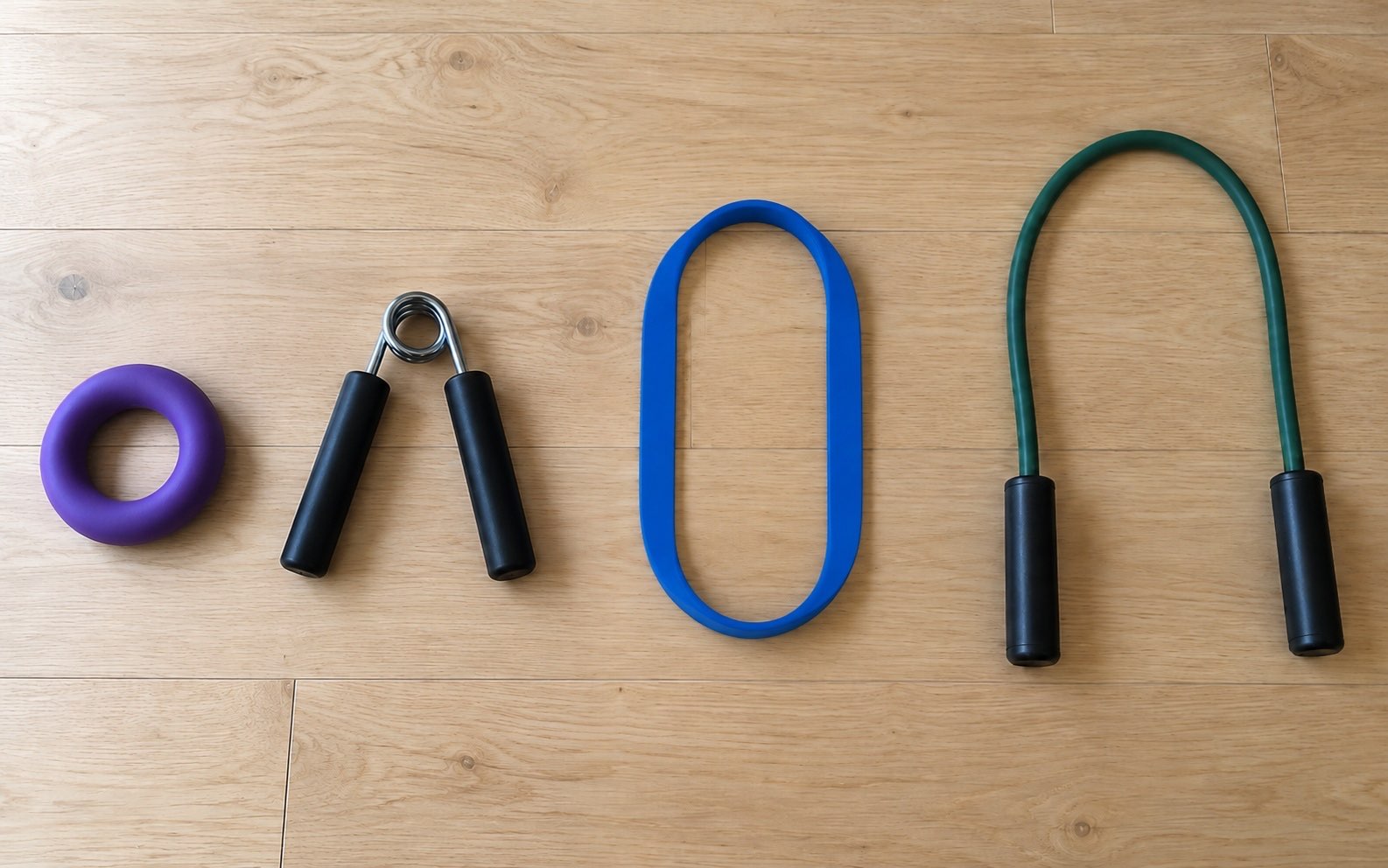
Hand gripper, chest expander or resistance tube: what each one works
Here's what six small home strength tools train:
| Tool | What it looks like | What it works | Best for |
|---|---|---|---|
| Hand gripper (hand grip exerciser) | a rubber ring, or two handles joined by a coil spring | fingers, wrist, forearm, grip | pull-ups, deadlifts, climbing |
| Loop band | a wide, flat rubber loop | whole body: glutes, back, shoulders | home, travel, beginners |
| Resistance tube with handles | rubber tubes with handles and a door anchor | chest, back, shoulders, arms | cable-machine moves at home |
| Chest expander | several springs (or rubber cords) between two handles | chest, shoulders, arms | home training; spring models are stiff for beginners |
| Gyro ball | a ball with a rotor you spin with your wrist | wrist, forearm | warming up and loading the wrist |
| Finger exerciser | a pad with a button for each finger | each finger separately | climbers, anyone who needs strong fingers |
A gyro ball works your wrist as you fight its spin: an add-on to a gripper, not a replacement. On a spring chest expander, you change resistance by adding or removing springs: start with 1 or 2.
More band exercises and weekly plans are in our resistance band workout.
Can resistance tubes and chest expanders replace dumbbells?
Yes, if the load keeps growing. In a 2019 review of 8 studies, Brazilian researchers led by Lopes found the same strength gains in the arms and legs with elastic tubes and bands as with dumbbells and machines. They measured strength, not muscle size, but both need the same thing: the last 2–3 reps of every set should be hard. Spring chest expanders weren't in that review, but they work the same way: the further you stretch them, the harder they get.
One catch: a band gets harder as you stretch it and goes almost slack at the start of each rep, while a dumbbell weighs the same throughout. That's fine for starting out at home; once your bands feel light, add dumbbells.
Resistance tube and chest expander workout: 5 exercises, 3 days a week
Use a tube with handles and a door anchor. Train 3 times a week with a rest day in between; each session takes about 30 minutes.
- Standing row (back): anchor the tube in a door at chest height, pull the handles to your ribs and squeeze your shoulder blades.
- Chest press (chest): wrap the tube around your upper back and press the handles straight forward.
- Pull-apart (rear delts): with straight arms at shoulder height, pull the tube apart until your arms are out to your sides.
- Biceps curl: stand on the tube and curl the handles up to your shoulders.
- Squat with a tube: stand on the tube, hold the handles at your shoulders and squat.
Do 3 sets of 12–15 reps of each, resting 60–90 seconds. When the last set of 15 feels easy, switch to a stiffer tube or widen your stance. Men and women do the same routine; only the resistance differs. The press, pull-apart and curl also make a chest expander workout routine. Finish with 2–3 gripper sets per hand.
check your tube or band before every workout and replace it if you see cracks or worn spots: one that snaps can whip into your face or hands.
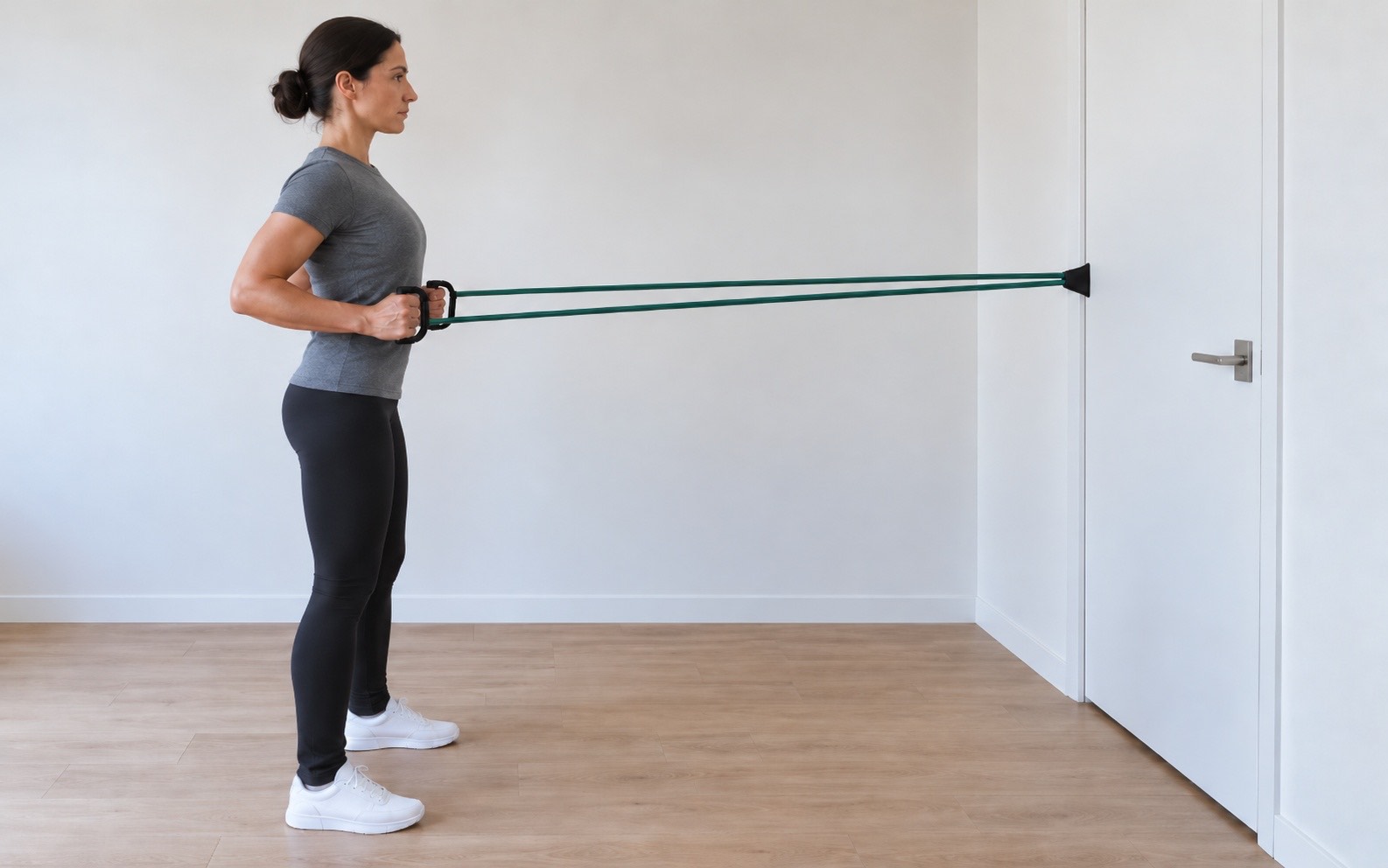
How to use a hand grip strengthener and tubes: 4 form rules
- Check the anchor. Put the door anchor on the hinge side of a door that opens away from you, so every pull only shuts it tighter.
- Move smoothly. Keep your torso still; only your arms or legs move.
- Control the return. The way back works your muscles too, and a band you let snap back can hit your hands.
- Close the gripper all the way. Hold it shut for 1 second, then open it slowly. Keep your wrist straight.
Which resistance to pick: band tension and hand gripper levels in pounds
Bands and tubes. Color codes and pound ratings vary by brand, so go by feel: the last 2–3 reps should be hard while your form holds. More than 20 easy reps means the band is too light; fewer than 8, too heavy. Buy a set: lighter bands for shoulders and arms, heavier ones for back and legs.
Hand gripper levels. The number on the package is the force needed to close the gripper fully. Typical peak grip strength is about 112 lb (51 kg) for men aged 29–39 and 68 lb (31 kg) for women aged 26–42, from 12 British studies (Dodds and colleagues, 2014).
By the label, a 66 lb (30 kg) gripper is close to a typical woman's max and about 60% of a typical man's, so women usually start lighter. A 100 lb (45 kg) gripper would take about 90% of a typical man's peak grip. Labels can be off, so choose by reps, not pounds; an adjustable gripper lets you start low and dial up.
Hand grip strengthener benefits: what muscles it works and why grip matters
When you squeeze a gripper, the finger flexors do the work and the wrist muscles keep your wrist straight. Most of these muscles sit in your forearm, which is why your forearm burns after a set and your biceps doesn't.
The PURE study (Leong and colleagues, The Lancet, 2015) measured grip strength in 139,691 adults in 17 countries. Every 11 lb (5 kg) of weaker grip was linked to a 16% higher risk of death from any cause, and grip predicted death better than systolic blood pressure did. That's a correlation, not proof: the study didn't test whether training your grip lowers the risk. Still, grip is easy to measure and improve.
How to train: 2–3 sets of 12–15 squeezes per hand, 3 times a week. If your wrist or elbow hurts, take a few days off. A strong grip pays off on the pull-up bar and in deadlifts.
FAQ
Does a hand gripper really work?
Yes, for grip and forearm strength. Move to a stronger gripper once 15 squeezes feel easy.
What is a hand gripper used for?
Building grip and forearm strength for pull-ups, deadlifts, climbing and carrying heavy grocery bags.
Does a hand gripper work your biceps?
No. The biceps bends your elbow, while a gripper loads the finger flexors and wrist muscles, which sit mostly in your forearm.
How many reps should you do with a hand gripper a day?
On a training day, 2–3 sets of 12–15 squeezes per hand, 3 days a week; when every set feels easy, move up a level.
Is it OK to use a grip strengthener every day?
Yes, with light squeezes, as long as your wrist and elbow feel fine. With a gripper you can close only 12–15 times, rest a day between sessions.
What level hand grip strengthener should I start with?
One you can close fully 12–15 times in a row. By the label, 66 lb (30 kg) is close to a typical woman's max, so most beginners start lower.
Do chest expanders work?
Yes, as long as you keep adding resistance: start with 1–2 springs and add one when 15 reps feel easy.
What muscles does a chest expander work?
Chest, shoulders and arms. Pressed out in front, it works your chest, front delts and triceps; pulled apart, your rear delts and upper back; in a curl, your biceps.
Resistance tube or band: which is better?
Neither is better overall: a tube with handles and a door anchor suits upper-body moves, while a loop band above the knees suits squats, glute bridges and side steps.
Can a hand grip strengthener lower blood pressure?
Possibly, with static holds; quick repeated squeezes weren't tested. In a review of 11 trials with 302 adults, isometric training lowered systolic pressure by about 5 mmHg (Inder and colleagues, 2016). If you have high blood pressure, ask your doctor first; see exercise with high blood pressure.
The bottom line
A hand gripper trains your grip and forearms; tubes and bands can replace dumbbells (Lopes, 2019); a chest expander works your chest, shoulders and arms. Train 3 times a week, keep adding resistance and give your grip a few sets: a strong grip is linked to better long-term health (Leong, 2015).
Sources
- Lopes J.S.S., Machado A.F., Micheletti J.K., de Almeida A.C., Cavina A.P., Pastre C.M. Effects of training with elastic resistance versus conventional resistance on muscular strength: a systematic review and meta-analysis. SAGE Open Medicine, 2019, 7. — 8 studies; no difference in strength gains between elastic tubes and bands and dumbbells or weight machines.
- Leong D.P., Teo K.K., Rangarajan S., et al. Prognostic value of grip strength: findings from the Prospective Urban Rural Epidemiology (PURE) study. The Lancet, 2015, 386(9990). — 139,691 people from 17 countries; risk of death 16% higher for every 5 kg of weaker grip.
- Dodds R.M., Syddall H.E., Cooper R., et al. Grip strength across the life course: normative data from twelve British studies. PLoS One, 2014, 9(12): e113637. — 49,964 people; median peak grip strength 51 kg in men (ages 29–39) and 31 kg in women (ages 26–42).
- Inder J.D., Carlson D.J., Dieberg G., McFarlane J.R., Hess N.C., Smart N.A. Isometric exercise training for blood pressure management: a systematic review and meta-analysis to optimize benefit. Hypertension Research, 2016, 39(2): 88–94. — 11 randomized trials, 302 adults; systolic pressure fell by 5.2 mmHg on average and by 7.3 mmHg with 8 weeks of training or more.
This article is for informational purposes only and is not a substitute for medical advice. With joint pain or shoulder, elbow or wrist injuries, choose your load with a doctor or coach.